
Dune Acquisition Corp II: Severe Liquidity Strain and the Stakes of SPAC Execution
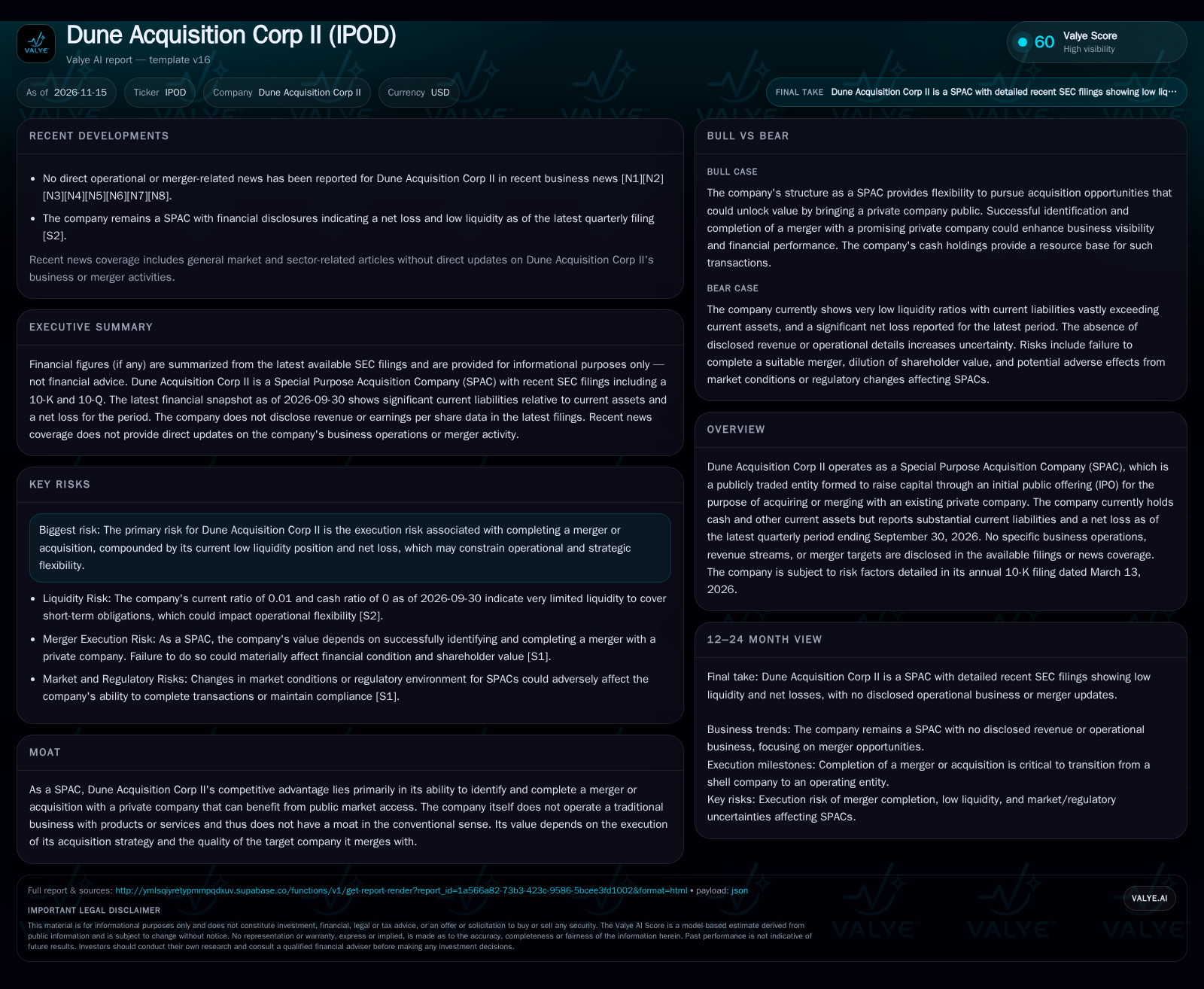
Dune Acquisition Corp II faces a critical liquidity shortfall and substantial net losses, with no operating revenues disclosed. Its future hinges on the timely identification and consummation of a suitable merger, as regulatory and market headwinds intensify the risks inherent to the SPAC model.
Dune Acquisition Corp II currently reports extremely low liquidity and a significant net loss, with no operating revenues or earnings disclosed. As a SPAC, its business model is entirely contingent on successfully merging with a private company. The risk of failing to execute a transaction—compounded by new SPAC regulations and adverse market conditions—could result in material erosion of shareholder value.
Dune Acquisition Corp II stands at a precarious crossroads. Despite its recent IPO and mandate as a blank check company, Dune faces an acute liquidity crunch: its current liabilities vastly outweigh its available cash, and it continues to post considerable net losses without generating operating revenue. With the SPAC market under heightened regulatory scrutiny and no merger target secured, the company’s ability to realize its business purpose—and protect shareholder interests—hangs on the timely and successful execution of a business combination. The coming months will test not just Dune’s deal-making prowess, but the viability of its capital structure amid SPAC sector headwinds.
Liquidity Collapse and Absence of Revenue Define Current Reality
Dune Acquisition Corp II’s latest financial snapshot underscores a critical liquidity crisis. As of September 30, 2026, the company reported only $1,973 thousand in cash and cash equivalents and $16,514 thousand in total current assets, set against $2,864,538 thousand in current liabilities—a current ratio of 0.01 and a cash ratio of 0 [S2]. This imbalance signals that Dune cannot meet its short-term obligations through its existing liquid resources. The company also reported a net loss of $844,269 thousand for the period, with no operating revenue or earnings per share data disclosed [S2]. As a SPAC, Dune has not consummated a merger or identified a target, and remains in its pre-combination, non-operating phase.
SPAC Economics: The Binary Nature of Value Creation
Dune Acquisition Corp II’s business model is fundamentally binary: value realization is contingent upon successfully merging with a private operating company. Until such a transaction occurs, the SPAC generates no operating revenue and incurs costs related to administration, regulatory compliance, and deal sourcing. The economics are driven by the ability to identify, negotiate, and close a business combination within a fixed timeline, typically 18-24 months post-IPO, after which unspent trust capital is returned to shareholders and the vehicle is wound down.
SPACs typically finance their operations with IPO proceeds held in trust, which must be preserved for the benefit of redeeming shareholders. Only a small portion of the IPO proceeds and any additional sponsor capital are available for working capital and transaction expenses. With Dune’s current cash and current asset levels dwarfed by liabilities, it is likely reliant on either sponsor loans or additional capital infusions to cover ongoing expenses and potential deal costs. This creates a scenario where financial runway is extremely limited, increasing pressure to close a transaction quickly or risk forced liquidation.
If a merger is successfully executed, Dune’s economics shift dramatically: the combined entity may generate operating revenue, and the value of the public listing can potentially unlock liquidity for the target’s shareholders. However, the dilution from redemptions and sponsor incentives, as well as transaction costs, can reduce the net benefit to legacy SPAC investors.
SPAC Market Dynamics and the Erosion of Structural Advantages
Dune Acquisition Corp II competes in a crowded and maturing SPAC market, where the initial arbitrage opportunities of 2020-2021 have largely dissipated. The proliferation of blank check companies has intensified competition for attractive targets, increasing acquisition multiples and reducing the pool of willing merger partners. In this environment, SPACs with experienced management teams or differentiated networks may still attract high-quality targets, but Dune’s current financial constraints place it at a disadvantage.
New SEC regulations implemented in 2024 require greater disclosure about sponsor incentives, related-party transactions, and projections, imposing higher compliance costs and extending deal timelines. This regulatory tightening reduces the speed and flexibility that were previously hallmarks of the SPAC process. The company reported cash and liquidity metrics for the period; these figures do not by themselves establish operating runway, investment capacity, financial flexibility, or financing capacity.
Against this backdrop, Dune’s absence of a target and severe liquidity shortfall make it less attractive to private companies seeking a public listing, as they may prefer better-capitalized or more stable SPAC partners. The company’s competitive position is further weakened by its inability to offer certainty of funding or transaction closure.
Unlocking Value Through a High-Quality Merger Despite Adverse Conditions
The most favorable outcome for Dune Acquisition Corp II would be the identification and rapid execution of a merger with a high-growth, capital-efficient private company. If Dune’s management can leverage its capital markets experience and networks to secure a target with strong fundamentals—particularly one overlooked by other SPACs or traditional IPO routes—the resulting transaction could restore investor confidence and create upside through public market re-rating.
Evidence confirming this scenario would include a definitive merger agreement with a credible target, clear disclosure of post-transaction capital structure, and indications of strong target business fundamentals (e.g., revenue growth, positive EBITDA, differentiated technology or market position). Further, a low redemption rate and the ability to supplement trust proceeds with additional PIPE (private investment in public equity) financing would signal robust investor appetite.
Falsification would occur if Dune fails to announce a merger within the regulatory time window, or if announced deal terms reveal excessive dilution, poor target quality, or an inability to secure necessary financing.
Facing the Clock: The Most Likely Course Is a Deal Under Duress or Liquidation
Given Dune’s extreme liquidity constraints and lack of a disclosed target, the most plausible near-term scenario is a last-minute attempt to secure a merger, likely under less favorable terms. This could involve partnering with a lower-quality target or one willing to accept higher dilution, as well as a high probability of redemptions that further erode available cash for the post-merger business.
Confirmation of this scenario would be a late-stage merger announcement with a target of modest scale or limited growth prospects, accompanied by high redemption rates, minimal PIPE participation, or the need for sponsor backstops. A further sign would be extensions to the SPAC’s combination window, as Dune seeks additional time to close a deal.
If Dune is unable to secure a transaction or extend its timeline, forced liquidation would return remaining trust assets to shareholders, likely at a loss given current liability levels and the cost structure of the vehicle.
Erosion of Shareholder Value Through Inaction or Adverse Deal Terms
The most adverse outcome would see Dune exhaust its financial runway without securing a merger, triggering a liquidation that returns only a fraction of initial capital to shareholders after liabilities and costs are settled. Alternatively, a rushed or low-quality merger could saddle public investors with a weak business, high dilution, and limited prospects for value creation, exacerbated by high redemptions and insufficient post-merger liquidity.
Confirmation of this scenario would include continued absence of a merger announcement, public disclosures of sponsor loans or urgent capital raises, or regulatory filings indicating potential delisting or liquidation. High-profile redemptions or negative proxy recommendations would further signal eroding confidence.
Failure to address the liquidity shortfall, even with sponsor support, would likely result in Dune’s dissolution and the effective loss of shareholder value beyond trust asset recovery.
Milestones That Will Determine Whether Dune’s SPAC Thesis Can Survive
Announcement of a definitive merger agreement with a credible private company, including clear transaction terms and post-merger capital structure.
Disclosure of any sponsor loans, PIPE financing commitments, or new capital infusions to address the liquidity shortfall.
Redemption rates at the time of merger vote—high redemptions would indicate lack of investor confidence and further constrain post-merger capital.
SEC or stock exchange filings related to extensions of the combination window or warnings of potential delisting or liquidation.
If disclosed, the quality and growth profile of any announced target company, including historical financials, customer concentration, and competitive positioning.
Public proxy materials or third-party fairness opinions regarding the value and risks of any proposed business combination.
Any mention of changes in regulatory environment or litigation risk affecting the ability to close a transaction or retain trust assets.
Disclaimer: This is research-only, informational analysis and not investment advice. It may include AI-generated interpretation and general industry context. Always verify important details using primary sources.

Comments