
Liberty Media Corp’s Return to Profitability Spurs Strategic Capital Management
Liberty Media leverages exclusive motor racing rights to fuel financial recovery while balancing regulatory risks and capital constraints.
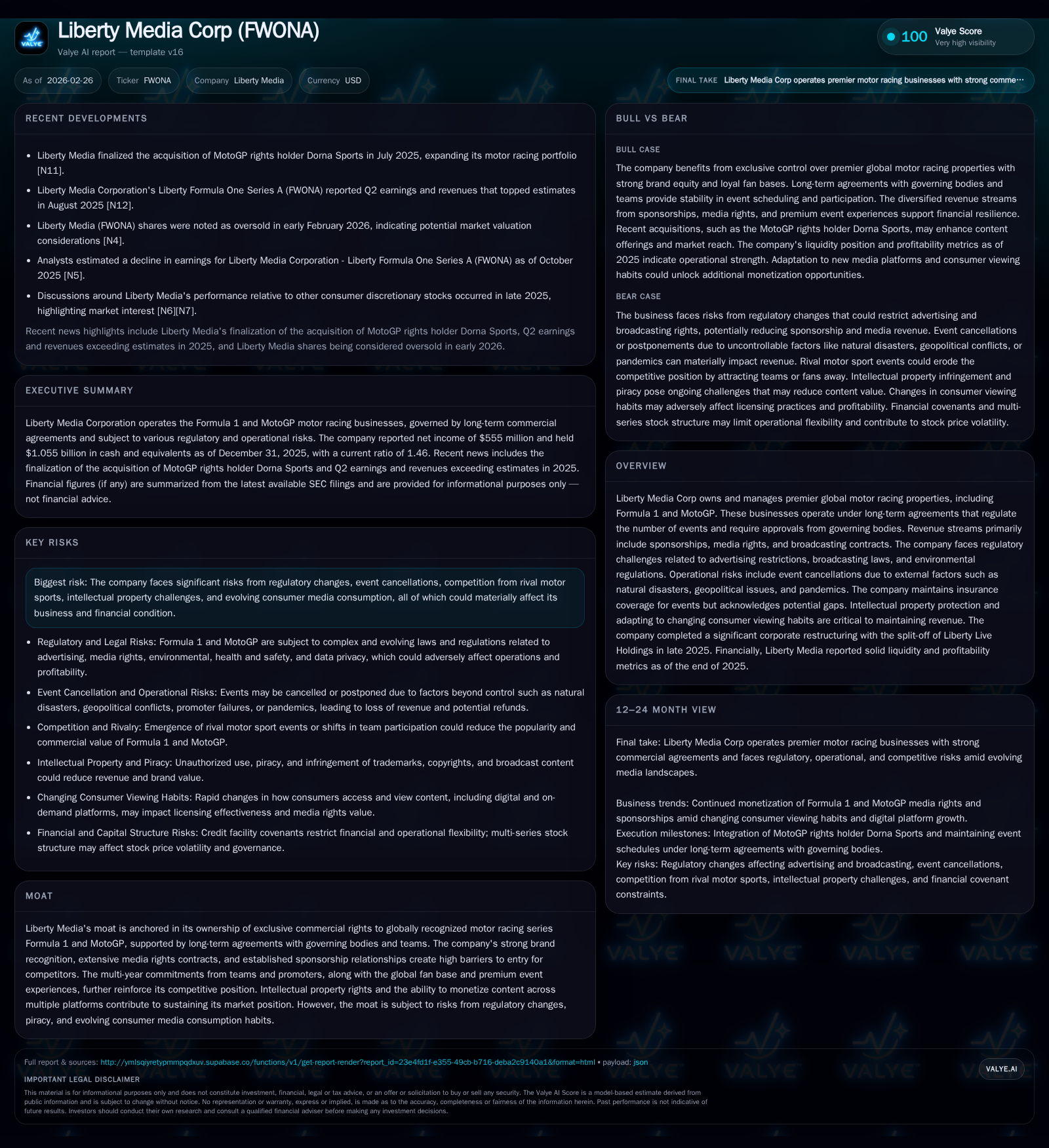
After posting a substantial net loss in 2024, Liberty Media Corporation sharply reversed course, delivering $206 million in operating income and $555 million in net income in 2025, driven primarily by its exclusive Formula 1 and MotoGP commercial rights. This rebound accompanies ongoing regulatory challenges related to advertising restrictions and broadcasting laws that could cap growth. The company's liquidity remains solid with a current ratio of 1.46 amid restrictive debt covenants limiting leverage flexibility. Capital allocation reflects measured buyback activity and an absence of dividends, with significant insider voting power shaping governance dynamics. Going forward, market participants should monitor media contract renewals, event approval limits, and evolving consumer viewing behaviors as potential catalysts.
From Loss to Gain: Tracing Liberty Media’s Financial Turnaround
Liberty Media Corporation executed a remarkable financial turnaround from fiscal year 2024 to 2025. Operating income skyrocketed from $19 million to $206 million, a near tenfold increase representing a 984% year-over-year rise [F1]. This operational improvement drove net income from a significant loss of negative $2.06 billion to a positive $555 million in 2025, reflecting a robust swing in profitability of approximately 127% [F1]. The stark contrast underscores successful execution on core assets and cost management amid lingering industry headwinds.
Operating cash flow remained strong at over $2.46 billion despite a modest contraction of about 3.2% compared to prior year, indicating healthy cash generation capacity [F1]. Capital expenditures decreased moderately by approximately 6.3%, aligning with disciplined investment focused on asset maintenance rather than expansion [F1]. Equity levels declined relative to prior years following the company’s December 2025 split-off transaction reducing consolidated balance sheet size but maintaining financial integrity [S22][S27].
Historical performance (annual)
| FY | Net ($bn) | CFO ($bn) | OpInc ($bn) | Net YoY |
|---|---|---|---|---|
| 2025 | 0.6 | 0.2 | +126.9% | |
| 2024 | -2.1 | 0.0 | -371.1% | |
| 2023 | 0.8 | 2.5 | 2.1 | -58.1% |
| 2022 | 1.8 | 2.5 | 2.1 |
Source: SEC companyfacts cache [F1].
Capital returns and efficiency (annual)
| FY | Buybacks ($mm) | ROE% |
|---|---|---|
| 2025 | 7.2 | |
| 2024 | 37 | -29.3 |
| 2023 | 395 | 4.6 |
| 2022 | 395 | 11.4 |
Source: SEC companyfacts cache [F1].
Table shows operating income leap reversing prior year losses; net income similarly rebounds.
Exclusive Rights Propel Revenue Streams in Global Motor Racing
Liberty Media’s primary business leverages exclusive ownership and management of premier global motor racing properties — notably Formula 1 and MotoGP — governed under century-long commercial agreements amended by Concorde Implementation protocols [S1]. These binding arrangements prescribe upper limits on hosted events (Formula 1 capped at maximum of 25 events annually until scheduled reduction post-2030) subject to FIA’s approval. Similarly, MotoGP's events require IRTA consent for exceeding twenty-two races per season [S1]. These exclusivity contracts provide a stable framework for lucrative long-term media rights segmentation across multiple geographies alongside multi-year sponsorship deals underpinning revenue predictability.
Key revenue streams encompass sponsorship categories, segmented broadcast licensing fees tethered to geographic packages, and emerging digital platform monetization channels. Largest contributors remain traditional broadcast contracts yielding recurring license fees from pay television rights holders complemented by global advertising partnerships targeting premium audiences attending or viewing Formula 1 and MotoGP events worldwide [F1][S7]. Seasonally recurring championship calendars facilitate predictable cash flows subject to event continuity.
This competitive moat revolves around long-term commercial agreements restricting entry barriers for rival motorsport organizers attempting comparable scale or brand recognition. Furthermore, Liberty’s stewardship encompasses monetization rights for extensive intellectual property including trademarks, logos, proprietary content footage, and broadcasting archives crucial for integrated media exploitation strategies enhancing sponsor value propositions across linear and streaming channels [S11].
Navigating Advertising and Broadcast Regulations Impacting Growth
Liberty Media operates within complex multilayered regulatory environments governing motor sport-specific broadcasting and advertising frameworks. Advertising bans on product categories such as alcohol vary by jurisdiction affecting Formula 1's ability to achieve uniform sponsorship campaigns globally. Certain countries impose prohibitions not only on direct advertising but also on brand visibility within broadcast imagery compelling regional advertisement adaptations by Liberty’s promotional partners [S1][S26]. This fragmentation creates valuation uncertainties for sponsorship contract renewal rates.
Broadcasting laws present further hurdles — regulations mandating free-to-air broadcasts restrict Liberty's ability to maximize pay-TV revenues in those regions effectively capping media rights valuations where implemented. Government actions and courtroom interventions can interfere with segmenting or sublicensing media rights packages fundamental to differentiated territorial revenue capture models employed across Europe, Asia-Pacific, and Americas markets [S1][S26].
Environmental legislation poses incremental constraints including potential limits on motor engine designs aimed at reducing emissions during events or social mandates restricting certain motorsport activities if concerns escalate locally [S26]. Regulatory uncertainty extends to pandemic-era responses impacting event schedules; natural disasters or geopolitical conflicts may cancel or postpone races causing suspension or loss of expected revenues without comprehensive insurance coverage mitigating every risk scenario as acknowledged by management disclosures [S15][S28].
Increasing privacy regulations such as GDPR extensions combined with US state laws like CCPA add compliance costs potentially limiting use of fan engagement data essential for digital platform monetization models necessitating adaptive customer relationship management frameworks across Liberty's consumer touchpoints [S8][S18][S20].
Promises and Pitfalls: What Shapes Liberty’s Future Earnings Potential
Future growth prospects hinge significantly on Liberty’s ability to expand the calendar beyond existing event caps subject to FIA/IRTA approvals—an inherently uncertain variable given governing bodies’ discretion influenced by economic pressures, political climates, arena availability, and team consent rights detailed under the Concorde Agreements restricting unilateral event proliferation beyond stipulated maxima through at least the end of this decade [S1][S15][S25].
Digital transformation poses dual-edged challenges: while opening new monetizable avenues via streaming services complements conventional cable feeds (“media rights segmentation”), failure to accelerate platform integration risks downward pressure on traditional licensing values as consumer viewing behaviors increasingly favor interactivity and on-demand formats not fully optimized yet within Liberty's existing contractual structures [S17]. Targeted innovation investments focused on user experience personalization are necessary without cannibalizing core broadcast revenues.
Competitive threats from rival motorsport series with overlapping team affiliations could erode participation levels or dilute fan engagement resulting in lower attractiveness of core properties—although current contractual commitments from teams extend through defined horizons providing some booking visibility these rivalries remain latent risks threatening contractual stability going forward [S29]. External event cancellations due to terrorism fears or health crises present episodic revenue interruptions out of company control requiring sustained risk mitigation vigilance including insurance underwriting that may fall short during extreme circumstances [S28]. Political instability or sanctions may impair local event execution feasibility especially as Liberty seeks growth outside mature markets.
Liquidity Strength and Debt Constraints: Understanding Leverage and Covenants
Liberty Media maintains liquidity strength evidenced by a current ratio of approximately 1.46 at fiscal year-end with cash balances exceeding $1 billion offering short-term solvency comfort despite sizeable current liabilities approximating $939 million [F1][S4]. Nonetheless, substantive debt agreements relating to Formula 1 and MotoGP subsidiaries embed restrictive covenants which collectively:
- Limit incurring additional indebtedness without lender consent.
- Restrict dividend payments, stock repurchases, acquisitions or asset disposals.
- Prohibit entering into transactions with affiliates except at arm’s length terms.
- Require consent for mergers or amendments impacting commercial contracts.
- Enforce repayment triggers upon covenant breaches exposing risk of default if refinancing options become unavailable unexpectedly [S4][S5][S13].
These clauses materially curtail management’s financial strategic flexibility particularly when navigating expansion opportunities or responding swiftly to adverse market developments (e.g., pandemic-related disruptions). Variable-rate indebtedness constitutes exposure to interest rate fluctuations obligating hedge instruments like interest rate swaps; however imperfect hedging could result in increased debt service burdens adversely affecting free cash flow generation capacity during rising rate cycles common in the current monetary environment [S4].
Currency fluctuations also represent earnings volatility sources given Formula 1 revenues predominantly transacted in USD versus expenses incurred variably across Euros and British pounds requiring active currency risk management policies frequently operationalized through derivatives tied to key revenue streams [S25].
Capital Deployment Decisions: Buybacks, Dividends, and Strategic Reserves
Capital return initiatives remain cautious but constructive reflecting prioritization of balance sheet stability amidst regulatory lumpiness impacting revenue predictability. Recent years have seen measurable share repurchase activity within manageable scales ($37 million documented as recent buybacks relative to historical peaks at $395 million annually earlier in the decade), underscoring restrained capital redeployment supporting share price stability rather than aggressive leverage reduction or acquisition financing due primarily to covenant limitations described priorly [F1][S6][S9].
No dividends have been declared historically nor are any planned according to latest filings signaling retained earnings reinvestment bias essential for sustaining content development and event promotion costs intrinsic to high fixed-cost sports entertainment properties like F1/MotoGP platforms lacking majority yield mandates thus far analyzed by management bodies [F1][S9].
Governance structure tightly linked with substantial insider influence: Chairman Emeritus John C. Malone controls close to half (~49%) of voting power via multi-class stock design featuring super-voting Series B shares facilitating decisive impact over corporate strategies including potential transactions such as mergers or asset dispositions which can effectively limit unsolicited takeover attempts thereby preserving continuity but raising shareholder activism dynamics considerations around capital efficiency debates [S6][S9][S22].
Watching Key Milestones: Upcoming Catalysts and Market Considerations
Absent explicit forward-looking guidance within recent disclosures spotlighting actionable milestones includes:
- Regulatory approvals permitting Formula 1 calendar expansion beyond current caps which would unlock incremental race-hosting revenue increments dependent on FIA consensus processes.[S1]
- Renewal cycles or renegotiation outcomes for major geographic region media broadcasting contracts influencing near-to-medium term top-line trajectories derived from license fee adjustments reflecting shifting consumption paradigms.[N4]
- Monitoring geopolitical developments potentially disrupting supply chains or local hosting feasibility impacting race day viability directly affecting contracted revenue recognition patterns.[S15]
- RSI technical indicator signals framing FWONA shares as oversold suggesting possible correction window investors might interpret alongside fundamental developments around capital structure moves such as repurchase program adjustments or deal activity announcements.[N4]
- Developments regarding digital platform monetization innovations addressing viewership shifts critical for preserving media rights valuations under growing OTT competitive pressures.[S17]
Together these constitute primary levers where material changes can pivot market perception regarding Liberty Media’s sustainable earnings momentum amidst layered regulatory complexity enveloping global motor sport commercialization.
Disclosure: This analysis is based solely on company-reported figures published through official SEC filings ([F1], [S#]) and publicly available news sources ([N#]). It excludes any investment advice or price-sensitive speculation.
Disclaimer: This is research-only, informational analysis and not investment advice. It may include AI-generated interpretation and general industry context. Always verify important details using primary sources.

Comments