
Swiss Franc Trust Shares Track Currency Exposure Amid Expense-Driven NAV Decline
FXF offers passive USD-listed Swiss Franc exposure backed by physical deposits but faces persistent losses due to expenses exceeding near-zero interest income.
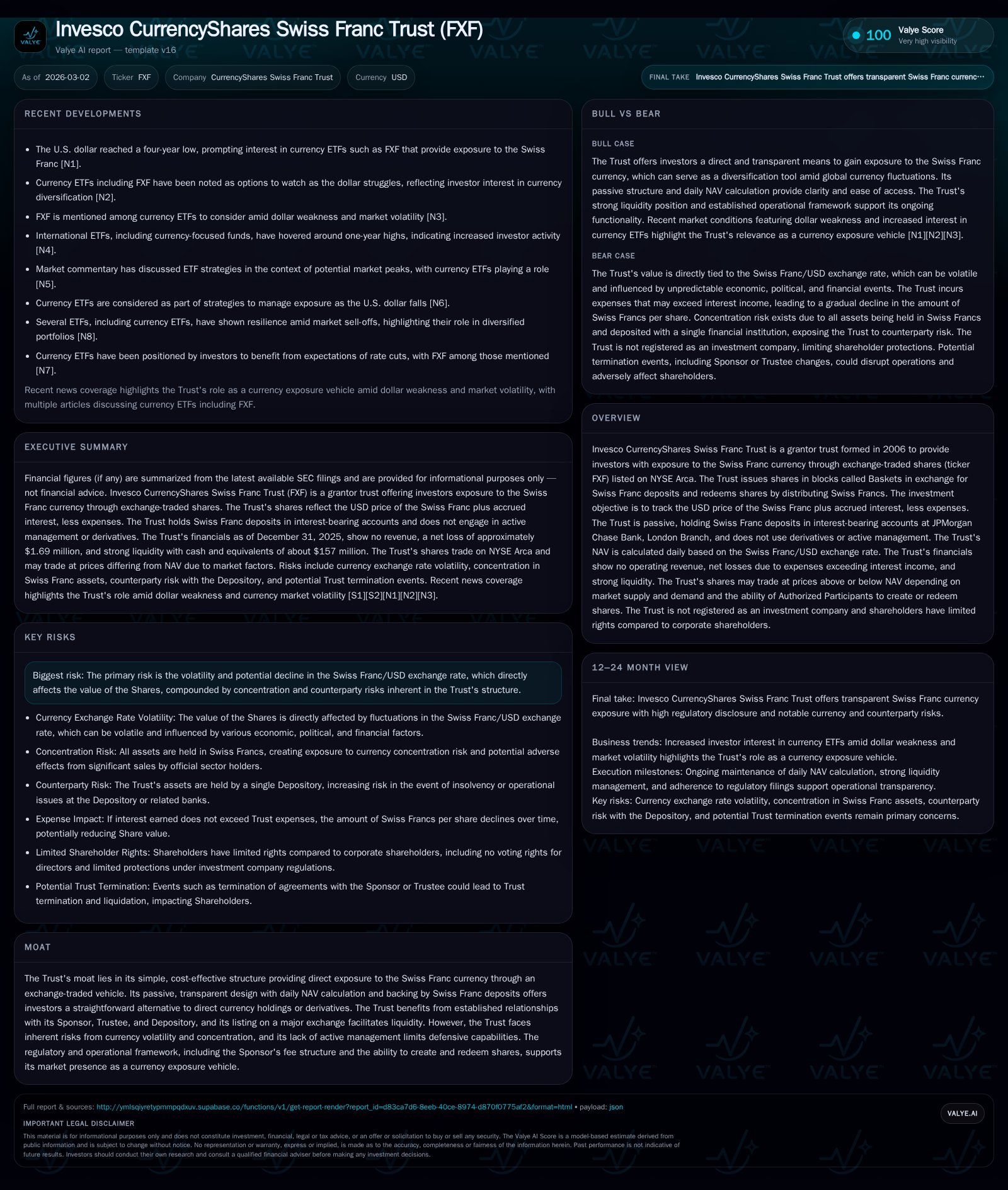
The Invesco CurrencyShares Swiss Franc Trust (FXF) offers investors a direct, passive investment vehicle for exposure to the Swiss Franc through shares representing fractional interests in Swiss Franc deposits. The Trust’s returns are primarily driven by changes in the USD/CHF exchange rate but have been consistently pressured by expenses exceeding interest income, resulting in recurring net losses and negative operating cash flows. Liquidity remains strong with over $500 million CHF held mid-2025, but concentration risk and currency volatility remain key risks. Distributions are minimal and tied solely to excess interest when available, with no buyback programs currently active.
Overview and Business Model
Invesco CurrencyShares Swiss Franc Trust (ticker FXF) is a grantor trust formed in 2006 to provide U.S. investors direct exposure to the Swiss Franc currency through an exchange-traded product listed on NYSE Arca. The Trust issues shares that each represent a fractional undivided interest in actual Swiss Francs deposited into interest-bearing accounts maintained by JPMorgan Chase Bank's London Branch [S1][S27].
Shares are created or redeemed in "Baskets" of 50,000 shares by authorized participants depositing or receiving corresponding amounts of Swiss Francs. This mechanism keeps share prices aligned with the spot USD/CHF exchange rate plus accrued interest less Trust expenses.
The Trust operates passively without engaging in active management or derivatives. It holds CHF cash deposits primarily in two accounts: a primary account potentially earning interest at near-zero rates, and a secondary non-interest-bearing account used for accounting accrued interest and paying expenses [S5][S21].
Historical Financial Performance
The Trust does not generate traditional revenue as it holds only cash deposits and incurs operating expenses including a Sponsor fee (0.40% annual nominal rate), Trustee fees, administrative costs, and regulatory expenses.
Due to prevailing low or zero Swiss Franc deposit rates, interest income has generally failed to cover these expenses resulting in consistent net comprehensive losses:
Historical performance (annual)
| FY | Rev ($) | Net ($mm) | CFO ($mm) | Rev YoY | Net YoY |
|---|---|---|---|---|---|
| 2025 | 0 | -2 | -2 | -100.0% | -966.3% |
| 2024 | 458644 | 0 | 0 | +43.9% | +65.1% |
| 2023 | 318783 | 0 | -1 | +79.9% | |
| 2022 | 0 | -2 | -2 |
Source: SEC companyfacts cache [F1].
Capital returns and efficiency (annual)
| FY | Div ($) |
|---|---|
| 2025 | 54755 |
| 2024 | 54755 |
| 2023 | 39091 |
| 2022 |
Source: SEC companyfacts cache [F1].
Share issuance/redemption activity has increased outstanding shares materially from roughly 1.4 million in late 2023 to about 3.55 million by September 2025 [F1][S4][S7]. The per-share value erodes gradually if expenses continue to exceed accrued interest unless offset by favorable foreign exchange movements.
No recent share repurchases have been recorded; historical buybacks occurred earlier in the decade and do not reflect current operations [F1]. Distributions relate solely to excess interest after fees and have been marginal or nil recently due to the low yield environment [S25].
Growth Prospects and Market Drivers
Growth potential for FXF depends largely on investor demand for Swiss Franc exposure and macroeconomic factors influencing forex markets rather than organic business expansion.
Key growth drivers include:
- Increased demand for CHF as a safe-haven currency amid global uncertainty.
- Trading volume opportunities arising from USD/CHF volatility on NYSE Arca.
- Structural portfolio diversification trends favoring currency ETFs.
Constraints include:
- Minimal yield on underlying CHF deposits limiting appeal beyond currency speculation.
- Concentration risk restricting asset diversification.
- Regulatory volatility impacting cross-border ETF flows.
Investors bear direct foreign exchange risk plus expense-related NAV erosion without active management or hedging strategies. Monitoring monetary policy changes by the Swiss National Bank and U.S. Federal Reserve will be important for assessing FXF’s performance outlook [N1][S15].
Capital Allocation and Returns Profile
As a grantor trust holding only CHF-denominated cash equivalents without leverage or equity investments, capital allocation centers on managing share creations/redemptions tied directly to CHF deposits.
Returns reflect USD/CHF exchange rate movements minus an expense margin dominated by the Sponsor’s fee (~0.40% annually). The Sponsor absorbs most ordinary operational costs but fees still reduce investor returns relative to pure currency holdings [S1][S6].
Operating cash flows remain negative due mainly to costs exceeding minimal earned interest under current conditions—this results in gradual reduction of underlying CHF per share unless offset by currency appreciation [F1][S5].
Distributions are irregular and depend solely on excess interest after fees; none were paid recently reflecting minimal yield conditions [S25]. No share repurchase or capital return programs are currently active given the vehicle’s structure.
Liquidity is strong with substantial CHF deposits held at JPMorgan Chase Bank London Branch providing credit security aside from concentration risk inherent to a single depository arrangement [S12][S14].
Financial governance appears robust with no material litigation or control deficiencies reported recently [S15].
Risks and Operational Considerations
Principal risks include:
- USD/CHF exchange rate fluctuations directly impacting NAV values as all assets are denominated exclusively in CHF.
- Structural expense drag reducing NAV absent currency appreciation due to low-yield environment.
- Concentration risk from holding all assets within one institution’s CHF deposits.
- Counterparty risk related to Depository insolvency is limited but present.
- Geopolitical and regulatory developments particularly involving U.S./foreign trade policies increasing forex market volatility [S3][S13][N1].
- Tax implications from expense-driven reductions in underlying franc representation causing potential taxable events even if market price remains stable [S18][S26].
FXF lacks active risk mitigation or hedging capabilities; it passively tracks CHF/USD market movements less operating costs [S1].
What To Watch Next (Analysis)
Absent explicit forward guidance,[N#] key metrics include:
- Trends in USD weakness supporting potential appreciation of FXF shares when CHF strengthens versus USD;
- Changes in Swiss National Bank monetary policy affecting deposit yields;
- Share creation/redemption volumes signaling investor demand shifts;
- Fee adjustments impacting future expense margins;
- Regulatory developments influencing fund operations or forex trading environments;
- Quarterly financial updates revealing net loss trends and cash flow evolution post-2025.[S2][S4]
Currency ETFs like FXF present unique return profiles requiring monitoring of macroeconomic drivers over traditional company fundamentals.
Conclusion
Invesco CurrencyShares Swiss Franc Trust offers transparent access to Swiss franc fluctuations for investors seeking passive currency exposure via a liquid NYSE Arca-traded vehicle backed by physical currency deposits. Its structure contrasts with leveraged or synthetic products but carries inherent limitations: persistent fee-based expense pressures cause gradual NAV dilution absent favorable currency moves while shareholders face direct forex risks without active management buffers.
Historical financials underscore these challenges with recurring net losses driven by expenses exceeding minimal deposit interest.[F1] Despite this constraint, FXF remains an important tool for strategic currency positioning where direct franc exposure is prioritized over yield generation.
Capital allocation involves no distributions beyond occasional excess interest payouts nor buybacks—reflecting its passively managed trust status focused on precise currency tracking rather than return enhancement.[S8] Strong liquidity supported by substantial deposits at JPMorgan Chase London Branch provides credit assurance though concentration risks persist.[S12][S14]
Future performance hinges predominantly on global economic trends influencing USD/CHF rates alongside evolving monetary policies and geopolitical factors shaping FX markets as highlighted by recent tariff-induced volatility spikes.[N1][S13]
Disclaimer: This analysis is informational only and does not constitute investment advice or recommendations. Readers should conduct individual due diligence regarding FXF before making investment decisions.
Disclaimer: This is research-only, informational analysis and not investment advice. It may include AI-generated interpretation and general industry context. Always verify important details using primary sources.

Comments