
Invesco CurrencyShares Japanese Yen Trust (FXY): Currency Exposure Constrained by Expense Drag and Yen Volatility
FXY delivers passive Japanese Yen exposure via a deposit-backed trust, but expense overruns and currency shifts pressure returns.
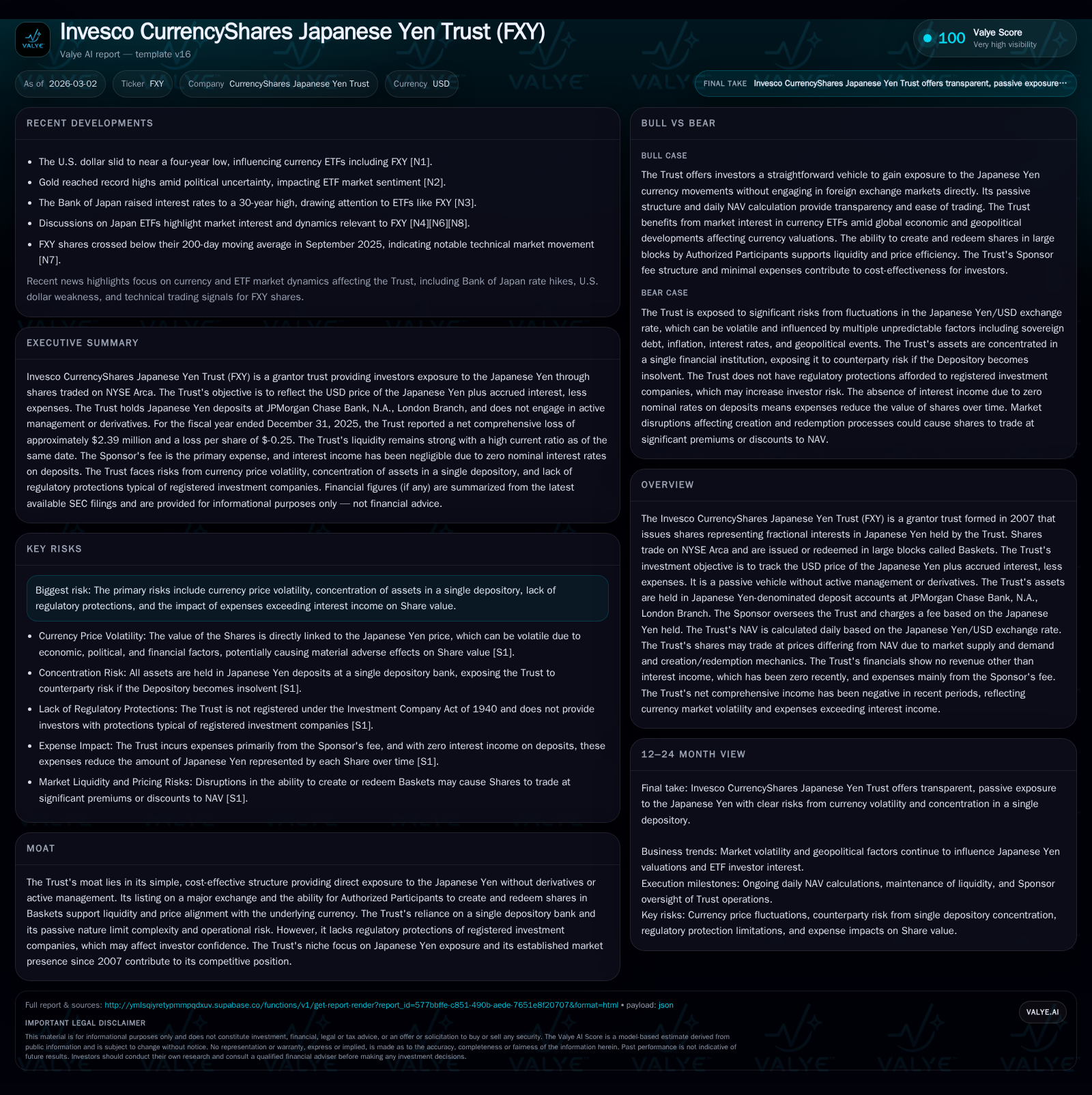
The Invesco CurrencyShares Japanese Yen Trust (FXY) offers investors a direct way to gain USD-denominated exposure to the Japanese Yen through shares backed by yen deposits. Established in 2007 as a grantor trust, it holds yen in bank accounts without derivatives, allowing daily NAV calculation tied closely to FX rates. However, ongoing expenses consistently exceed interest income on yen deposits, causing a gradual decline in the yen value represented per share. The Trust faces headwinds from low or zero interest rates in Japan and yen/USD volatility driven by global economic and geopolitical factors. With no revenue generation and persistent net losses reported in recent years, FXY’s growth depends mainly on shifts in yen demand and management of operational costs. Investors should monitor FX trends and expense ratios as key performance drivers.
Company Overview
Invesco CurrencyShares Japanese Yen Trust (ticker: FXY) was established in 2007 as a grantor trust designed to provide U.S. investors liquid access to exposure linked directly to the Japanese Yen's value against the U.S. Dollar. The Trust issues shares representing fractional interests in physical Japanese Yen held in deposit accounts with JPMorgan Chase Bank's London Branch [S1][S17]. These shares trade on NYSE Arca similar to ETFs but represent ownership interests in currency deposits rather than securities portfolios.
Investment Objective & Structure
FXY aims to track the USD price of the Japanese Yen plus any accrued interest earned by deposit accounts, minus Trust expenses. It is a passive vehicle: it neither employs active trading strategies nor uses derivatives or leverage. The Sponsor charges an annual fee around 0.40%, applied daily against the amount of Japanese Yen held [S1][S25]. Share creations and redemptions occur only through Authorized Participants and only in large blocks called Baskets (50,000 shares).
Asset Holdings & Administration
All underlying assets are held exclusively as yen-denominated demand deposit accounts with JPMorgan Chase Bank's London branch—one primary account that may earn interest (currently near zero), and a secondary non-interest-bearing account for managing operational cash flows [S4][S10][S14]. This custodian concentration presents counterparty risk mitigated by the bank’s scale.
Historical Performance & Financials
As FXY holds currency deposits rather than operating businesses or securities portfolios, it generates no revenue outside minimal interest income. Operating results primarily reflect expenses borne largely by the Sponsor but accrued through fees charged against underlying yen balances.
Net income has been negative since at least FY2022 with losses increasing recently — reported net loss widened from about -$1.05M in FY2022 to nearly -$2.39M in FY2025, representing an approximately 47% year-over-year increase [F1]. Operating cash flow similarly remained negative over this period:
Historical performance (annual)
| FY | Rev | Net ($mm) | CFO ($mm) | Net YoY |
|---|---|---|---|---|
| 2025 | 0 | -2 | -2 | -46.9% |
| 2024 | 0 | -2 | -2 | -13.0% |
| 2023 | 0 | -1 | -1 | -37.0% |
| 2022 | 0 | -1 | -1 |
Source: SEC companyfacts cache [F1].
The Trust has not paid dividends nor conducted share repurchases; capital changes derive solely from share creations/redemptions reflecting investor demand and underlying yen deposits/withdrawals [S9][S13][S28].
Interest Income versus Expenses
Interest income has been minimal or zero due to near-zero nominal yields on yen deposits. For periods ending mid-2025, deposit interest rates hovered at approximately 0% [S4][S10][S14]. Since Trust expenses exceed any yield—primarily Sponsor fees—the amount of Japanese Yen represented per share declines gradually over time as excess costs are paid out of principal.
Growth Outlook & Risks
Growth Drivers
The core proposition remains providing cost-effective USD liquidity linked directly to physical yen holdings without derivative complexity or synthetic counterparty risk. Increased investor demand for straightforward currency exposure during dollar weakness (e.g., US dollar nearing four-year lows as of January 2026 [N1]) could boost assets under management.
Geopolitical tensions affecting FX markets—including trade policy shifts or economic measures—could trigger volatility that enhances trading volume and hedging demand via FXY [S12][S15].
Constraints & Risks
Structural limitations include:
- Expense Drag: Operational costs notably Sponsor fees exceed negligible interest yields reducing NAV per share absent currency appreciation [S1][S21].
- Currency Volatility: FX rates fluctuate due to trade deficits, sovereign debt conditions, central bank interventions globally impacting yen stability [S6][S25]. Sudden devaluations may depress share prices.
- Concentration Risk: Assets reside with one depository increasing vulnerability absent federal insurance protections common for U.S. banks [S12].
- Regulatory Caveats: As a grantor trust not registered under the Investment Company Act of 1940, FXY lacks certain investor protections typical for regulated investment companies [S12][S22].
- Tax Considerations: Distributions primarily arise from excess interest income which currently does not exist; expenses paid from principal may trigger taxable events unfavorable for shareholders [S1][S24].
- Operational Risks: Reliance on electronic systems for custody and NAV calculation exposes assets to potential disruptions impacting shareholder interests materially [S22].
Capital Allocation & Returns
FXY does not generate revenues beyond limited interest on deposits nor retain earnings; all operational costs including Sponsor fees reduce net asset values continually [F1][S9][S19]. No dividends or share repurchases occur; capital fluctuates via share creations/redemptions aligned with brokerage activities by Authorized Participants [S9][S27]. Returns depend directly on currency performance—a weakening yen relative to USD penalizes shareholders’ returns—and may be further eroded by expense drag if yields remain nil.
Conclusion
Invesco CurrencyShares Japanese Yen Trust provides precise spot exposure to one of the world’s most widely traded currencies through a straightforward deposit-backed structure minimizing derivative counterparty risk. However, its long-term return profile is challenged by systemic low-interest-rate environments reducing income offsets against operating costs alongside persistent exchange-rate volatility shaped by complex global economic factors. Investors should weigh its pure-play FX exposure benefits against incremental erosion risks posed by continuous expense deductions on near zero-yielding collateral and custodian concentration.
This analysis is based solely on publicly available SEC filings [S#], company facts data [F1], and relevant news sources [N#] up to March 2nd, 2026.
Disclaimer: This is research-only, informational analysis and not investment advice. It may include AI-generated interpretation and general industry context. Always verify important details using primary sources.

Comments