Comprehensive Analysis of GE HealthCare Technologies Inc: Strategic Positioning and Industry Dynamics
An in-depth exploration of GE HealthCare’s business model, competitive moat, financial health, and industry landscape as of early 2026.
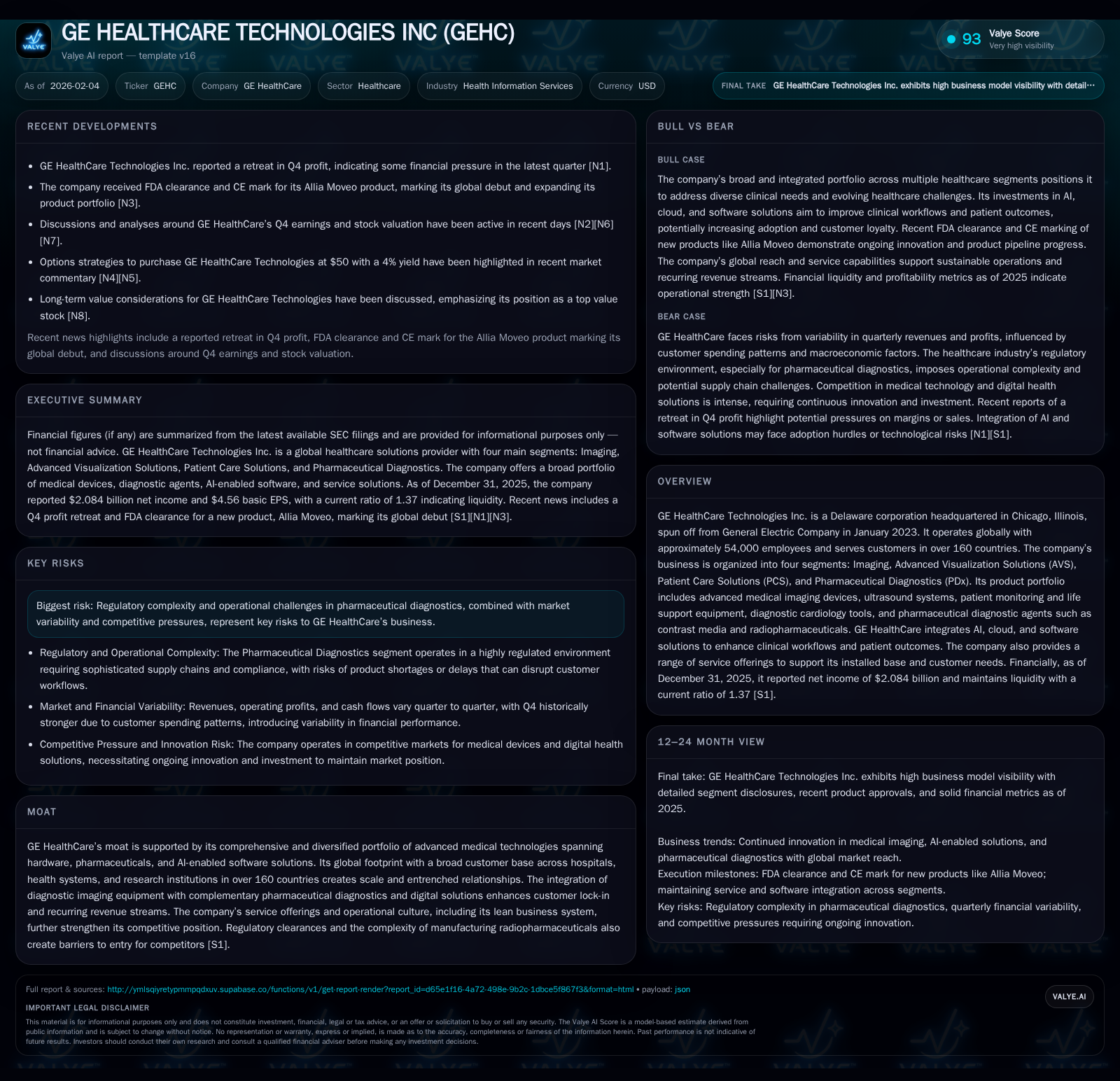
GE HealthCare Technologies Inc., a spin-off from General Electric in 2023, operates globally with a diversified portfolio spanning advanced medical imaging, pharmaceutical diagnostics, and AI-powered healthcare solutions. Its four core segments—Imaging, Advanced Visualization Solutions, Patient Care Solutions, and Pharmaceutical Diagnostics—complement each other to support a strong competitive moat reinforced by integration, scale, and regulatory barriers. While the company maintains solid financial performance with robust net income and liquidity as of 2025, it faces complex regulatory challenges and competitive pressures inherent in healthcare technology markets. Ongoing investments in AI and cloud capabilities signal GE HealthCare’s strategic focus on innovation to drive clinical outcomes and customer loyalty across more than 160 countries.
Company Background and Structure
GE HealthCare Technologies Inc., headquartered in Chicago, Illinois, emerged as an independent entity following its spinoff from General Electric Company in January 2023 [S1]. With nearly 130 years of heritage in medical technology innovation, the firm employs approximately 54,000 people globally and maintains a wide-reaching footprint spanning over 160 countries. Its client base consists of hospitals, health systems, academic institutions, government entities, and researchers [S1].
The company operates via four distinct but strategically interrelated segments: Imaging; Advanced Visualization Solutions (AVS); Patient Care Solutions (PCS); and Pharmaceutical Diagnostics (PDx), each addressing critical needs across the healthcare continuum.
Business Segments Overview
Imaging
This segment is subdivided into Molecular Imaging (MI), Computed Tomography (CT), Magnetic Resonance (MR), Women’s Health (WH), and X-Ray (XR) product lines. Molecular Imaging provides crucial cellular-level insights via PET/CT scanners and related radiopharmaceuticals enabling clinicians to visualize disease pathways—a capability tightly integrated with the PDx segment's pharmaceutical diagnostics [S1]. CT generally renders high-resolution anatomical images assisting diagnosis across oncology to cardiology. The synergy between these technologies helps highlight GE HealthCare's holistic approach to diagnostic workflows.
Advanced Visualization Solutions (AVS)
AVS develops sophisticated software applications that complement imaging technologies by transforming raw data into clinically actionable insights using AI algorithms. These visualization tools help clinicians enhance accuracy and speed when interpreting complex imaging studies.
Patient Care Solutions (PCS)
Encompassing monitoring devices for vital signs and life support systems such as ventilators or anesthesia delivery equipment, PCS supports intensive care units and surgical environments. This segment strengthens GEHC’s presence in acute patient management beyond diagnostics.
Pharmaceutical Diagnostics (PDx)
PDx focuses on contrast media agents for imaging enhancement alongside radiopharmaceuticals used in nuclear medicine. The segment requires advanced manufacturing capabilities that heighten regulatory complexity but also create significant barriers for competitors [S1].
Competitive Moat Analysis
GE HealthCare benefits from a multifaceted moat grounded in its extensive product breadth spanning hardware devices, consumables like diagnostic agents, integrated AI-software offerings, and comprehensive service contracts. The firm’s global sales force (~9,700 professionals) coupled with nearly 8,900 field service engineers nurtures entrenched relationships within hospitals and health systems worldwide [S1].
Integration across segments enables bundled offerings—for instance combining imaging equipment with proprietary contrast agents plus AI-driven analytic software—augmenting value proposition while engendering customer dependence through recurring revenues tied to consumables and maintenance services.
Furthermore:
- Operational efficiencies are amplified via the company’s lean management system (“Heartbeat”), which sharpens execution consistency.
- Regulatory clearances such as the FDA approval for the Allia Moveo platform underscore technological innovation protected by complex compliance processes [N11].
- Sophisticated pharmaceutical diagnostics manufacturing demands specialized knowledge deterring new entrants.
Collectively these dynamics solidify GE HealthCare as a formidable player difficult for rivals to displace swiftly.
Financial Overview
As of December 31, 2025 ([F1]), key financial metrics reveal:
- Net income: $2.08 billion,
- Cash & equivalents: $4.49 billion,
- Current assets: $12.5 billion,
- Current liabilities: $9.11 billion, yielding a current ratio of approximately 1.37—indicative of sound short-term liquidity.
Historically GEHC’s fourth quarter has tended to outperform other quarters due to customer purchasing cycles favoring end-of-year capital allocations [S1], consistent with slowed profit margins observed in Q4 reported recently [N10]. Despite some retreat in quarterly profits reflecting competitive pricing pressures or cost inflation headwinds noted by analysts [N1,N3], overall profitability remains robust with ongoing margin management efforts prioritized.
Industry Context & Trends
GE HealthCare operates within an intensely competitive ecosystem characterized by continuous innovation waves—particularly convergence between imaging modalities enhanced through artificial intelligence—and growing demands for personalized medicine solutions enabled via data-driven insights [N6]. Competition comes from established multinational corporations as well as nimble startups addressing niche spaces.
Payers globally exert pressure on prices amid cost containment efforts; this sets challenging conditions for sustaining pricing power especially on commoditized platforms such as X-ray or ultrasound devices [S1]. Supply chain disruptions impacting critical components remain systemic risks given global sourcing complexities. Additionally cybersecurity threats increasingly demand significant investment due to the sensitive nature of patient data involved [S1].
Geopolitical uncertainties can impede product registrations or restrict access to certain markets further complicating growth trajectories.
Amid these challenges however lies opportunity: Expansion of AI-powered cloud platforms coupled with subscription-based software services opens new revenue streams less dependent on capital equipment sales cycles—potentially smoothing out seasonal fluctuations while delivering scalable clinical value [S1,N6].
Recent Developments & Outlook Considerations
Key recent news highlights include:
- FDA clearance & CE Mark for Allia Moveo digital workflow platform signaling advancement into integrated clinical software pathways enhancing operational efficiency [N11],
- Analyst discourse prior to Q4 earnings day weighing growth prospects against margin compression realities [N3,N4],
- Ongoing dialogue around leveraging AI tools not only in diagnostics but broader healthcare automation potentially impacting ecosystems beyond traditional modality manufacturers [N6].
While cautious about macroeconomic headwinds affecting capital expenditures by customers globally plus regulatory uncertainties primarily surrounding pharmaceutical diagnostics sub-segment compliance costs [S1], GE HealthCare's diversified portfolio combined with strategic investments in next-generation technologies keeps it well-positioned within evolving healthcare delivery paradigms.
Risks Summary
Per SEC filings ([S1]), principal risks facing GE HealthCare include:
- Intense competition requiring continual innovation balanced against pricing pressures,
- Complexity navigating diverse regulatory frameworks affecting product approvals and government reimbursement,
- Operational risks linked to supply chain interruptions or facility disruptions impacting production timelines,
- Cybersecurity vulnerabilities threatening intellectual property protection or patient information confidentiality,
- Talent acquisition/retention challenges critical for sustaining innovation momentum,
- Exposure to litigation typical within medical device/pharmaceutical industries including product liability claims,
- Macroeconomic risks from geopolitical instability influencing global market access,
- Postretirement benefit obligations potentially straining financial flexibility.
Management acknowledges these factors explicitly emphasizing mitigation through diversified offerings and lean operations but investors should recognize these inherent systemic exposures remain relevant especially amid rapid technology advances disrupting conventional healthcare business models.
Conclusion
GE HealthCare Technologies Inc. represents a leading global force within healthcare technology underpinned by an expansive product mix innovatively fused across diagnostic imaging hardware, pharmaceutical diagnostic agents, patient monitoring systems, and cutting-edge digital-health software including AI applications. The company's entrenched global presence backed by extensive service infrastructure fuels durable relationships securing recurring revenues vital for sustainable long-term performance.
While challenges persist relating primarily to competitive dynamics alongside regulatory rigor intrinsic to high-barrier pharmaceutical manufacturing segments—and broader external economic risks—the firm's robust balance sheet coupled with proactive R&D initiatives focused on digital transformation shape a compelling enterprise profile navigating the next generation of medicine.
Stakeholders should continue monitoring progress around seamless integration of new AI-enabled offerings into clinical routines alongside evolving reimbursement landscapes that will define how providers adopt evolving technologies over time.
Disclaimer: This analysis is for informational purposes only based on publicly available data as of February 2026. It does not constitute investment advice nor recommendations regarding any securities.
Disclaimer: This is research-only, informational analysis and not investment advice. It may include AI-generated interpretation and general industry context. Always verify important details using primary sources.

Comments