
Global Innovative Platforms Advances Non-Invasive Animal Diagnostics With Latest Quarter Developments
GIPL's 2026 Q1 10-Q highlights sustained R&D efforts in breath-based diagnostics and continued compliance with licensing agreements, reinforcing its position in early-stage veterinary disease detection.
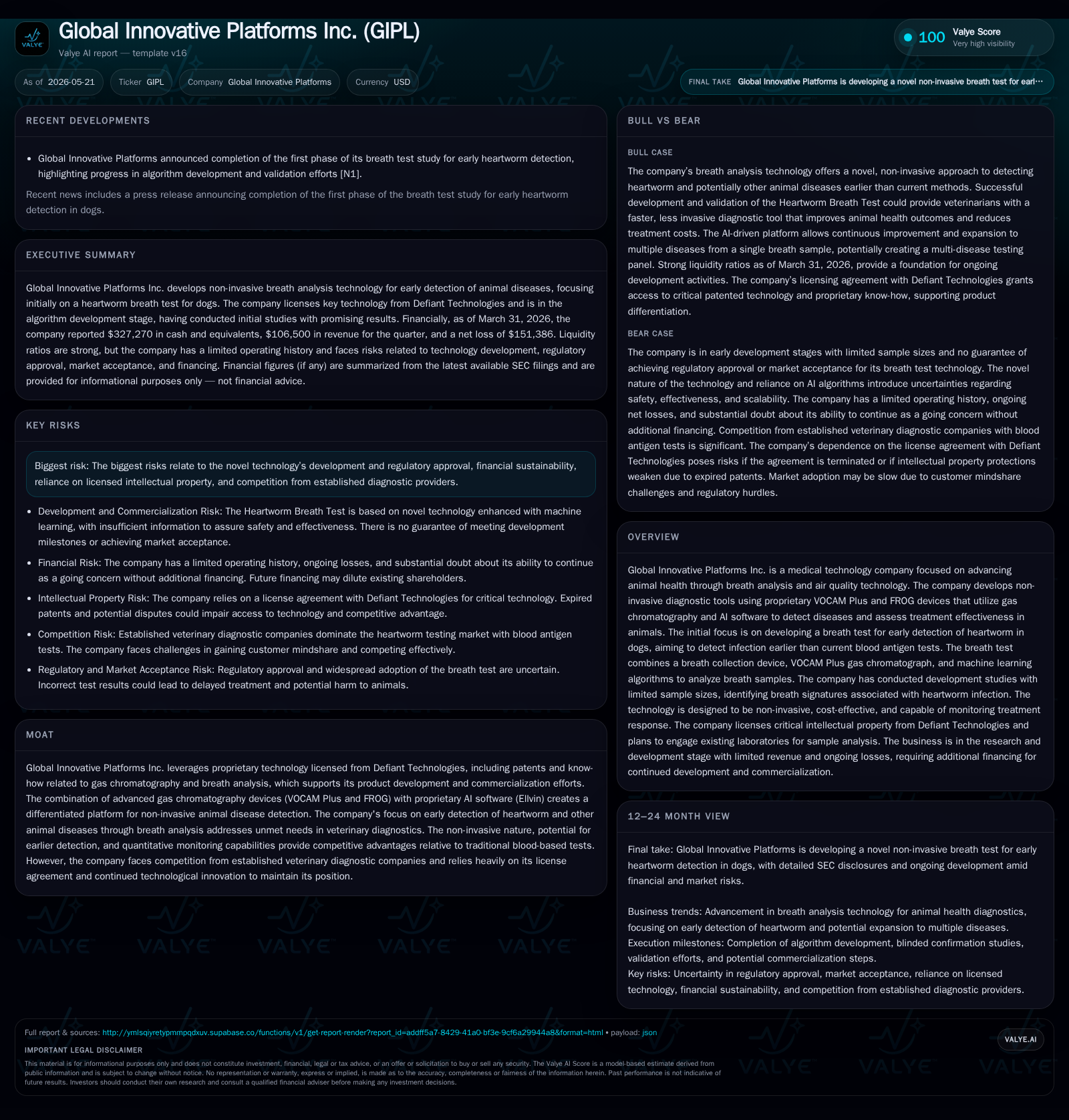
Global Innovative Platforms Inc. (GIPL) reported ongoing research and development progress in the first quarter of 2026, with no revenue recorded but full compliance on licensing payments to Defiant Technologies. Its proprietary VOCAM Plus and FROG platforms combine advanced gas chromatography and AI-driven breath analysis to detect heartworm infections earlier than traditional blood antigen tests, potentially transforming animal health diagnostics. The company faces competitive pressures from established veterinary diagnostic firms and risks related to regulatory pathways and funding. Key upcoming milestones include expanded clinical validation and potential regulatory engagements critical for commercialization.
Latest Quarterly Operating Update: Focused R&D Progress Amid Licensing Compliance
Global Innovative Platforms Inc.'s latest quarterly report filed May 20, 2026 confirms ongoing dedicated research and development on its breath-based animal diagnostic technology [S2]. While the company remains pre-revenue, it continues to meet its licensing payment obligations under its agreement with Defiant Technologies, having paid $150,000 toward an overall $250,000 commitment as of the latest annual report period [S1], [S5]. The quarter reflected sustained investment in product validation activities without revenue recognition.
A contemporaneous 8-K filing notes recent Board of Directors appointments aimed at bolstering governance oversight, which may enhance strategic execution as GIPL progresses toward commercialization phases [S3]. Notably, there have been no reported regulatory setbacks; the relatively light FDA oversight of veterinary diagnostic devices reduces procedural barriers compared to human medical devices [S22].
Business Model: Proprietary Breath Analysis Platform Targeting Early Animal Disease Detection
GIPL develops diagnostic instruments—VOCAM Plus and FROG—that integrate microfabricated gas chromatography columns licensed exclusively from Defiant Technologies with proprietary AI software (Ellvin) designed to analyze volatile organic compound (VOC) patterns in animal breath samples [S1], [S9]. This platform aims to deliver rapid, non-invasive detection of diseases such as heartworm in dogs.
Current heartworm diagnostics rely on blood antigen tests typically effective only after the parasite matures (~six months), requiring invasive sampling. GIPL’s breath analysis technology seeks to identify disease-specific VOC "breathprints" earlier in the infection cycle, potentially enabling timelier intervention while reducing discomfort associated with blood draws [S1].
The exclusive license covers patents enabling smaller, lower-cost devices without sacrificing analytical performance—an important competitive advantage within veterinary diagnostics reliant on immunological assays by larger incumbents [S5], [S9].
Industry Context and Competitive Positioning
Veterinary diagnostics is dominated by established players offering blood-based antigen detection tests across multiple species. These incumbents benefit from broad product lines, entrenched distribution through veterinary channels, and strong customer relationships.
GIPL occupies a niche focused on advanced analytical chemistry applied via breath analysis—a modality still emerging in animal health despite growing interest in human medicine. Adoption barriers include veterinarians’ familiarity with blood tests and initial reluctance to switch absent clear clinical or economic benefits.
FDA regulation of veterinary diagnostic devices is minimal; formal approvals are generally not required unless safety or misbranding issues arise. This regulatory environment lowers entry barriers but shifts emphasis onto generating compelling clinical evidence for market acceptance [S22].
The company’s licensed intellectual property portfolio provides a technical moat around device miniaturization and sensitivity but does not eliminate competition from entities investing heavily in alternative diagnostic technologies.
Growth Drivers: Clinical Validation, AI Enhancement, and Market Expansion Potential
Key growth catalysts depend on demonstrating that VOCAM Plus can reliably detect heartworm infections earlier than current standards while maintaining accuracy. The ability to monitor treatment response longitudinally via non-invasive breath sampling could further differentiate GIPL’s offering.
Beyond heartworm, the company plans to extend its breath analytics platform to detect multiple animal diseases identifiable through specific VOC signatures—potentially addressing companion animals and agricultural livestock markets alike [S1]. Continuous improvement of AI algorithms within Ellvin software is critical for enabling multi-disease detection capability.
Rising pet owner demand for less stressful veterinary procedures aligns well with GIPL’s non-invasive approach. With approximately half of U.S. dogs receiving heartworm preventives currently (AHS estimate), demand exists for diagnostics that can identify breakthrough infections sooner.
The licensing agreement also includes royalty provisions on net sales of licensed products globally, providing a future revenue stream aligned with commercialization success [S5]
Risks: Developmental Uncertainty, Regulatory Dynamics, Financial Constraints
As an emerging growth company without historical profitability or meaningful revenues, GIPL faces significant financial risks. It held approximately $327k in cash equivalents at quarter-end March 31, 2026 with zero debt—reflecting sound liquidity management but limited capital available for scaling operations amid ongoing R&D requirements [F1]. Continued access to external funding remains essential.
Technical validation remains at relatively early stages with limited sample sizes publicly disclosed; broader clinical studies are needed to confirm effectiveness across diverse populations [S2]. Although FDA regulatory hurdles are lower for veterinary diagnostics compared to human devices, any delays or unexpected issues could impact time-to-market.
Competition from larger diagnostic firms with extensive vet market penetration poses structural challenges; entrenched customers may resist adopting novel breath-based methods absent clear cost or performance advantages.
Dependence on licensed IP introduces risk should licensor terms change or alternative technologies emerge. Management turnover risk persists despite recent board enhancements; small teams typical of early-stage ventures may experience disproportionate operational impact from personnel changes [S3], [S18].
What Investors Should Watch Next
Upcoming milestones include expanded clinical validation studies involving larger sample sets that better establish reliability relative to existing assays [S2]. Regulatory engagement updates—while expectedly limited due to FDA's leniency—will be important if voluntary certifications or endorsements occur.
Securing additional financing via equity raises or strategic partnerships will be critical for sustaining R&D investment. Commercial agreements contingent upon successful product demonstration would indicate growing market confidence [S3].
Enhanced governance through recent board appointments focusing on partnership management and pet healthcare innovation may improve execution speed—warranting close monitoring as these factors influence commercialization timelines.
Financial Snapshot Supports Operational Assessment
As of March 31, 2026, GIPL’s balance sheet showed cash and equivalents of approximately $327k with no outstanding debt liabilities resulting in a robust current ratio above 160x—signaling negligible immediate liquidity stress but highlighting modest scale capital relative to operating needs [F1]
Operating losses exceeding $700k were recorded in prior periods reflecting continuing R&D expenditures without offsetting revenues; this pattern is typical for early-stage medical technology startups prior to product launch [F1]. The absence of revenues underscores reliance on external capital sources until commercial viability is achieved.
Management acknowledges going concern risks tied to funding needs outlined in the recent annual report emphasizing liquidity management as a priority moving forward [S18], [S25].
This analysis synthesizes Global Innovative Platforms Inc.'s SEC filings up through May 2026 alongside current financial data focusing strictly on documented facts without speculative assumptions. It is not investment advice but aims to provide a comprehensive understanding of the company's operational status and prospects.

Comments