
GLPI Enhances Capital Structure and Demonstrates Resilient Rental Income Growth
Gaming & Leisure Properties advances refinancing efforts with a new term loan while securing stable cash flows from its specialized gaming real estate portfolio.
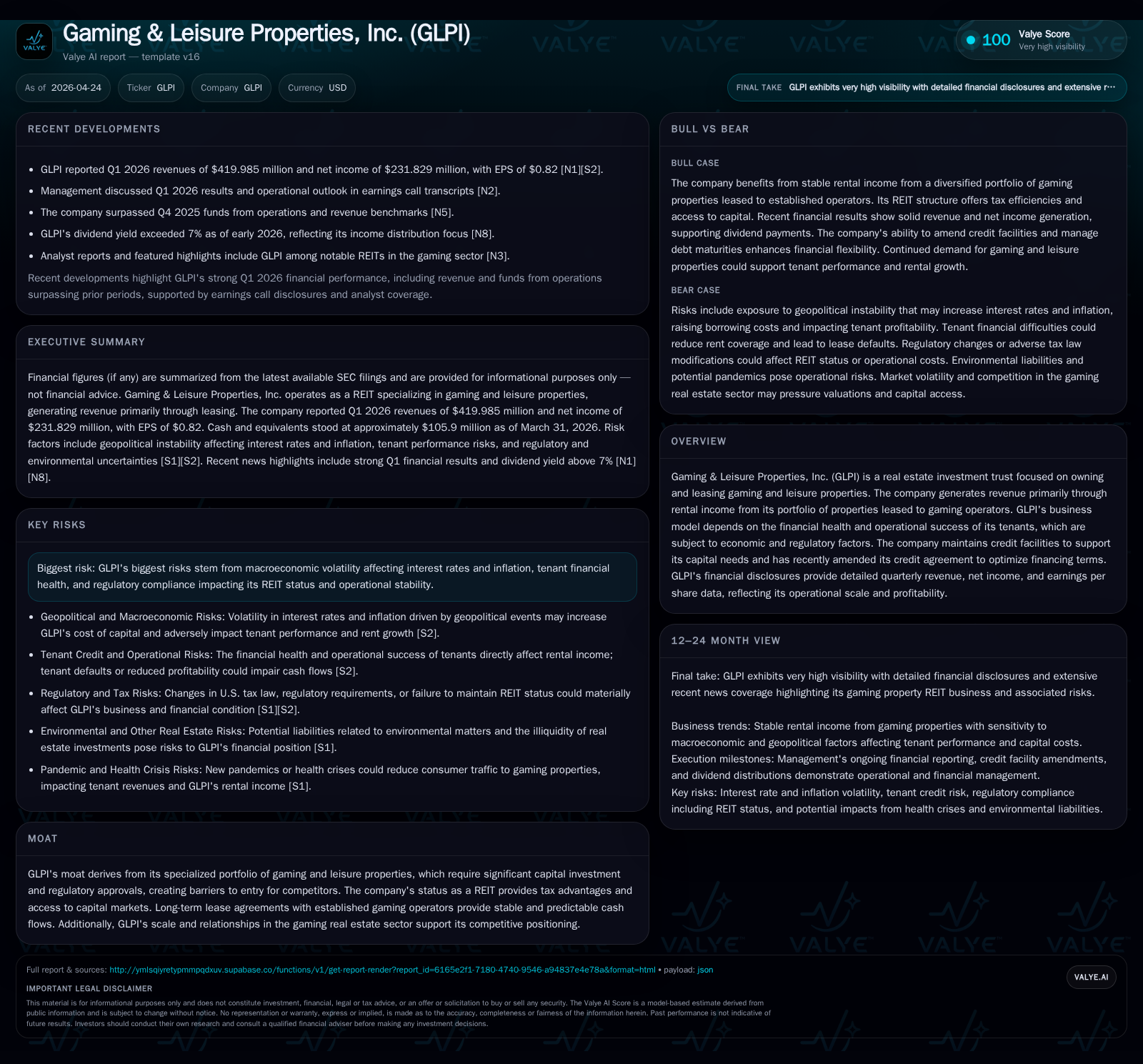
In its latest 10-Q filing dated April 23, 2026, Gaming & Leisure Properties, Inc. (GLPI) completed a strategic credit facility amendment that replaced bridge revolving loans with a $679 million term loan maturing in late 2028, enhancing medium-term capital stability and potentially lowering its cost of capital amid volatile interest rates. GLPI's business model centers on owning gaming real estate leased to established operators under long-term agreements, which underpin resilient rental income streams despite macroeconomic uncertainties and inflationary pressures. The company's moat is reinforced by regulatory barriers and capital intensity in the sector, ensuring limited competition and stable tenant relationships. Future growth depends on tenant performance, lease escalations, and selective acquisitions balanced against inflation risks and regulatory compliance. Financially, GLPI reports steady revenue and income growth alongside strong operating cash flow supporting dividends, with a refined debt profile enhancing liquidity and flexibility going forward.
Latest Quarterly Operating Highlights: Capital Structure Optimization
Gaming & Leisure Properties (GLPI) took proactive steps to strengthen its capital structure during Q1 2026 as detailed in its April 23, 2026 quarterly report [S2]. On March 4, 2026, GLP Capital L.P., its operating partnership, executed Amendment No. 3 to the Credit Agreement originally dated May 13, 2022 [S3]. Additionally, GLP fully repaid all obligations under its previous term loan agreement dated September 2, 2022 without incurring termination penalties as confirmed in the March event filing [S3]. This refinancing sequence reflects management’s strategic initiative to optimize leverage terms while preserving borrowing flexibility critical for acquisitions or funding development projects.
Business Model: Real Estate Leasing in the Gaming Sector
GLPI operates as a specialized real estate investment trust (REIT) focused exclusively on owning land and buildings dedicated to gaming and leisure enterprises [S1]. Its revenues derive primarily from long-term triple-net leases to casino operators who manage the daily gaming operations. These tenants typically bear most property-level expenses including taxes, maintenance, and insurance.
Lease contracts blend fixed base rents with periodic escalations and often include variable rent components tied to tenants’ gross gaming revenues under percentage rent clauses [S1]. Consequently, GLPI’s rental income is structurally linked to the financial health and operational success of its tenants operating in highly discretionary consumer markets.
The business model benefits from significant entry barriers within the gaming property sector. These stem from stringent licensing requirements, extensive regulatory oversight at state and federal levels, as well as substantial capital costs needed to develop casino-grade real estate [S1]. GLPI leverages these conditions through exclusive relationships with established operators like Bally's Corporation (which provides secondary guarantees on some credit facilities) limiting competition for desirable assets.
This specialized REIT structure allows GLPI to convert high-capital assets into predictable cash flows while outsourcing operational risks related to gamesmanship and customer acquisition to tenants rather than itself.
Competitive Positioning and Industry Dynamics
GLPI holds a moat rooted in its scale as one of the largest publicly traded owners of gaming real estate combined with tax advantages associated with REIT status [S1]. The company’s ability to access capital markets efficiently facilitates acquisitions or enabling construction finance for projects like Bally’s Chicago Casino Resort [N1].
The niche nature of casino property ownership curtails competition due to the complexity of regulatory approvals required across jurisdictions which can stretch over several years and contingent on intricate negotiations with state governments [S4]. Moreover, seasoned relationships with marquee operators offer GLPI preferential deal flow.
Industry drivers like legalized casino expansion fuel demand for new properties while older operators look to monetize real estate value by sale-leaseback arrangements—a trend that supports portfolio growth opportunities [S1]. However, market challenges persist including cyclical sensitivity tied to consumer discretionary spending patterns affected by macroeconomic cycles and geopolitical events that spike inflation or energy costs [S20].
Mitigating factors include GLPI’s diversified geographic footprint across mature casino hubs diminishing concentration risk along with contractual lease protections such as rent escalations mitigating inflation impact partially.
Drivers of Growth and Potential Constraints
Growth initiatives for GLPI principally revolve around accretive acquisitions of existing casino properties or funding expansions/developments alongside tenants [S1, N1]. The firm’s capital strategy enabled by recent amendments positions it well for opportunistic investments while maintaining manageable leverage profiles.
Lease structures frequently incorporate annual fixed escalations or percentage rent floors tied to operator revenues supporting organic rental growth over time provided tenant operations remain sound [S1]. Improving tenant creditworthiness—particularly through diversification among multiple tenants—enhances coverage ratios reducing downside risk.
However, inflation pressures present dual challenges: increased tenant operating costs can compress profit margins thus reducing their ability to meet rent obligations; simultaneously higher interest rates elevate GLPI’s borrowing costs despite refinancings aimed at mitigating this exposure [S20]. Expectation management is prudent given uncertainties around ongoing geopolitical conflicts fueling energy cost volatility further constraining consumer discretionary behaviors impacting casino visitation frequency.
Regulatory vigilance is another constraint given evolving tax codes affecting REIT qualification criteria or specific gaming laws potentially restricting expansion agility or imposing operational burdens on tenants that could ripple into lease performance metrics [S5].
Key Upcoming Milestones and Market Signals
Looking ahead under this refined credit agreement framework [S2], market observers should monitor metrics such as tenant gross gaming revenues reported quarterly which influence percentage rent components impacting total rental income volatility. Progress on development projects where GLPI provides funding commitments also merit scrutiny for timely completion influencing future cash flows.
Macro signals tied to inflation trajectories or interest rate directions will remain key external variables shaping GLPI’s cost of capital environment and valuation discounts applied in capital markets potentially altering access terms for incremental financing capacity.
Financial Summary: Credit Facilities, Debt Profile, and Cash Flow Stability
GLPI’s latest full-year data through FY2025 reflects steady top-line revenue growing at approximately +4.1% year-over-year to $1.5947 billion supported by increasing leasing activity and portfolio scale per company facts records [F1]. Operating income rose more robustly by +6.3% reaching about $1.2015 billion indicative of improving operational efficiency or added rental yields within the property base.
Net income advanced +5.2% year-over-year totaling $825.1 million while operating cash flows grew +5.3% reaching nearly $1.129 billion furnishing solid free cash flow even after modest capex outlays facilitating maintenance and select development projects [F1]. Dividends paid approximated $871.9 million signaling conservative payout ratios consistent with REIT cash distribution norms.
On balance sheet aspects substantiated by recent filings [S3][S12], total debt stands close to historical levels but with strategic tenor extensions via the March amendment—replacing short-lived bridge facility draws with a sizeable term loan maturing end-2028—thereby smoothing upcoming refinancing risk peaks (final maturity range extended beyond typical shorter-term revolvers).
Interest costs are structured competitively given current credit spreads pegged partly on SOFR benchmarks factoring sector-specific risk premiums providing reasonable borrowing economics under prevailing monetary conditions [S12].
Historical performance (annual)
| FY | Rev ($mm) | Net ($mm) | CFO ($mm) | OpInc ($mm) | Rev YoY | Net YoY |
|---|---|---|---|---|---|---|
| 2025 | 1595 | 825 | 1129 | 1201 | +4.1% | +5.2% |
| 2024 | 1532 | 785 | 1073 | 1131 | +6.3% | +6.9% |
| 2023 | 1440 | 734 | 1009 | 1069 | +9.8% | +7.2% |
| 2022 | 1312 | 685 | 920 | 1030 |
Source: SEC companyfacts cache [F1].
Capital returns and efficiency (annual)
| FY | Div ($mm) | ROE% |
|---|---|---|
| 2025 | 872 | 17.8 |
| 2024 | 831 | 18.4 |
| 2023 | 834 | 17.7 |
| 2022 | 771 | 18.1 |
Source: SEC companyfacts cache [F1].
Collectively these indicators portray GLPI as maintaining resilient rental income streams secured by robust leasing fundamentals alongside enhanced financial flexibility afforded by recent refinancing moves critical for navigating elevated interest rate environments.
This analysis is prepared solely for informational purposes based on public SEC filings and disclosed data without providing investment advice.
Disclaimer: This is research-only, informational analysis and not investment advice. It may include AI-generated interpretation and general industry context. Always verify important details using primary sources.

Comments