
GLSI’s Breast Cancer Immunotherapy Poised at Phase III Inflection Amid Recent Trial Milestones
Greenwich LifeSciences advances its GLSI-100 immunotherapy with FDA manufacturing clearance and promising Phase III trial data, underscoring a pivotal clinical development phase.
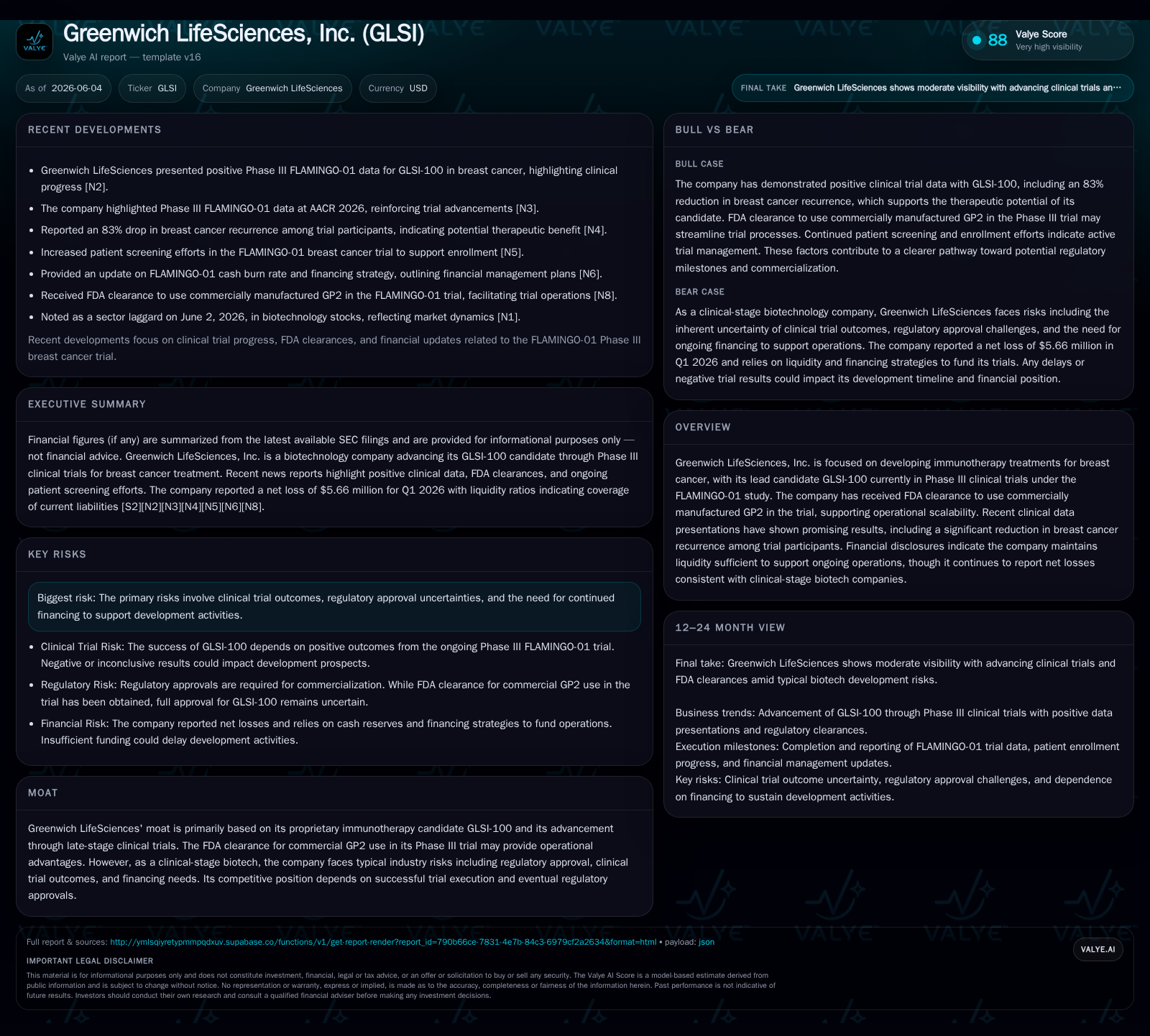
In its latest quarterly filing, Greenwich LifeSciences confirmed progress in its Phase III FLAMINGO-01 trial for GLSI-100, an immunotherapy targeting HER2-positive breast cancer. FDA clearance allowing commercial-scale GP2 peptide supply enhances operational scalability as the company expands trial sites up to 150 globally. Early clinical data indicate meaningful reductions in cancer recurrence, reinforcing the potential of the GP2+GM-CSF regimen. Despite solid liquidity positioning with a current ratio above 2.0, GLSI remains reliant on continued financing amid sustained net losses typical of clinical-stage biotech firms.
Latest Clinical Development Update: FLAMINGO-01 and Regulatory Milestones
Greenwich LifeSciences’ June 2026 quarterly filing highlights notable operational progress for its lead candidate GLSI-100 within the Phase III FLAMINGO-01 trial [S2]. The company obtained FDA clearance to utilize commercially manufactured GP2 peptide in the ongoing study, a critical enabler that shifts manufacturing from a more limited scale toward commercial readiness. This regulatory milestone helps address traditional bottlenecks faced by immunotherapy developers in scaling peptide supply under GMP conditions. In parallel, Greenwich continues an aggressive global trial expansion, targeting approximately 150 sites worldwide to facilitate enrollment acceleration and statistical power acquisition.
Recent presentations of FLAMINGO-01 data at scientific forums revealed encouraging early efficacy findings, particularly notable reductions in breast cancer recurrence among enrolled patients [N2][N3]. These results bolster confidence in GLSI-100's differentiated mechanism that targets residual disease post-standard trastuzumab therapy. The operational combination of scalability and clinical promise situates Greenwich closer to potential registration endpoints compared with peers still reliant on experimental or smaller-scale peptide supply.
Immunotherapy Business Model: GP2 Mechanism and Commercial Considerations
At its core, Greenwich’s revenue model hinges on successful commercialization of GLSI-100, a combinatorial immunotherapy consisting of the GP2 peptide fused conceptually with recombinant GM-CSF (sargramostim) [S1]. GP2 is a nine amino acid transmembrane peptide derived from HER2/neu protein expressed across diverse breast cancer phenotypes—ranging low (1+) to high (3+) expression levels—positioning it uniquely for wide patient applicability beyond limited overexpressors.
The therapy is administered intradermally as a mixture of GP2 and GM-CSF at injection time, stimulating the patient’s immune system to target HER2-expressing tumor cells selectively. This delivery mode demands precise supply management; notably, GM-CSF currently comes from a single FDA-approved manufacturer primarily servicing U.S. markets [S1]. While alternative supply mechanisms exist through named patient programs internationally, reliance on this single source introduces potential vulnerability both to ongoing clinical programs and eventual commercial scale-up.
Commercial strategy remains nascent given GLSI-100 is still under clinical evaluation; however, future plans may incorporate strategic partnerships or direct sales forces tailored by geography if regulatory approvals are achieved [S1]. The product’s role as adjunct therapy post-trastuzumab distinguishes it within the breast cancer treatment paradigm but also requires market education and payer adoption pathways aligning with health economics of reducing costly recurrences.
Industry Competitive Setting: Peers, Markets, and Regulatory Landscape
Greenwich LifeSciences operates in the competitive immuno-oncology space focused on HER2-positive breast cancer, where established treatments such as trastuzumab dominate frontline regimens [S1][N1]. The strategic niche for GLSI-100 lies in addressing residual disease or high-risk patients after completing neoadjuvant and adjuvant trastuzumab therapies where recurrence risk remains significant.
The immunotherapy landscape in this indication includes other candidates attempting to harness cellular immunity or checkpoint blockade approaches but often struggle with heterogeneous HER2 expression or tumor microenvironment challenges. Greenwich’s approach using a specific transmembrane peptide combined with an immune adjuvant offers mechanistic differentiation potentially yielding improved tolerability and specificity.
From a regulatory perspective, the challenge remains convincing authorities of meaningful clinical benefit via statistically robust recurrence reduction endpoints while demonstrating safety across expanded international patient cohorts [S1]. Given growing attention by regulatory bodies on oncology innovation paired with complex reimbursement environments, the pathway mandates exemplary trial execution coupled with comprehensive pharmacoeconomic data generation.
Growth Drivers: Trial Expansion, Endpoint Validation, and Global Footprint
Greenwich’s near-term growth trajectory is tightly linked to successful enrollment pace and endpoint achievement within FLAMINGO-01 [S2]. The expansion plan to approximately 150 global trial sites reflects urgency to reduce patient recruitment timelines given competitive oncology study landscapes. Strong site-level adoption will underpin timely data accrual enabling interim analyses that drive developmental momentum.
Safety and efficacy validations are central growth levers; demonstration of statistically significant recurrence rate reductions will provide foundational evidence supporting eventual NDA submissions. Should these be achieved convincingly alongside acceptable safety profiles documented thus far [N3], label expansion strategies could potentially follow into other HER2-expressing malignancies beyond breast cancer given the peptide’s target biology.
Operationally, scaling manufacturing capacity facilitated by FDA GMP clearance for GP2 peptide production reduces supply bottlenecks representing a meaningful inflection point. These improvements may also attract strategic partnerships or licensing deals enhancing capital resources required for late-stage development and launch preparations.
Risks and Constraints: Clinical Outcomes, Manufacturing Dependencies, Financing Needs
Despite advances, critical risks remain entrenched in clinical uncertainties customary within oncology biotechs [S1][S2][F1]. Clinical trial outcomes depend on achieving reproducible efficacy signals meeting regulatory standards; any setbacks would materially impair prospects given lack of approved products currently.
Manufacturing risk is heightened by sole dependency on one GM-CSF supplier authorized under FDA approval pathways [S1]. Disruptions here could delay trials or commercialization timelines absent alternative sourcing strategies or geographic registration enhancements.
Financially, Greenwich reported continuing net losses exceeding $19 million annually as of year-end 2025 consistent with their clinical-stage status [F1]. Cash resources totaling about $6.18 million at December 31, 2025 alongside current assets supporting a ratio of roughly 2.0 as of Q1 2026 offer runway into near term but underline the necessity for additional capital raises or partnerships imminently to sustain operations through costly Phase III completion phases.
Upcoming Catalysts to Monitor: Enrollment Data, Regulatory Feedback, Funding Events
Investor attention should focus on forthcoming operational milestones indicative of execution success including periodic interim FLAMINGO-01 efficacy results measuring recurrence rate reductions which can validate therapeutic potential [S2][N2].
Regulatory interactions concerning further manufacturing approvals or feedback on trial design adjustments will also be pivotal in shaping development timelines.
Capital markets activities such as equity offerings or strategic alliances would signal efforts to bolster balance sheets needed due to R&D intensity characteristic of late-stage biopharma development cycles.
Financial Contextual Overview: Liquidity Position and Expense Trajectory
From a financial vantage point grounded in latest filings and companyfacts as of Q1 2026 [S2][F1], Greenwich LifeSciences maintains liquidity adequate for immediate operational needs with current assets surpassing liabilities by more than twofold (current ratio ~2.0). Yet cash reserves standing at just over $6 million as of year-end 2025 highlight limited runway absent supplemental funding sources.
Operating losses registered close to $19.4 million for fiscal year 2025 reflect standard investment spending patterns typical among clinical-stage therapeutics developers aggressively advancing pipeline assets without commercial product revenues yet realized. Expense trajectories are expected to rise commensurately with expanded trial site activations and preparatory steps toward eventual commercialization infrastructure build-out.
The company’s ability to secure future financing remains critical for sustaining momentum beyond Phase III completion through regulatory filings leading potentially into market launch phases should approvals materialize.
This analysis is based solely on publicly available information from company filings and news reports as cited above. It does not constitute investment advice or research views. Readers should consider all relevant risks and consult professional advisors when evaluating opportunities related to Greenwich LifeSciences or its sector peers.
Disclaimer: This is research-only, informational analysis and not investment advice. It may include AI-generated interpretation and general industry context. Always verify important details using primary sources.

Comments