
Corning's Optical Communications Growth Faces Supply Chain and Capital Intensity Challenges
Q2 2026 results highlight Corning’s strength in AI-driven fiber demand amid margin pressures and supply chain volatility.
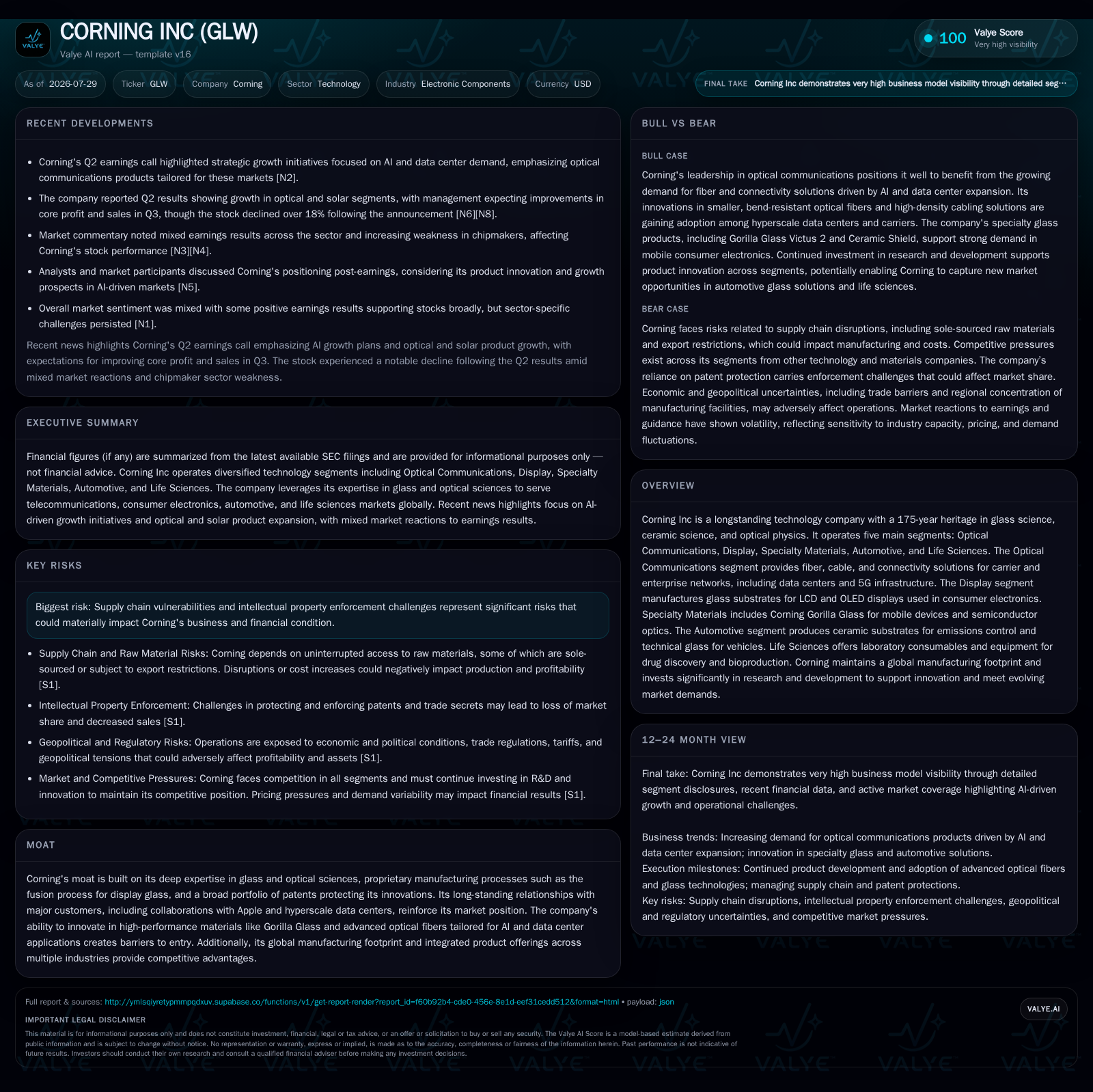
In its latest quarter, Corning Inc reinforced its leading role in optical communications, benefiting from AI and data center expansion, while navigating ongoing supply chain disruptions and raw material cost inflation. The company’s diversified portfolio across optical fiber, specialty materials, automotive ceramics, and life sciences underpins steady segment revenue growth despite operating margin pressures due to input costs and capacity investments. Corning’s moat relies heavily on proprietary manufacturing processes and innovation in materials science, but near-term risks include supply chain shortages, capital intensity, and enforcement of intellectual property rights.
Recent Operating Update: Q2 2026 Highlights
Corning Inc’s second-quarter 2026 results underscored robust demand growth in its Optical Communications segment, primarily driven by accelerated artificial intelligence (AI) deployments that are expanding data center infrastructure [S2]. This segment benefits from a structural shift as telecommunications carriers and enterprise networks migrate from legacy copper systems to high-bandwidth optical fiber solutions. Corning’s connectivity products, including fiber and optical components, are integral to hyperscale data centers requiring high-density, low-latency interconnects. Despite strong volume growth, operating margins faced pressure due to inflationary raw material costs—such as precious metals used in optical components—and ongoing supply chain disruptions affecting manufacturing throughput and product yield rates [S2]. The company reaffirmed its commitment to sustained R&D investment targeting next-generation fiber technologies optimized for evolving network architectures and AI-driven traffic patterns [N1].
Business Model: Diversified Advanced Materials Manufacturing Across Multiple End Markets
Corning’s business model centers on designing, manufacturing, and selling advanced glass, ceramic, and optical materials that serve diverse high-technology industries. The company operates five reportable segments: Optical Communications, Display, Specialty Materials, Automotive, and Life Sciences, each addressing distinct customer bases ranging from global telecom carriers and hyperscale cloud providers to consumer electronics OEMs, automotive manufacturers, and biopharmaceutical companies [S1].
Revenue is primarily generated through long-term supply agreements and volume-based contracts with large carriers and hyperscalers in Optical Communications, consumer electronics manufacturers in Display and Specialty Materials, automotive OEMs for emissions control and technical glass, and life sciences firms for precision lab consumables. Monetization depends heavily on Corning’s proprietary manufacturing processes—such as fusion forming for ultra-thin display glass substrates and advanced ceramic fabrication techniques—that enable differentiated product performance and durability. Pricing structures often incorporate volume commitments and premium pricing tied to technical specifications and product reliability.
Key operational levers include manufacturing capacity utilization, which influences fixed cost absorption, and product yield rates, critical for maintaining gross margins given the complexity of specialty materials production. Corning’s R&D expenditure remains elevated relative to sales, reflecting its strategy to sustain technological leadership and introduce new products aligned with fast-evolving market demands [S1]. The company’s global manufacturing footprint supports supply chain resilience but also exposes it to geopolitical risks and logistics challenges.
Industry Structure and Competitive Positioning
Operating within the Advanced Materials and Electronic Components Manufacturing industry, Corning specializes in optical fibers, display glass substrates, ceramic materials for automotive emissions control, and specialty lab instruments. Its competitive set includes advanced materials manufacturers such as II-VI Incorporated (specialty photonics), Lumentum Holdings (optical components), and Asahi Glass (display and specialty glass) [S1].
Corning’s competitive moat is anchored in its decades-long expertise combining glass science with optical physics innovation, supported by a substantial patent portfolio protecting core technologies. This intellectual property barrier, coupled with capital-intensive, proprietary manufacturing processes and entrenched customer relationships—particularly with telecom carriers and hyperscale data center operators—limits new entrants. The Gorilla Glass brand exemplifies Corning’s market leadership in durable cover glass for mobile devices, secured by ongoing innovation and patent protection.
Benchmarking against peers, Corning maintains strong R&D efficiency, regularly filing patents and introducing new products that align with industry KPIs such as order backlog health and book-to-bill ratios, which provide forward revenue visibility. Its manufacturing scale and geographic diversification mitigate single-location supply risks but add operational complexity.
Growth Drivers
Corning’s growth is underpinned by several macro-technology trends:
- Fiber Optic Network Expansion & 5G Infrastructure: Global telecom carriers are investing heavily in fiber-to-the-home (FTTH) and 5G deployments, driving demand for Corning’s low-loss optical fibers and connectivity solutions optimized for high-capacity carrier networks.
- AI and Cloud Computing Data Center Growth: The surge in AI workloads increases intra- and inter-data center traffic, necessitating higher-capacity fiber arrays and advanced connectivity products supplied by Corning.
- Consumer Electronics Demand for Advanced Display Glass: The proliferation of smartphones and wearables requires thinner, more damage-resistant glass substrates produced via Corning’s proprietary fusion forming processes.
- Automotive Emissions Control and Technical Glass: Stricter global emissions regulations boost demand for ceramic substrates used in catalytic converters, while advanced technical glass applications grow in electric vehicles (EVs).
- Life Sciences Consumables and Equipment: Expansion in biopharmaceutical research and drug discovery fuels steady demand for precision labware and specialty glass components.
These drivers translate into supportive book-to-bill ratios and justify Corning’s capital expenditures aimed at expanding production capacity, although equipment lead times remain long due to the complexity of semiconductor-grade manufacturing tools [S2]
Risks and Watchpoints
Several operational and market risks could impact Corning’s near-term performance:
- Raw Material Price Volatility and Supply Constraints: Fluctuations in prices and availability of critical inputs such as rare earth elements and industrial gases can increase production costs and compress gross margins.
- Supply Chain Disruptions: Delays in logistics or supplier capacity reductions could impair manufacturing continuity, affecting order fulfillment and customer satisfaction.
- Intellectual Property Enforcement: Maintaining patent protection and defending against infringement claims are essential to preserving Corning’s competitive advantage.
- Capital Intensity and Equipment Lead Times: The high upfront capital expenditure required to scale manufacturing capacity involves multi-year build cycles, with risks of obsolescence if technology cycles accelerate.
- Customer Concentration: Heavy reliance on a limited number of large telecom carriers and hyperscalers exposes Corning to demand fluctuations or shifts in sourcing strategies.
- Pricing Pressure: Competition from lower-cost suppliers or alternative technologies may force pricing concessions, necessitating operational efficiencies.
- Geopolitical and Trade Policy Risks: Global manufacturing and supply chain operations are vulnerable to tariffs, export controls, and regulatory changes that could affect cost structures and market access.
Monitoring order backlog trends, segment revenue growth, and product yield improvements will be critical to assessing whether these risks materialize significantly.
What to Watch Next
Key upcoming milestones include the successful scaling of optical fiber production capacity to meet AI-driven enterprise network demand highlighted in recent earnings commentary [N1]. Improvements in product yield rates will be vital to restoring operating margins pressured by raw material inflation and supply chain challenges reported in Q2 2026 [S2].
The pace of innovation, as reflected in patent filings and new product introductions, will indicate Corning’s ability to maintain its technology leadership. Supply chain lead times for critical capital equipment require close monitoring given ongoing global logistics complexities. Additionally, any developments regarding contract renewals or purchasing patterns among major hyperscale cloud providers would provide forward-looking insights into demand visibility.
Conclusion
Corning Inc continues to leverage secular growth trends in optical communications infrastructure driven by AI and data center expansion, supported by its diversified advanced materials portfolio spanning automotive emissions control and life sciences. The company’s competitive moat is reinforced by proprietary manufacturing processes and a robust patent portfolio that protect its technology leadership. However, near-term operational risks persist, including supply chain fragility related to raw material volatility and the capital intensity required to scale capacity. Monitoring segment growth trajectories, product yield improvements, and supply chain developments will be essential to understanding the company’s ability to navigate margin pressures and capitalize on expanding market opportunities through 2026.
This analysis is based solely on publicly available SEC filings and corroborated news sources referencing Corning’s Q2 2026 reporting cycle. It does not constitute investment advice or research views.
Disclaimer: This is research-only, informational analysis and not investment advice. It may include AI-generated interpretation and general industry context. Always verify important details using primary sources.

Comments