
General Motors Navigates EV Transition and Global Challenges with Strategic Capital Deployment
GM reports robust financial results, accelerated EV initiatives, and strategic shifts in manufacturing amid competitive headwinds.
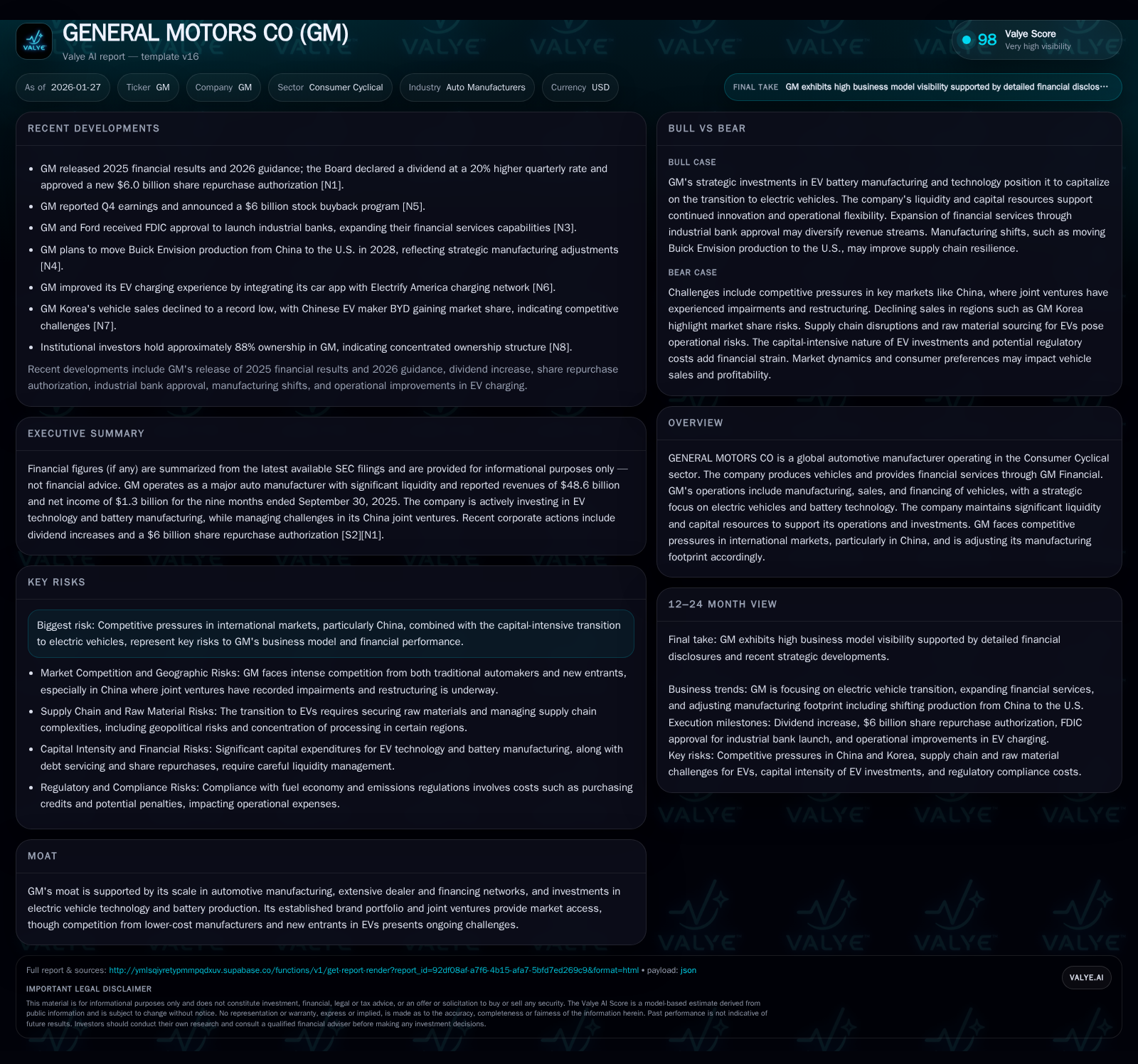
General Motors delivered a strong 2025 financial performance, highlighted by a dividend increase and a substantial $6 billion share repurchase program. The company is actively advancing its electric vehicle and battery technology strategy while recalibrating its geographic manufacturing footprint, notably relocating Buick Envision production from China to the U.S. by 2028. GM faces ongoing pressures in China’s highly competitive market and is addressing these through joint venture restructuring and portfolio optimization. Meanwhile, the launch of an industrial bank marks a strategic diversification in financial services, complementing its core automotive operations.
What Changed Recently
In January 2026, General Motors announced its 2025 financial results and guidance for 2026, which included a 20% increase in its quarterly dividend and a new $6 billion share repurchase authorization, reflecting strong cash flow and capital return priorities [N1][N2]. The Q4 earnings surpassed expectations, reinforcing operational execution amid industry transformation. GM also disclosed plans to relocate production of the Buick Envision SUV from China to the U.S. by 2028, a move indicative of strategic rebalancing influenced by geopolitical considerations and the evolving competitive landscape in China [N5].
Adding to its diversification, GM received FDIC approval to establish an industrial bank, joining Ford in this financial services expansion. This step suggests a push to broaden financial product offerings beyond traditional automotive lending, potentially enhancing control over financing margins and customer relationships [N4].
Finally, GM enhanced its EV customer experience by integrating Electrify America’s charging network directly into its vehicle app, addressing a common pain point in EV ownership and aligning with its electric mobility strategy [N6].
Business Model as a System
General Motors operates as an integrated automotive manufacturer and financial services provider. Its core automotive segment encompasses design, manufacturing, and sales of vehicles, including internal combustion engine (ICE) models and an increasing portfolio of electric vehicles (EVs) [S1]. GM’s product lineup spans multiple brands and vehicle types, targeting a broad consumer base across North America, China, and other international markets.
The company’s financial services arm, GM Financial, extends consumer and dealer financing solutions, creating a closed-loop system that supports vehicle sales and customer retention through credit provision and leasing options [S7]. This vertical integration allows GM to derive recurring income streams and manage credit risk more directly.
Geographically, GM’s operations include wholly owned facilities and joint ventures, especially in China, where partnerships with SAIC facilitate market access. However, these ventures face margin pressures due to local competitors’ cost advantages and aggressive volume strategies, necessitating joint restructuring efforts [S2]. GM’s manufacturing footprint and product portfolio are continuously optimized to align with shifting demand, regulatory mandates, and production economics.
Capital allocation prioritizes investments in electric and autonomous vehicle technologies and battery manufacturing, reflecting the industry's capital-intensive transition. GM balances these outlays with disciplined liquidity management, maintaining over $22 billion in cash equivalents and a current ratio above 1.2 as of late 2025 [XBRL]. Regulatory compliance, including emissions credits purchases and safety standards adherence, forms a substantial recurring cost and influences product planning and pricing strategies [S8][S13].
Industry Map & Competitive Battlefield
The automotive industry remains highly competitive and capital-intensive, characterized by rapid technological change, evolving consumer preferences, and stringent regulatory requirements. Legacy OEMs like GM compete with traditional rivals (Ford, Stellantis, Toyota) and increasingly with new entrants targeting EVs, such as Tesla and Chinese manufacturers (BYD, NIO).
In China, GM’s joint ventures confront intense competition from local brands producing low-cost vehicles at scale, putting pressure on margins and sales growth [S2]. The Chinese market’s significance as the largest global automotive market motivates GM to maintain a presence but also necessitates restructuring and portfolio rationalization.
The EV transition is central to competitive positioning. Control over battery technology and charging infrastructure is a key battleground. GM’s investments in battery joint ventures and integration with Electrify America’s charging network seek to create a differentiated customer experience and reduce dependency on third parties [N6].
Financial services innovation, exemplified by the launch of industrial banks, may offer new competitive advantages by expanding credit product offerings and potentially lowering financing costs [N4].
Regulation shapes the industry landscape heavily, with emissions standards tightening globally, especially in Europe, China, and the U.S. Compliance costs and credit purchases materially affect profitability and product mix decisions [S8][S13][S14].
Where the Economics Become Real
Unit economics in automotive manufacturing hinge on scale, cost control, product mix, and regulatory cost management. GM’s scale provides leverage in procurement and manufacturing efficiency but also demands continuous capital investment to modernize plants and develop EV platforms.
The shift to EVs introduces new cost dynamics: battery cell production, raw materials sourcing, and charging infrastructure integration are capital and operational cost centers. GM’s joint ventures in battery manufacturing represent both a strategic necessity and a bottleneck, as global battery supply constraints and material costs remain volatile [S1][S11].
GM’s vehicle sales generate revenue not only from new units but also from financing and leasing programs via GM Financial, which adds margin layers but also credit risk exposure. The establishment of an industrial bank may improve financing economics by internalizing more of the financial services value chain [N4][S7].
Regulatory compliance costs—including emissions credit purchases (over $2 billion in 2024) and safety regulations—are significant and can erode automotive margins, especially when product portfolios must be adjusted to meet evolving standards [S8][S13].
Liquidity management is critical given the cyclical nature of automotive demand and capital intensity. GM’s cash position and current ratio of 1.23 provide a buffer to fund investments and weather market fluctuations [XBRL]. The $6 billion share repurchase signals confidence in free cash flow generation but also requires balancing against reinvestment needs.
Diligence Questions / Disconfirming Signals
How sustainable are GM’s margins in China given the ongoing JV restructuring and intense local competition? The $2.1 billion impairment on equity interests in China JVs indicates significant challenges [S2].
To what extent will the relocation of Buick Envision production from China to the U.S. affect cost structure, supply chain complexity, and pricing competitiveness in key markets? [N5]
How will GM scale and integrate its industrial banking operations, and what regulatory or credit risks might emerge from this new initiative? [N4]
What is GM’s exposure to raw material price volatility and supply chain disruptions for battery manufacturing, and how might this impact EV rollout timelines and costs? [S1][S11]
Considering the multi-billion dollar spend on emissions credits in recent years, how will tightening environmental regulations affect GM’s product strategy and profitability going forward? [S8][S13][S14]
How effective is GM’s integration of charging infrastructure into the vehicle experience at driving EV adoption and customer retention? Are there measurable impacts on sales or brand loyalty? [N6]
What are the potential margin and volume impacts from the ongoing global semiconductor shortages and other supply chain constraints that have affected the automotive industry broadly?
How resilient is GM’s liquidity and capital structure if macroeconomic conditions worsen or vehicle demand softens?
This analysis synthesizes publicly available financial releases, reputable news sources, and regulatory disclosures to provide a comprehensive overview of General Motors’ current strategic positioning and operational dynamics. It is intended for informational purposes and does not constitute investment advice.
Disclaimer: This is research-only, informational analysis and not investment advice. It may include AI-generated interpretation and general industry context. Always verify important details using primary sources.

Comments