
GameStop's Strategic Shift in Specialty Retail and Digital Collectibles Landscape
GameStop Corp. is transforming its retail footprint and product mix amid ongoing sector challenges and digital innovation.
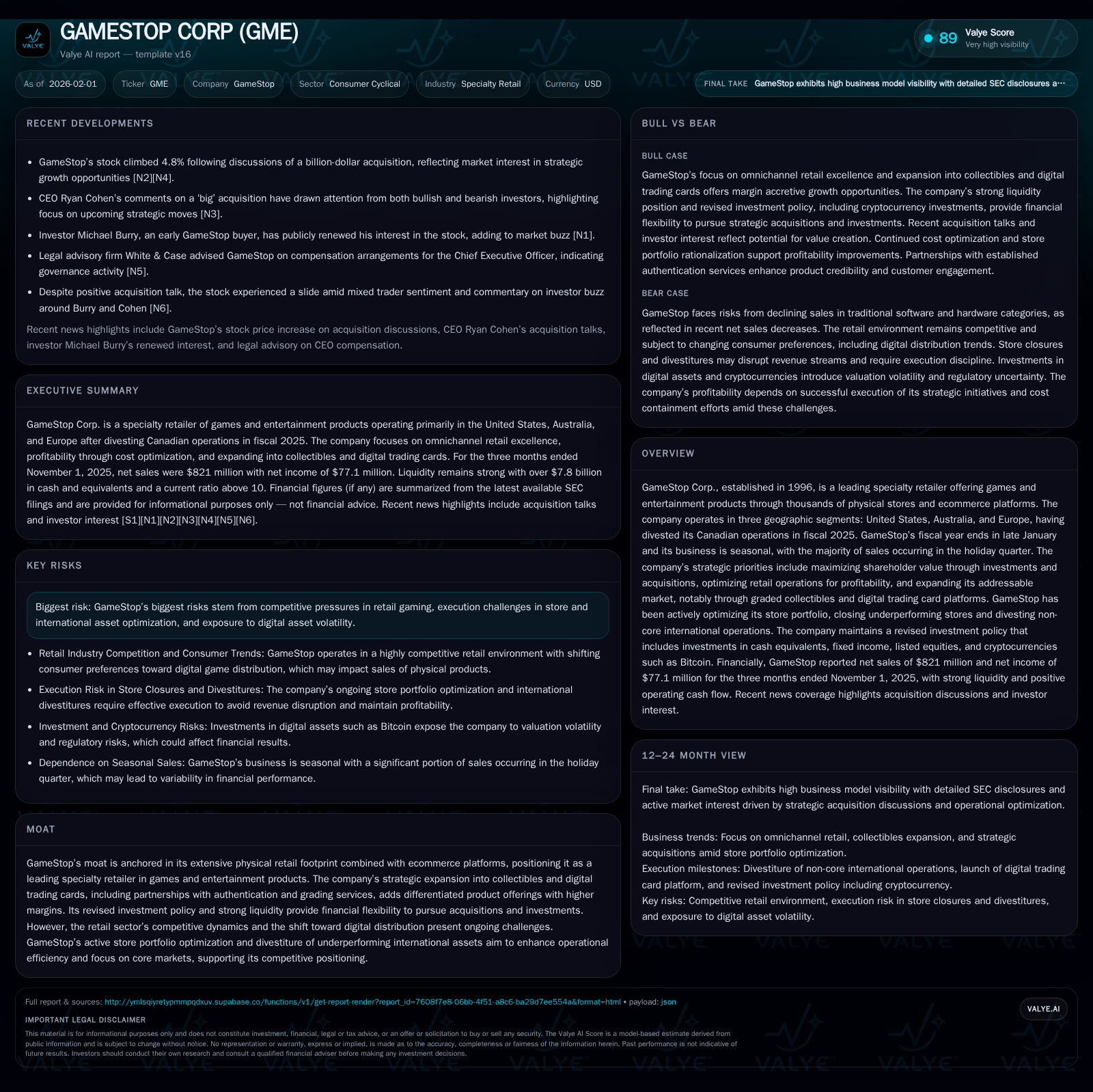
GameStop continues to evolve its business model by optimizing its physical store portfolio, divesting non-core international operations, and expanding into higher-margin collectibles and digital trading cards. The company maintains strong liquidity, including a sizable Bitcoin treasury reserve, supporting its acquisition-driven growth strategy. Despite progress in profitability and margin improvement, GameStop faces execution risks tied to store closures, competitive pressures from digital game distribution, and volatility in digital assets. Recent market enthusiasm around a potential billion-dollar acquisition reflects investor focus on strategic growth initiatives.
What Changed Recently
GameStop's stock price gained nearly 5% following CEO Ryan Cohen's public discussion of a "big" acquisition, fueling speculation about a transformative deal in the company's growth trajectory [N1][N2][N3]. This follows an earlier resurgence in market interest partly driven by notable investors like Michael Burry returning to highlight the stock [N4]. Meanwhile, GameStop has been actively optimizing its retail footprint by closing underperforming stores and divesting non-core international assets, including the completed sale of its Canadian subsidiary in fiscal 2025 and prior exits from several European markets [S3][S4]. These moves align with the company's strategic priorities to achieve profitability and focus on core markets. Additionally, GameStop’s investment policy revision now includes Bitcoin as a treasury reserve asset, with a $500 million allocation to digital currency, reflecting an unconventional liquidity management strategy [S2][S6]. The company also launched a digital trading card platform, Power Packs, in partnership with PSA, expanding its presence in graded collectibles and digital assets [S8][S9]. Recent quarterly results exhibit sales growth in collectibles and hardware categories, alongside significant SG&A expense reductions, driving improved operating income [S11][S12]. However, the stock experienced volatility amid mixed investor reactions to these developments [N6].
Business Model as a System
GameStop operates as a specialty retailer focusing on games and entertainment products, distributing through thousands of physical stores and ecommerce platforms. Its business is seasonal, with most sales occurring in the holiday quarter, and geographically segmented into the United States, Australia, and Europe after divesting Canada and other international operations [S5][S7].
Retail revenue streams encompass sales of hardware and accessories, software, and collectibles, with collectibles increasingly contributing a higher margin and larger share of sales. The company strategically targets omnichannel retail excellence by integrating brick-and-mortar stores with ecommerce capabilities to meet consumer preferences [S2].
GameStop's investment policy, approved by the board in early 2025, empowers an Investment Committee, including CEO Ryan Cohen, to allocate capital into public securities and digital assets like Bitcoin. This policy aims to maximize shareholder value through strategic investments and acquisitions, leveraging GameStop's strong liquidity position [S2][S6].
The company continues to optimize its store portfolio, closing underperforming locations and exiting markets to reduce redundancies and improve profitability. Recent store closures in the U.S. numbered 590 in fiscal 2024, with more anticipated in 2025 [S3][S9].
Complementing physical retail, GameStop has expanded into higher-margin categories such as graded collectibles, collaborating with PSA for autograph authentication, grading services, and enabling digital trading through the Power Packs platform. This product and service innovation aims to broaden the addressable market and provide margin accretive opportunities [S8][S9].
Industry Map & Competitive Battlefield
The retail gaming industry is undergoing a profound transformation driven by digital distribution platforms, evolving consumer habits, and the rise of collectibles and digital assets. Traditional specialty retailers like GameStop face competition from console manufacturers (Sony, Microsoft, Nintendo), digital storefronts (Steam, Epic Games Store, Xbox Marketplace), and general retailers (Amazon, Walmart).
GameStop's physical retail footprint, once a core competitive advantage, is challenged by the convenience and scale of digital distribution. To counterbalance this, GameStop is pivoting toward collectibles, preowned hardware, and digital trading cards—niches where physical presence and authentication services add value.
The collectibles market itself is competitive and fragmented, with online marketplaces (eBay, StockX) and dedicated platforms vying for customer attention. GameStop's partnership with PSA and launch of Power Packs are strategic moves to differentiate through in-store physical authentication combined with digital trading capabilities.
Beyond gaming, GameStop’s inclusion of Bitcoin in its treasury and interest in acquisitions under Ryan Cohen’s leadership position the company uniquely at the intersection of retail, digital assets, and technology-driven growth, though this also places it in competition with crypto platforms and investment funds engaged in similar spaces.
Where the Economics Become Real
GameStop's unit economics reflect a mix of product categories with differing margin profiles. Hardware and accessories, while representing the largest revenue segment, carry lower margins than collectibles. The shift toward collectibles, which grew to 25.8% of net sales in the six months ended August 2025 from 16.4% the prior year, has contributed to gross margin expansion (31.4% vs. 29.4%) [S11][S12][S13].
Cost containment efforts have materially lowered SG&A expenses, reducing them by over 19% year-over-year in recent quarters, attributed to labor, consulting, marketing, and store-related cost reductions. Store closures and international divestitures have also trimmed depreciation expenses, improving operating income from a loss to positive territory [S11][S12].
Liquidity is a critical enabler: as of November 2025, GameStop held approximately $7.8 billion in cash and cash equivalents, supplemented by nearly $1 billion in marketable securities, yielding a robust current ratio of 10.39, indicating strong short-term financial flexibility [S17].
This liquidity underpins GameStop's capacity for acquisitions and investments, including a $500 million Bitcoin purchase and an ongoing at-the-market equity offering raising over $900 million in gross proceeds [S15][S16]. The company also carries some liabilities related to divested international operations but maintains a conservative capital structure overall.
The seasonal nature of the business concentrates revenue and profitability in the fourth quarter, requiring effective inventory and working capital management to meet holiday demand peaks. Vendor relationships include credit support collateral terms, adding complexity to procurement and inventory financing [S14].
Diligence Questions / Disconfirming Signals
What are the exact contours and timing of the rumored billion-dollar acquisition, and how will it integrate with GameStop’s current business and strategic priorities? The absence of details creates uncertainty around execution and capital allocation.
To what extent can GameStop sustain its profitability improvements given the secular decline in physical software sales and competitive pressures from digital distribution platforms?
How scalable and defensible is the growth in the collectibles and digital trading card categories? Is GameStop positioned to fend off competitors in authentication services and digital marketplaces?
What risks are associated with the company’s Bitcoin treasury holdings, especially given price volatility, regulatory scrutiny, and potential liquidity constraints?
How effective has the store portfolio optimization been in practice, and what are the risks of customer attrition or revenue loss from store closures? How will GameStop balance physical presence with ecommerce growth?
Are there significant operational or integration risks related to prior and ongoing international divestitures, and how might these affect financials or brand perception in Europe and Australia?
Given the large cash balance and ongoing equity issuance, what is the company’s capital deployment discipline, and how is shareholder value protected against dilution or misallocated investments?
How does the company’s competitive positioning evolve relative to platform holders’ own direct-to-consumer sales and the emergence of blockchain-based gaming and collectibles?
What contingencies or risk management practices does GameStop have in place regarding vendor credit support requirements and inventory financing?
This analysis is based on available public sources and SEC filings as of early 2026. It aims to provide a comprehensive understanding of GameStop Corp.’s business model, recent developments, and strategic challenges without offering investment advice or forecasts. Considerations around execution risk, competitive dynamics, and financial management remain critical to assessing the company's future performance.
Disclaimer: This is research-only, informational analysis and not investment advice. It may include AI-generated interpretation and general industry context. Always verify important details using primary sources.

Comments