
GreenPower Motor Advances Electric School Bus Orders Amid Improving Margins
GreenPower's latest quarterly filings reveal secured electric school bus orders and marked gross margin improvement, bolstered by certification compliance and vertical integration.
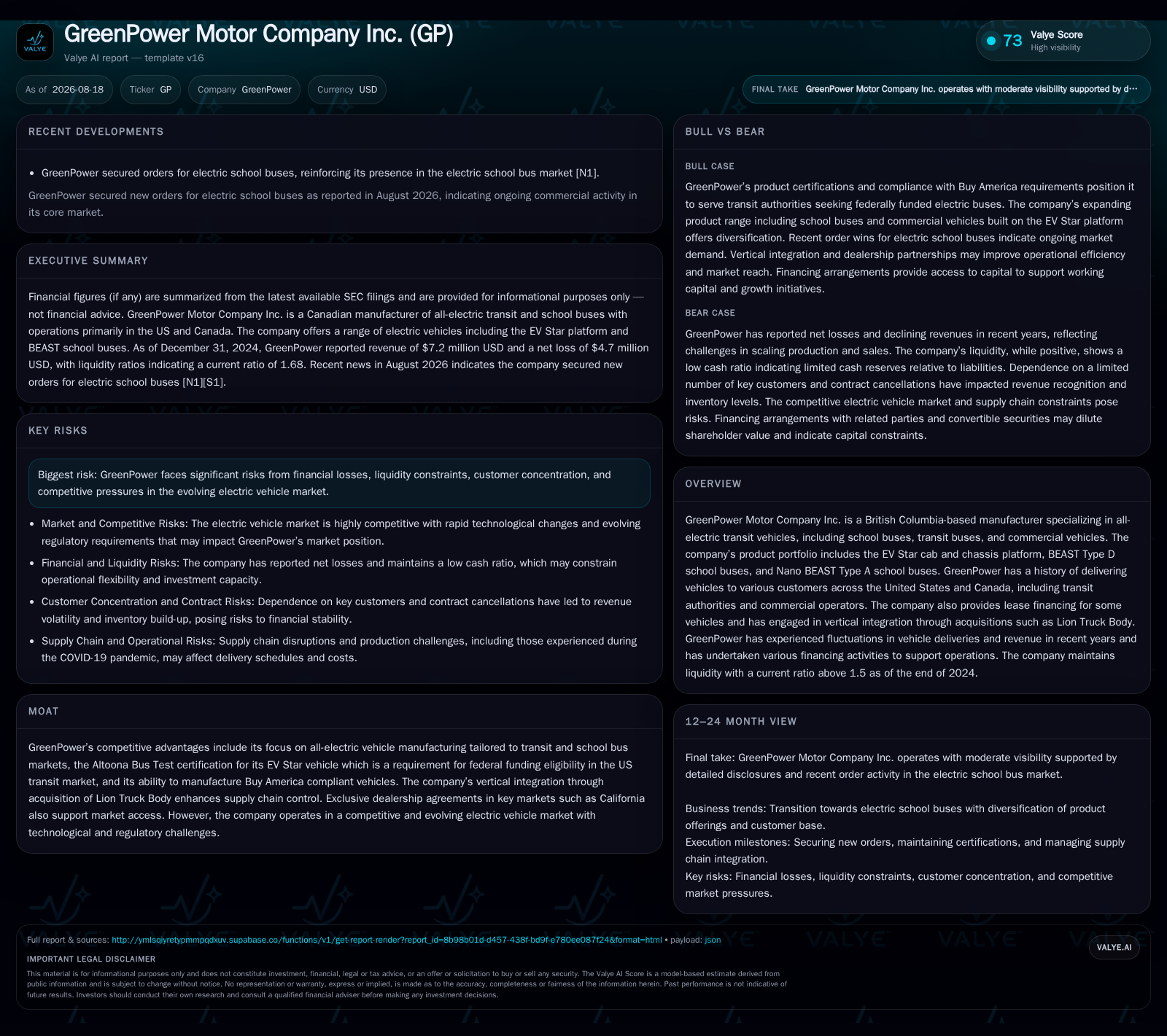
GreenPower Motor Company’s August 2026 quarterly disclosures demonstrate operational progress with new battery electric school bus orders supporting revenue visibility. The company’s focus on regulatory certifications such as the Altoona Bus Test and Buy America compliance underpins its competitive positioning in a highly regulated US transit market. Vertical integration through acquisitions enhances supply chain control, contributing to meaningful gross margin expansion despite softer revenue trends. However, financial losses and customer concentration risks persist in this capital-intensive fleet electrification sector.
Secured Electric School Bus Orders Highlight Growth Opportunity
GreenPower's August 2026 Form 6-K filings disclose newly secured purchase orders for battery electric school buses, underscoring renewed demand traction after prior contract cancellations that had depressed recent deliveries [S2][N1]. These new orders notably bolster the firm's order backlog — a critical KPI signaling near-term production volume ramp prospects in a sector where fleet electrification replaces aging diesel buses under regulatory mandates. These customers primarily comprise public school districts and transit authorities in North America, whose procurement cycles often dictate quarterly variability but offer sizable revenue streams when aggregated over multi-year replacement plans. The visibility afforded by these confirmed orders improves GreenPower’s operational planning horizon in a capital-intensive manufacturing environment.
Certification and Vertical Integration Enable Competitive Positioning in Fleet Electrification
GreenPower operates in an industry heavily shaped by government regulation and funding qualification, making its Altoona Bus Test certification a significant competitive moat. This federally sponsored structural durability test is mandatory for vehicles seeking Federal Transit Administration (FTA) grants or subsidies within the US transit market [S1]. Complementing this is GreenPower’s Buy America compliance — enabling eligibility for state and federal procurement programs favoring domestically produced vehicles — further solidifying its penetration in key government-backed fleet electrification projects. These certifications act as regulatory gating factors, limiting participation to certified OEMs during tightening zero-emission mandates such as California's Innovative Clean Transit (ICT) regulation.
Additionally, vertical integration has emerged as a critical strategic lever for GreenPower. Its acquisition of Lion Truck Body enhances supply chain control by internalizing the production of key vehicle components, mitigating risks from outside supplier shortages prevalent across the EV manufacturing industry. This move enables more reliable inventory management, cost containment, and agility in responding to fluctuating order volumes [S1]. While peers like Lion Electric pursue similar integration strategies to tighten operational control, GreenPower's approach leverages both North American assembly capacity in West Virginia and specialized subcomponents production to optimize throughput.
(Re)Emerging Gross Margin Improvement Reflects Production Efficiency Gains
Despite a reported annual revenue decline of 17.4% to $16.4 million for fiscal year ended March 31, 2026, GreenPower delivered a dramatic gross margin improvement from 11.1% the previous year to 56.2% [S1]. This shift is attributable primarily to enhanced cost of goods sold (COGS) management through better fixed overhead absorption as vehicle production scales with confirmed order flows. Lower warranty accruals—linked to reduced prior year sales volatility—and streamlined component sourcing via vertical integration also contribute positively.
This margin expansion suggests emerging operating leverage typical of battery electric vehicle manufacturing as scale builds; however, sustaining this requires continued demand conversion from backlog into deliveries without incurring impairments or quality-related costs. Margin stability will also hinge on maintaining competitive pricing aligned with government incentive frameworks while controlling raw material inputs such as battery cells—an area subject to volatile commodity pricing impacts.
Customer Concentration Risks Amid a Capital-Intensive Fleets Market
A persistent risk factor evident from the filings is heightened customer concentration centered on large transit authorities and school districts [S1]. Such concentration magnifies revenue variability due to the episodic nature of institutional procurement linked to public budget cycles and regulatory milestones rather than steady commercial buying patterns. Consequently, order backlogs may experience batchy inflows with potential postponements or cancellations impacting near-term visibility.
Given the high fixed costs baked into manufacturing facilities and labor specialization for BEV transit vehicles, any shortfall in sizable fleet contracts can disproportionately impact profitability metrics and cash conversion efficiency. Additionally, reliance on limited dealerships or regional distributors accentuates sales channel dependency risks especially if key partnerships are terminated or renegotiated unfavorably.
Regulatory Frameworks Like Buy America Licensing Confirm Market Access
The importance of regulatory frameworks cannot be overstated in shaping GreenPower’s addressable market. The company highlights compliance with the Buy America provisions which mandate domestic content thresholds on federally funded transit procurements [S1]. This legal framework directly affects fleet operators seeking federal grants for zero-emission vehicle acquisitions under programs targeting medium- and heavy-duty truck emission reductions.
Moreover, California’s ICT regulation compels all public transit fleets progressively toward zero-emission bus adoption by calendar year milestones stretching through 2040. Being licensed motor vehicle manufacturers in states like California and West Virginia further facilitates GreenPower’s ability to participate competitively within these legislatively driven markets—helping lock in long-term demand pathways beyond current fiscal periods.
Growth Drivers: Government Mandates, Incentive Programs, and Fleet Replacement Cycles
Sector tailwinds stem primarily from escalating government mandates enforcing zero-emission fleets alongside supportive subsidy structures at federal and state levels designed explicitly to accelerate commercial EV uptake [N1]. Technological advances reducing battery costs combined with rising environmental awareness among municipal operators fuel replacement cycles favoring less polluting electric transit buses and school buses.
Fleet electrification momentum across the U.S., led by regulations such as CARB standards and EPA emissions rules, propels tenders requiring BEV procurement capable of meeting GVWR classifications fitting traditional diesel bus applications — niches where GreenPower specializes with offerings like BEAST Type D school buses and Nano BEAST Type A models calibrated for different route profiles.
Near-Term Risks: Supply Chain Vulnerabilities and Financial Liquidity Constraints
Indexed against risk factors cited by management are persistent supply chain vulnerabilities—particularly around sourcing batteries, electronic modules, and chassis components—which could curtail vehicle completion timelines or inflate input costs unfavorably compared to fixed-price contracts [S1][S2]. Although vertical integration via Lion Truck Body mitigates certain external dependencies, full insulation is not yet achievable given complexities involved in EV drivetrain elements.
Eyes on Execution — Key Metrics to Monitor in Upcoming Quarters
Critical execution markers include sequential growth in vehicle deliveries converting backlog orders into recognized revenue—a KPI tied closely to factory throughput utilization rates—and gross margin maintenance evidencing cost discipline amidst scale expansion [S2][S3]. Monitoring trends in customer diversification will reveal progress reducing dependence on large individual buyers.
Additionally, R&D investment shifts away from heavy development toward refinement signal product maturity aligning with stable demand windows while minimizing expense drag on operating results. Importantly, subtle improvements in accounts receivable turnover and inventory management metrics will indicate working capital efficiency gains underpinning financial sustainability prospects.
This report is based solely on publicly available information including GreenPower Motor Company Inc.’s SEC filings dated August 2026 and corroborated news articles [N1], combined with industry contextual analysis relevant to commercial electric vehicle manufacturing trends across North America without relying on speculative projections or proprietary datasets.
Disclaimer: This is research-only, informational analysis and not investment advice. It may include AI-generated interpretation and general industry context. Always verify important details using primary sources.

Comments