
Graphic Packaging’s Turnaround: Balancing Sustainability with Profitability Pressures
Graphic Packaging Holding Company navigates the interplay of sustainable innovation and operational restructuring amid financial headwinds.
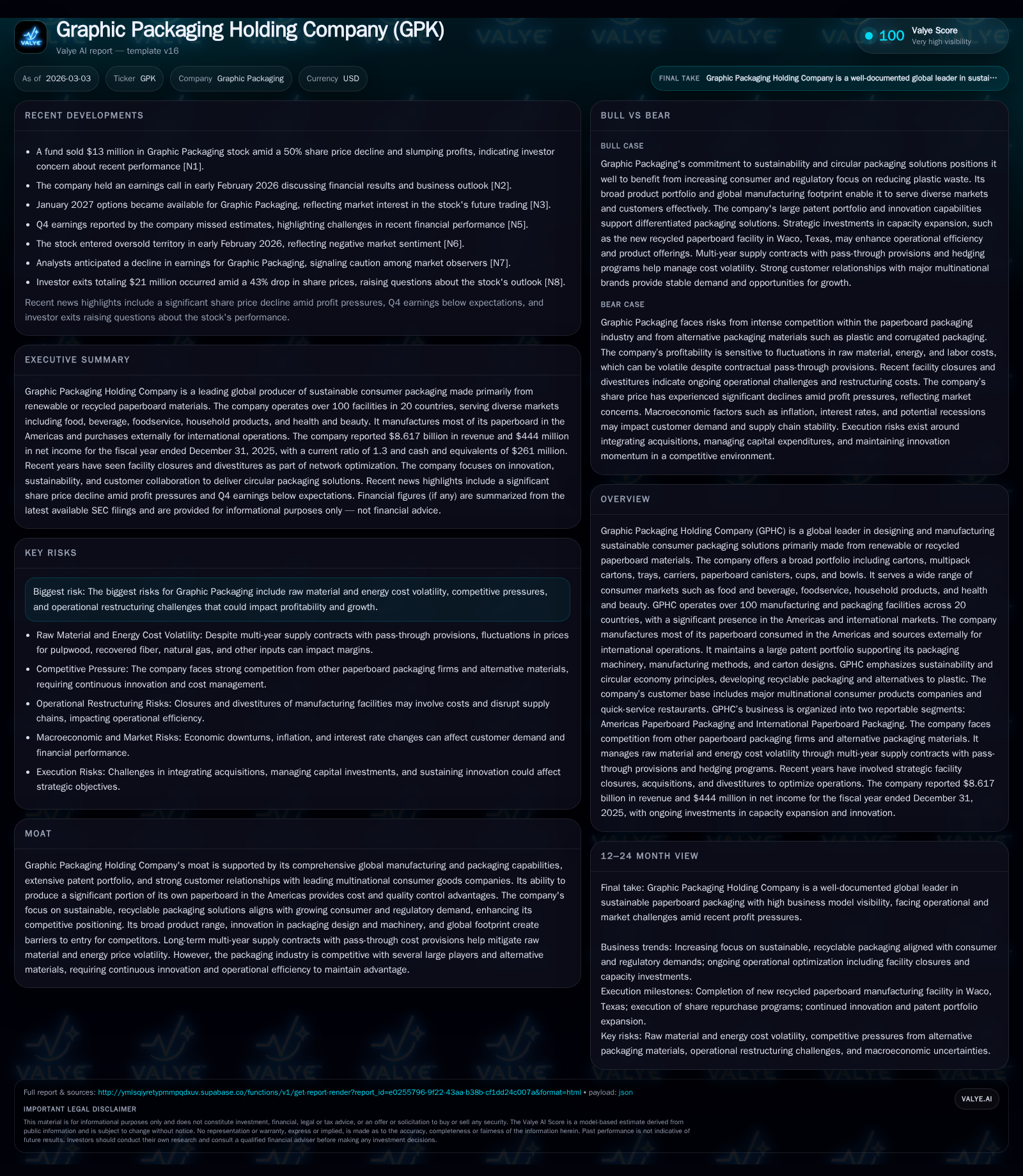
Graphic Packaging Holding Company stands as a global leader in renewable paperboard consumer packaging, leveraging vertical integration and a vast innovation portfolio. However, after years of solid growth driven by sustainable demand and capacity expansions, the company faced earnings pressure in 2025 stemming from raw material cost volatility and restructuring initiatives including facility closures. Its strategic recalibration involves consolidating operations, emphasizing circular economy principles, and managing capital prudently within amended credit agreements that restrict buybacks and acquisitions. Investors should watch upcoming debt covenant milestones and operational efficiency improvements as indicators of turnaround progress.
Corporate Overview: Sustainable Packaging with Global Scale
Graphic Packaging Holding Company (GPHC) is a foremost global player specializing in designing and manufacturing sustainable consumer packaging primarily made from renewable or recycled paperboard materials [S1]. Its product suite spans cartons, multipack cartons, trays, carriers, canisters, cups, and bowls serving diverse markets such as food & beverage, foodservice, household products, health, and beauty sectors. The firm operates over 100 manufacturing sites across 20 countries—predominantly in the Americas where it vertically integrates by producing most of the paperboard it consumes. This vertical integration provides cost control advantages and consistent quality output critical for global supply chains [S1]. GPK embraces circular economy principles through its focus on recyclable designs and collaboration along the value chain to bolster end-consumer recycling.
The company’s substantial patent portfolio underpins proprietary packaging machinery innovations, manufacturing methods, and carton designs that enable tailored customer solutions enhancing brand position. Its competitive landscape features both large-scale paperboard competitors like Smurfit WestRock plc and alternative-plastic-packaging providers [S21], yet GPK differentiates itself through integrated manufacturing capabilities combined with a sustainability-centric product roadmap.
Historical Financial Trends and Key Drivers Through 2025
Over recent years, Graphic Packaging experienced gradual revenue erosion linked to divestitures—most notably the sale of its Augusta bleached paperboard facility for $711 million in mid-2024—and market dynamics tightening margins [F1][S1]. The table below summarizes key annual financials from FY2022 through FY2025:
Historical performance (annual)
| FY | Rev ($bn) | Net ($mm) | CFO ($mm) | OpInc ($mm) | Rev YoY | Net YoY |
|---|---|---|---|---|---|---|
| 2025 | 8.6 | 444 | 841 | 804 | -2.2% | -32.5% |
| 2024 | 8.8 | 658 | 840 | 1119 | -6.6% | -9.0% |
| 2023 | 9.4 | 723 | 1144 | 1174 | -0.1% | +38.5% |
| 2022 | 9.4 | 522 | 1090 | 906 |
Source: SEC companyfacts cache [F1].
Capital returns and efficiency (annual)
| FY | Div ($mm) | Buybacks ($mm) | ROE% |
|---|---|---|---|
| 2025 | 128 | 150 | 13.3 |
| 2024 | 122 | 200 | 21.8 |
| 2023 | 123 | 54 | 26.0 |
| 2022 | 92 | 28 | 24.3 |
Source: SEC companyfacts cache [F1].
Capital expenditure figures for prior years are not fully comparable; the sharp increase in capex in FY2025 is driven by investments such as the Waco recycled paperboard plant construction [S12].
The revenue decline in 2025 primarily reflected divestiture impacts plus softer demand conditions highlighted on recent earnings calls [N1][N2]. A pronounced operating income decline exposes margin pressures exacerbated by raw material input cost surges despite pass-through contract terms designed to absorb such volatility [S1]. Net income contraction follows suit partially due to higher interest expenses [F1][S10]. Nonetheless, operating cash flow remained resilient near flat year-over-year despite profitability drops owing partly to effective working capital management.
Operational Rationalization: Facility Closures and Portfolio Streamlining
As part of ongoing capacity rationalization efforts responding to competitive pricing pressures and input cost inflation cycles, Graphic Packaging permanently shuttered its Middletown recycled paperboard mill in Ohio (May 2025) followed by closure of East Angus, Québec mill in December 2025 [S1]. These moves complement past closures including packaging plants consolidated into other facilities during the prior years aiming to enhance operational efficiency [S1][S18].
Such production consolidation reduces overhead complexity while maintaining scale but challenges volume throughput until new facilities ramp—such as their strategically large-capacity recycled fiber plant under construction at Waco Texas [S12]. These rationalizations also meet strategic targets linked to product portfolio refinement matching evolving customer sustainability and functionality demands.
Sustainability as a Competitive Moat Amid Industry Cost Volatility
Graphic Packaging’s emphasis on "circularity" ensures packaging solutions are designed for recyclability—a selling point increasingly mandated by regulators and demanded by consumers globally [S1]. The company's strategy to self-manufacture much of its paperboard consumed in the Americas enables direct control over one of the most volatile cost inputs—fiber prices—mitigating exposure compared with relying wholly on third-party suppliers [S1][N1].
Multi-year supply contracts include pass-through provisions that adjust pricing based on raw material and energy costs ensuring reduced margin erosion during commodity price spikes [S1]. This contractual architecture helps stabilize EBITDA margins in an otherwise cyclical sector exposed heavily to pulp fiber prices, natural gas costs for drying processes, and logistic inflation [N2]. The patent-protected machinery innovations provide technical barriers that protect execution from lower-cost competitors using simpler equipment.
Growth Outlook: Innovation, Market Expansion, and Customer Partnerships
Future growth hinges on deepening collaborations extending beyond purchasing functions into brand management teams across customers—a trend noted explicitly during recent earnings commentary highlighting increased customization for brand activation via functional convenience attributes like easy-open features or moisture barrier improvements [N1][N2][S1].
Expansion into emerging geographic markets complements steady growth niches within health & beauty segments where packaging differentiation remains essential amid tightening regulatory requirements on recyclability.
Moreover, continued innovation portfolios target new substrate blends leveraging recycled content while balancing performance durability versus linear plastic alternatives positioning GPK favorably versus peers resisting transition pressures.
Financial Expectations and What to Watch in Coming Quarters
Near-term earnings remain challenged by demand softness coinciding with macroeconomic uncertainties cited on Q4'25 results calls alongside elevated input costs not yet fully recouped through pricing tiers [N3][N4]. Additionally noteworthy is the February 26 amendment increasing maximum Consolidated Total Leverage Ratio temporarily allowing up to 5.0x through end-2026 but introducing tiered pricing penalties for leverage above thresholds ≥4.75x plus limiting share repurchases capped at $65 million annually through September 2027—a constraint altering prior capital return flexibility significantly [S4][S18].
Monitoring covenant compliance closely alongside early benefits realized from operational restructuring will serve as interim indicators regarding margin stabilization trajectories amidst high inflationary backdrops.
Capital Allocation Priorities: Debt, Dividends, and Buyback Dynamics
Graphic Packaging delivered approximately $841 million operating cash flow consistent with prior year levels despite revenue contraction during fiscal year ending December 31 2025; however its aggressive capex spend totaling an estimated $922 million—up over fifty percent year-over-year—is driven largely by major capacity addition projects exemplified by the new Waco facility construction supporting long-term recycled fiber volume growth [F1][S12]. The resulting free cash flow after capex is about $462 million suggesting moderate reinvestment capacity alongside debt service commitments.
Return on equity approximated a robust ~13.3%, reflective of improving capital base from accumulated equity growth notwithstanding profit declines [F1]. Dividend payments increased slightly reaching $128 million while share repurchases moderated to $150 million due mainly to restrictive covenant terms imposed under amended credit facilities constraining discretionary capital outflows aimed at deleveraging or balance sheet preservation rather than aggressive buybacks seen previously [F1][S18][N3].
These deliberate capital allocation shifts underscore balancing shareholder returns while shoring up liquidity amid uncertain macroeconomic horizons requiring operational agility.
Risk Factors: Material Inputs, Competitive Pressures, and Potential Impairments
Key risks remain centered around raw material feedstock volatility especially in recycled fiber markets susceptible to geopolitical impacts affecting supply-demand balances exacerbated by energy cost fluctuations critical for drying/manufacturing processes which influence overall cost structures directly impacting margins [S11][N2].
Competitive dynamics are intense given multiple broad-based packaging providers integrating plastics or bio-materials presenting alternatives potentially encroaching on traditional paperboard demand though regulatory trends favor greener substrates offering partial mitigation [S21].
Goodwill totaled over $2 billion distributed across reporting units—with fair value presently exceeding carrying values narrowly especially within international operations where excess fair value is about only ~2%. The sensitivity analysis disclosed highlights that relatively modest adverse shifts (+100 bps discount rate or EBITDA multiple compression) could trigger impairment charges emphasizing financial fragility if projections materially underperform or stock price declines persistently weaken market capitalization underpinning fair value judgments [S11][S20].
From an environmental standpoint several historic sites remain under investigation/remediation obligations though provisions currently considered adequate barring unforeseen liabilities large enough to perturb consolidated financials meaningfully [S11].
This analysis strictly synthesizes documented financial data combined with company disclosures without expressing investment advice or price views. Readers should consider evolving market conditions affecting future outcomes beyond currently available public information.
Disclaimer: This is research-only, informational analysis and not investment advice. It may include AI-generated interpretation and general industry context. Always verify important details using primary sources.

Comments