
Grindr Inc.’s Expansion into Telehealth and Premium AI Tiers Boost User Engagement
Grindr leverages technology innovation and community focus to drive growth in users, revenues, and profitability as it advances health services and AI capabilities.
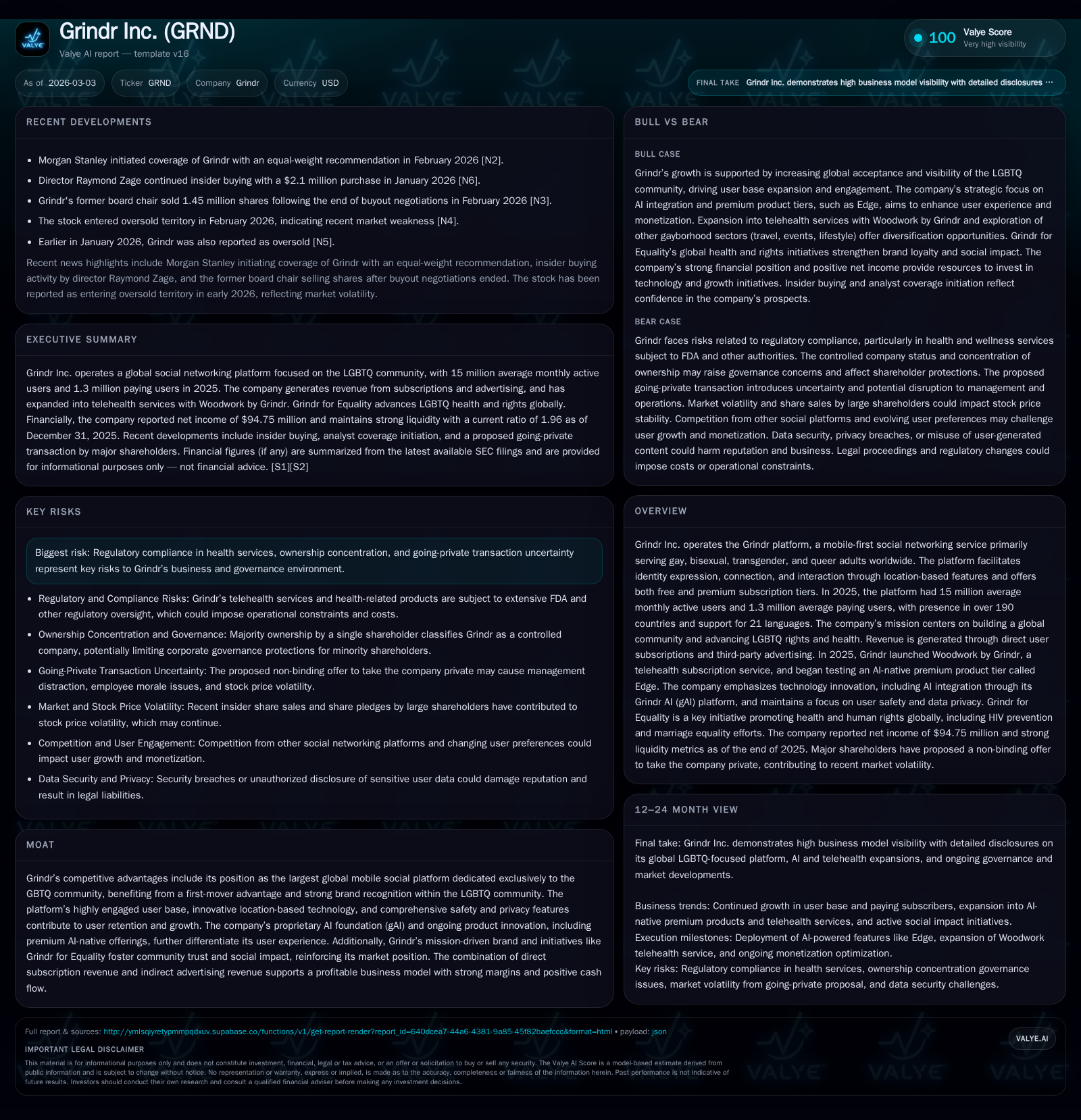
Grindr Inc. demonstrated strong growth in 2025, expanding its active and paying user base while launching Woodwork, a telehealth subscription service, and testing AI-driven premium tiers. The company reported sizable operating income and net profit increases, supported by efficient operations and robust cash flow generation. Regulatory risks related to health services and data privacy, along with governance dynamics stemming from ownership concentration, represent key challenges that could impact future momentum. Monitoring adoption of new AI products and regulatory developments will be critical to assessing Grindr's ongoing expansion beyond social networking.
Grindr's Journey: Evolution of User Base and Revenue Streams Through 2025
Historical performance (annual)
| FY | Net ($mm) | CFO ($mm) | OpInc ($mm) | Capex ($) | Net YoY |
|---|---|---|---|---|---|
| 2025 | 95 | 142 | 126 | 746000 | +172.3% |
| 2024 | -131 | 95 | 93 | 945000 | -134.9% |
| 2023 | -56 | 36 | 55 | 509000 | -6645.5% |
| 2022 | 1 | 51 | 13 | 430000 |
Source: SEC companyfacts cache [F1].
Capital returns and efficiency (annual)
| FY | FCF ($mm) |
|---|---|
| 2025 | 141 |
| 2024 | 94 |
| 2023 | 36 |
| 2022 | 50 |
Source: SEC companyfacts cache [F1].
Grindr has steadily grown its core social networking platform serving the global gay, bisexual, transgender, and queer (GBTQ) community. The platform reported an increase in average monthly active users (MAUs) from 14.2 million in 2024 to 15 million in 2025—a rise of approximately 5.2% year-over-year [F1], [S1], [S8]. Paying subscribers expanded at a faster rate: from roughly 1.1 million in 2024 to 1.3 million in 2025 (16.9% growth). This dynamic reflects deeper engagement driven by location-based technologies enabling refined search filters and real-time user interactions.
Grindr’s revenue streams historically balance direct subscription fees from premium users with indirect income from third-party advertising targeting this highly desirable demographic segment [S8]. The platform's presence across over 190 countries with support for more than two dozen languages underscores a global footprint benefiting from first-mover advantage within the LGBTQ market space.
In May 2025, Grindr strategically expanded beyond traditional social networking by launching Woodwork by Grindr—a telehealth subscription initiative focused initially on enabling access to certain treatments and compounded medications tailored for LGBTQ health needs [S16], [S20]. This diversification signals a shift towards embedding comprehensive wellbeing services within the digital gayborhood ecosystem.
Unpacking the Drivers Behind Grindr’s Significant Operating Income Growth
The company's financial trajectory shows marked improvement with operating income reaching approximately $126 million in fiscal year 2025—up a robust 36.4% compared to $92.6 million the prior year [F1]. After years of net losses ($131 million loss in FY24), Grindr swung to a positive net income of nearly $95 million in FY25—a gain of over 170% year-over-year [F1].
Strong operational cash flow generation also underpinned this transformation: cash flow from operations rose close to 49% YoY reaching about $142 million [F1]. Capital expenditures remained modest at under $1 million annually, suggesting capital-light scaling largely fueled by software enhancements rather than heavy infrastructure investment [F1]. These financially efficient results were likely supported by growing ARPU driven by premium subscription tier expansions alongside enhanced monetization of advertising demand globally.
Innovation Focus: AI Integration and the Launch of Woodwork Telehealth Service
Technological innovation sits at the heart of Grindr’s latest product roadmap. The company has developed gAI—a proprietary AI foundation encompassing integrated data models, technical architecture layers, and consumer-facing application components—to enable differentiated user experiences unavailable on generic platforms [S8], [S20].
In late 2025, Grindr began testing "Edge," an AI-native premium tier intended to aggregate advanced capabilities such as location-based real-time recommendation filters tailored dynamically based on user intent for dating or social discovery [N2], [S8], [S15], [S20]. Edge represents a vertical integration of AI/ML within subscription offerings aiming to deepen monetization leverage on top of existing paid features.
Meanwhile, Woodwork positions Grindr as a pioneer among niche health service providers embedded inside social apps. Powered clinically through OpenLoop Health Inc., Woodwork delivers telehealth access focused on compounded medication options regulated under U.S. FDA provisions (Section 503A/503B), offering care pathways that respect the complexity around LGBTQ health requirements including off-label treatments [S16], [S17], [S20].
Together these initiatives reflect an ambitious mission-aligned endeavor not only to connect individuals but also address critical health disparities using cutting-edge digital tools.
Opportunity and Boundaries: Regulatory Risks in Health and Data Privacy Services
Grindr operates under heightened regulatory scrutiny across both its telehealth ventures and data privacy domains. Healthcare-related products face enforcement risks tied to FDA compliance over compounded drugs safety standards plus myriad federal/state laws governing medical licensing and telehealth practice scope [S6], [S14], [S17]. Moreover, potential penalties carry risks ranging from injunctions to exclusion from government health programs.
Simultaneously, data privacy obligations span U.S. state laws like California's CCPA alongside international regulations including GDPR regimes applicable in Europe and select foreign markets where user bases are significant [S7], [S11]. These frameworks impose demands for transparency, consent management, breach notification protocols, and restrict targeted advertising practices—aspects central to Grindr’s direct-to-consumer business model.
In response, the company maintains a detailed cybersecurity risk management apparatus led by an experienced Chief Information Security Officer reporting directly into executive leadership with regular briefings to the Audit Committee overseeing threat mitigation policies [S1]. A formalized Privacy & Security Council convenes frequently to adapt policies amid fast-evolving legal obligations.
Despite these efforts, liabilities arising from user-generated content infractions or inadvertent data disclosures remain persistent concerns given the sensitive nature of user profiles and global jurisdictional complexities [S4], [S5], [S9]. This regulatory landscape constrains unrestrained product rollout speed but also elevates trustworthiness as a key brand differentiator.
Governance Dynamics Under Ownership Concentration and Stockholder Moves
As of September 2025, G. Raymond Zage III consolidated beneficial ownership exceeding 50% of outstanding common stock through significant share repurchase programs effectively rendering Grindr a "controlled company" per New York Stock Exchange rules [S2], [S19]. This status provides discretion regarding corporate governance mandates such as board independence composition or establishment of fully independent compensation committees.
While Grindr has not elected available exemptions yet—maintaining a practice aligned with standard governance expectations—the high ownership concentration concentrates decision-making power predominantly within Mr. Zage’s influence sphere potentially limiting minority shareholder protections or input into strategic choices [N3], [N2], [S2].
Adding complexity is recent insider selling activity following failed buyout negotiations initiated by top shareholders including Mr. Zage’s former board chair colleague James Fu Bin Lu; such liquidity events may prompt temporary volatility or heighten scrutiny around potential future privatization attempts or ownership restructurings impacting management continuity and market perception risk profiles [N3], [N2].
Financial Outlook: What Indicators to Monitor Ahead
Absent explicit forward guidance disclosures,[N3],[N4],[S3] key milestones warranting close attention include:
- Market adoption rates for Edge AI-enabled premium offerings which represent a test case for deepening paid user engagement;
- Expansion velocity of Woodwork’s telehealth subscriptions internationally amid varying healthcare regulatory acceptance;
- Regulatory outcomes concerning compounded drug approvals or privacy enforcement actions that could recalibrate operational flexibility;
- Potential developments around going-private proposals or associated financing arrangements given current shareholder control dynamics. Analyzing these indicators will deliver insights into Grindr’s capacity to sustain profitable growth while navigating evolving technological opportunities against rising compliance imperatives.
Capital Allocation Strategy: Cash Flows, Dividend Policies, and Buyback Insights
Grindr’s capital structure reflects a leverage profile supported by recent refinancing activities culminating in extended maturity terms for term loans ($400 million facility) and revolving credit ($200 million facility) arranged with JPMorgan Chase Bank as agent per late-2025 amendments [S13], [S23]. Operating cash flows robustly exceeded capex requirements resulting in free cash flow approximating $141 million during fiscal year 2025—facilitating reinvestment into R&D initiatives such as AI development without pressuring liquidity reserves which stood near $87 million at year-end [F1].
Despite solid profitability metrics featuring large net income turnaround [$95M net profit vs sizable prior period losses][F1], ROE remains depressed reflecting negative equity historically carried by the company somewhat skewed due to legacy accumulated deficits (approximate ROE -261%)—a distortion common among high-growth digital platform companies moving toward normalized earnings over time rather than immediate equity returns balance sheet-centred measures should thus be interpreted cautiously here.[F1]
The firm currently does not declare dividends nor has it announced formal share repurchase programs post-repurchase executed before Q4 ‘25; capital allocation appears focused primarily on organic innovation funding aligning tightly with mission-critical expansion avenues rather than return-of-capital distribution at present[S13],[S23]. Ownership concentration further implies capital redeployment decisions concentrated internally limiting traditional public market signal influences.
This analysis is based solely on publicly disclosed financial statements and regulatory filings up to March 2026 as well as recent authoritative news sources specified herein. It aims exclusively to illuminate Grindr Inc.’s operational trends, strategic pivoting toward health-focused offerings entwined with advanced AI capabilities amidst complex regulatory conditions without providing investment or trading advice.
Disclaimer: This is research-only, informational analysis and not investment advice. It may include AI-generated interpretation and general industry context. Always verify important details using primary sources.

Comments