
Goldman Sachs BDC Charts Mid-Market Lending Challenges and Returns in 2025
Goldman Sachs BDC experienced a notable decline in investment income in 2025, grappling with portfolio valuation volatility and regulatory constraints that shape its capital deployment and growth outlook.
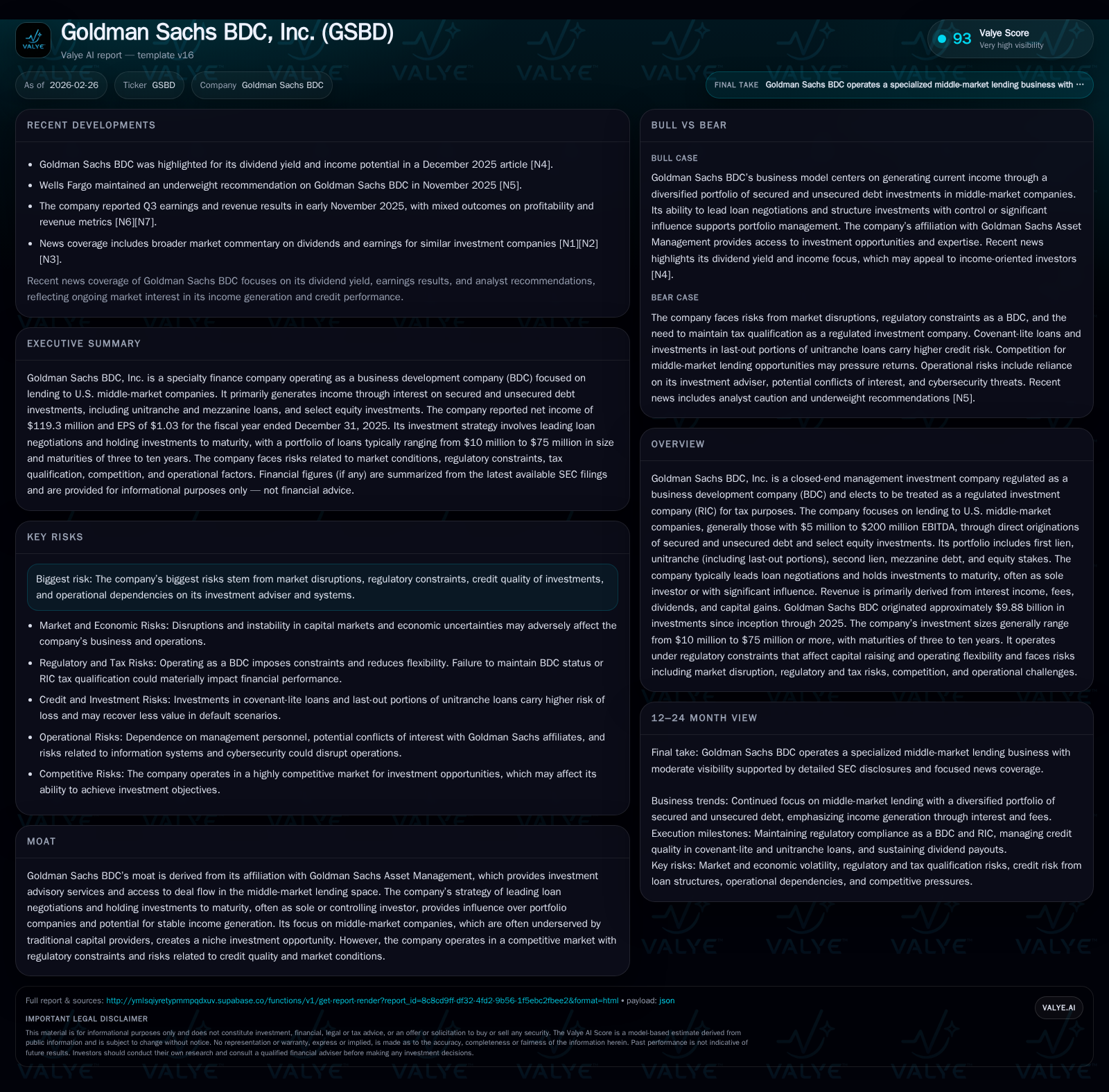
Goldman Sachs BDC, a specialist middle-market lender affiliated with Goldman Sachs Asset Management, reported a 16% year-over-year decline in total investment income to $366 million in 2025, alongside heightened unrealized losses impacting net income and net asset value. The company’s portfolio remains focused on secured and unsecured debt of U.S. middle-market firms, leveraging its strong deal flow and investment influence, yet faces headwinds from regulatory leverage limits and market credit risks. While dividend payments remain stable, capital allocation is cautious with limited buybacks amid operating cash flow fluctuations. Investors should monitor loan origination pace, credit performance trends, and potential impacts from recent debt refinancings and regulatory developments.
Investment Income Trends and Portfolio Valuation Dynamics in 2025
Goldman Sachs BDC's fiscal year 2025 results show total investment income declined by approximately 16%, from $434.37 million in 2024 to $365.57 million [S1][F1]. Net investment income after taxes also decreased from $252.55 million to $181.57 million during this period. This sharper decline reflects amortization of Purchase Discounts related to the October 2020 merger with GS MMLC, which continues to impact earnings through systematic adjustments over the life of acquired loans or upon disposition of equity investments [S1].
Net realized losses narrowed moderately while net unrealized losses increased due to ongoing market repricing of credit risk exposures. Adjusted net realized and unrealized losses were approximately -$59.6 million compared to -$184.48 million the prior year — an improvement but still a drag on overall returns [S1].
Portfolio Composition and Growth Outlook
Goldman Sachs BDC targets U.S. middle-market companies typically generating EBITDA between $5 million and $200 million [S1]. Its portfolio primarily consists of secured lending instruments including first lien loans (notably unitranche loans split into first-out/last-out tranches), second lien debt, mezzanine financings, and selective equity investments [S1]. The affiliation with Goldman Sachs Asset Management provides advantages such as premier deal flow access and leadership positions in loan syndications.
Despite these strengths, growth is tempered by regulatory leverage limits associated with BDC status that restrict borrowing capacity relative to assets under management [N3][S1]. Macroeconomic uncertainty and rising interest rates contribute additional challenges around credit quality, especially for covenant-lite loans which have fewer enforcement triggers.
Capital Structure and Debt Management
GSBD's capital structure centers on a Revolving Credit Facility with committed capacity of $1.695 billion, expandable up to $2.54 billion via an accordion feature [S4][S5]. As of December 31, 2025, outstanding borrowings were approximately $585.75 million USD equivalent spread across multiple currencies including EUR (€13.7M), GBP (£18.95M), CAD (C$52.27M), and AUD (A$24.5M) [S4]. Interest rates on USD borrowings are generally tied to Term SOFR plus margins ranging from about 1.75% to 2%, subject to credit rating maintenance or borrowing base conditions; similar terms apply for non-USD borrowings with currency-specific spreads [S4][S7].
In addition to revolver borrowings, GSBD issued unsecured notes including matured 2025 Notes at a coupon of 3.75%, as well as new $400 million notes due in 2030 bearing a fixed coupon of 5.65% [S8]. January 2026 saw issuance of another $400 million notes due January 2029 at a coupon of 5.10%, supported by hedging arrangements aligning fixed-rate liabilities with the floating-rate profile of the loan portfolio [S8][S20].
The asset coverage ratio stood near 175% at year-end 2025 — comfortably above the statutory minimum of 150% required for BDCs — enabling prudent leverage usage within regulatory bounds [S5][S19]. Currency exposures are managed through derivatives consistent with industry practice.
Dividend Policy and Capital Allocation
GSBD employs a dividend framework featuring quarterly base distributions supplemented by variable supplemental dividends contingent upon earnings tests approved each quarter [S9][S10]. Despite operating income pressures, cash distributions have remained stable.
No significant share repurchases occurred during 2025 despite authorization for up to $75 million under board-approved plans initiated mid-2024 continuing through mid-2026 [S9][S10][S24]. This conservative approach aligns with volatile operating cash flows which surged dramatically from roughly $2.46 million in FY24 to $325.68 million in FY25 — largely attributable to timing differences or nonrecurring working capital effects rather than steady-state operations alone [F1].
Return on equity based on net income over equity approximates an estimated ROE near 8.4% for fiscal year-end December 31, 2025 — indicating moderate profitability amid challenging market conditions [F1].
Risks Impacting Operations
Key risks detailed by GSBD include:
- Market disruptions affecting debt capital markets that may impair refinancing options or borrower creditworthiness.
- Regulatory constraints limiting leverage expansion or capital raising ability.
- Operational dependence on Goldman Sachs Asset Management for deal sourcing, portfolio management, risk oversight, and technology infrastructure.
- Cybersecurity threats or technology failures that could disrupt operations materially.
- Conflicts arising from shared interests within Goldman Sachs-affiliated entities potentially influencing deal allocations.
- Credit risks associated with covenant-lite loans and last-out unitranche positions carrying elevated loss severity potential under stress scenarios.
These factors highlight sensitivities that could materially affect NAV levels or distribution sustainability relative to broader private credit peers [S1].
Historical Performance Summary Table
Historical performance (annual)
| FY | CFO ($mm) |
|---|---|
| 2025 | 326 |
| 2024 | 2 |
| 2023 | 301 |
| 2022 | 27 |
Source: SEC companyfacts cache [F1].
Note: Operating cash flow volatility is largely driven by working capital timing effects; ROE calculated as net income divided by equity.
Investor Considerations Going Forward
Investors should closely monitor:
- Loan origination volumes as indicators of deal flow strength amid macroeconomic shifts.
- Credit loss provisioning trends reflecting emerging stresses within the portfolio.
- NAV per share movements adjusted for supplemental distributions given unrealized gain/loss volatility.
- Effects from recently issued unsecured notes including hedging performance.
- Regulatory developments potentially impacting leverage ceilings or tax treatment critical for growth plans.
- Sector insights from comparable BDCs such as SLR Investment (SLRC) or Gladstone Investment (GAIN) providing context for market-wide credit dynamics [N1][N2][N3].
GSBD’s position balances its privileged market niche supported by Goldman Sachs capabilities against macro headwinds compressing earnings stability and imposing structural growth limits.
This analysis is based exclusively on information available through SEC filings dated February 26, 2026 ([S#]) combined with validated financial data from official company disclosures ([F1]) alongside relevant recent industry news ([N#]). No speculative projections are included beyond explicit statements made by Goldman Sachs BDC representatives or regulatory documents.
Disclaimer: This is research-only, informational analysis and not investment advice. It may include AI-generated interpretation and general industry context. Always verify important details using primary sources.

Comments