
GT Biopharma Advances NK Cell Therapeutics Amid Growing Operating Loss and Capital Needs
Clinical-stage GT Biopharma makes progress in immuno-oncology trials while facing financial sustainability challenges.
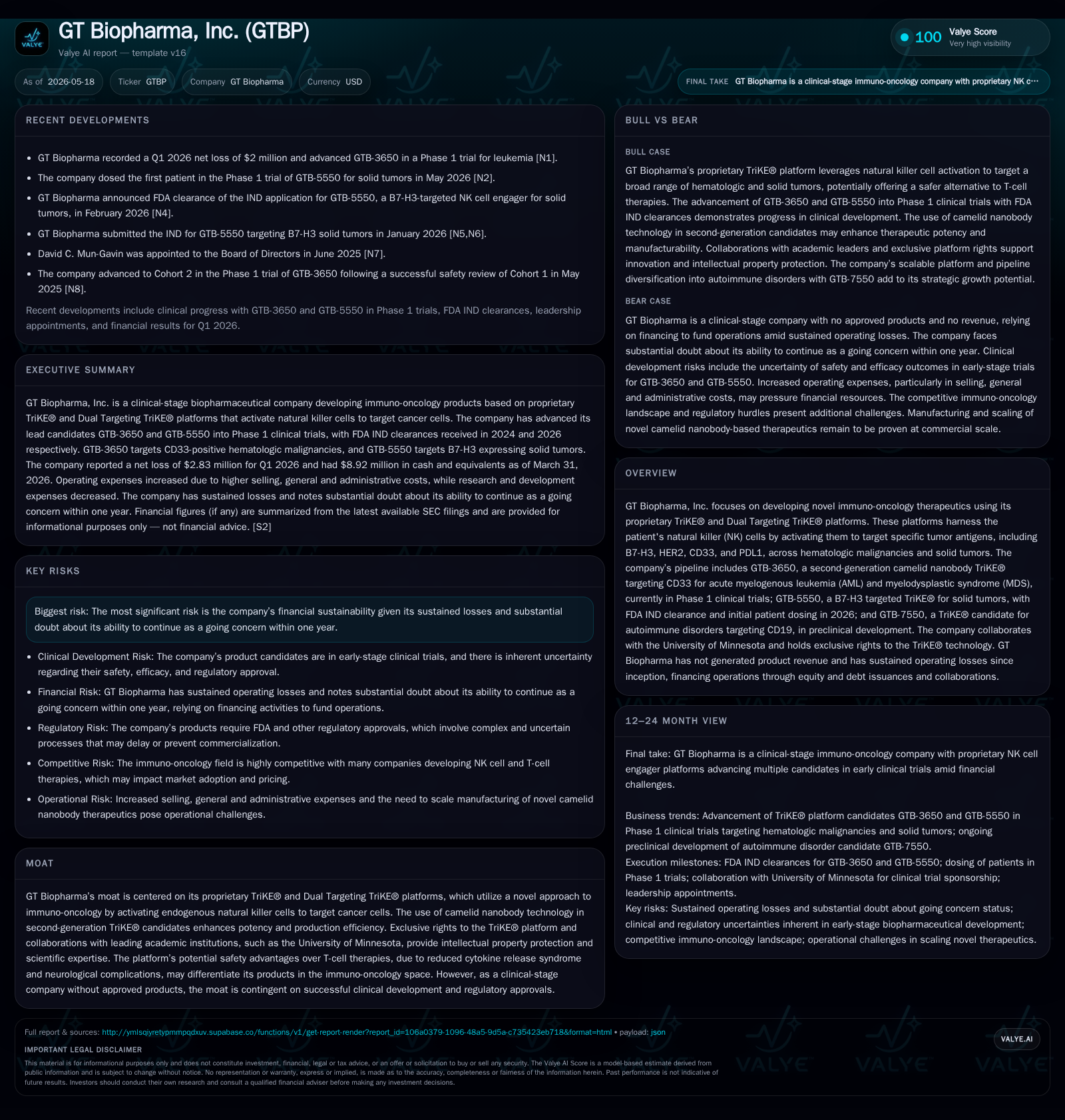
GT Biopharma, a clinical-stage biotech focused on novel immuno-oncology therapies leveraging its proprietary TriKE® platform, reported a net loss of $2.8 million for Q1 2026 and increased operating expenses mainly due to SG&A costs. The company advanced key product candidates GTB-3650 and GTB-5550 with ongoing Phase 1 studies targeting hematologic malignancies and solid tumors, respectively. Despite scientific promise and unique NK cell engager technology, financial sustainability remains a concern given continued losses and limited cash runway. Future milestones include dose escalation data from ongoing trials and potential collaborations to broaden development and commercial pathways.
Recent Operating Update
GT Biopharma’s latest quarterly report for Q1 ended March 31, 2026 ([S2], [F1]) reveals a net loss of approximately $2.8 million compared to $0.8 million during the same period last year. The loss escalation stems primarily from a sharp increase in selling, general and administrative (SG&A) expenses — rising nearly $1.6 million year-over-year — alongside a reduction in research and development (R&D) costs reflecting prudence in production expenses during rapid clinical progression ([S6]). Notably, R&D expense fell by 62%, indicating initial clinical costs may be stabilizing as programs advance beyond early manufacturing hurdles.
Cash and cash equivalents stood at roughly $8.9 million at quarter end with current assets totaling $10 million against liabilities of $2.4 million, yielding a healthy current ratio of 4.14 that suggests the company can meet near-term obligations without immediate distress ([F1]). However, the Q1 burn rate of roughly $2.5 million in operating cash flow implies the firm will need additional financing within the next several quarters absent significant revenue or strategic partnership inflows ([S4], [S5]). Management continues to disclose "substantial doubt" about going concern viability within one year based on operating losses and limited commercialization progress ([S7]).
Progress continues on two pivotal clinical candidates: GTB-3650 and GTB-5550 ([S25]). GTB-3650 is a second-generation TriKE® therapeutic employing camelid nanobody technology targeting CD33-positive acute myelogenous leukemia (AML) and myelodysplastic syndrome (MDS). Its Phase 1 trial began enrollment in early 2025 with approximately half the target patient population dosed as of early Q2 2026 ([N1]). Meanwhile, GTB-5550 targets the immune checkpoint ligand B7-H3 present on multiple solid tumors; it advanced through FDA IND clearance in early January 2026 with initial patient dosing executed in May 2026 ([N2], [S25]). These milestones mark important inflection points validating the platform’s flexibility across hematologic malignancies and solid tumors.
GTB-7550, still preclinical, is intended for autoimmune diseases such as lupus by targeting CD19-positive B-cells — positioning GT Biopharma into the wider immunology arena beyond oncology ([S25]).
Business Model
The core of GT Biopharma’s business lies in its proprietary Tri-specific Killer Engager (TriKE®) and Dual Targeting TriKE® platforms that develop recombinant fusion proteins designed to engage natural killer (NK) cells to eliminate cancer cells ([S1], [S2]). These fusion proteins bind simultaneously to CD16 receptors on endogenous NK cells and tumor-associated antigens such as CD33 or B7-H3 on malignant cells while also delivering an IL-15 cytokine signal that promotes NK cell proliferation.
Unlike many T-cell based immunotherapies requiring complex ex vivo cell manipulation or patient customization, the TriKE® platform leverages innate immune effectors without personalized manufacturing — potentially offering scalability advantages ([S1]). Therapeutics are envisioned both as monotherapies or combination agents alongside standard-of-care regimens.
Revenue generation remains distant since no product has yet received approval; current expenditures reflect R&D activities toward investigational new drug (IND)-enabling studies, clinical trials management, patent licenses (notably from University of Minnesota), and manufacturing outsourcing ([S1], [S2], [F1]). The company lacks internal clinical or commercial manufacturing capabilities relying fully on third-party contract manufacturers like Cytovance Biologics for production scale-up when necessary ([S1]). Intellectual property rights secured through exclusive agreements protect core technology.
Industry Structure and Competitive Position
GT Biopharma operates within the highly competitive immuno-oncology sector characterized by multiple approaches including checkpoint inhibitors (PD-1/PD-L1), CAR-T cell therapy, bispecific antibodies, and NK cell engaging platforms.
The company’s distinguishing factor is its focus on endogenous NK cell activation via multi-specific fusion proteins utilizing camelid nanobody engineering which may confer potency improvements over first-generation prototypes (). Reduced incidence of cytokine release syndrome (CRS) relative to T-cell therapies is cited as a potential safety moat that could ease adoption barriers if efficacy translates clinically ([S1], [S2]).
Much larger peers with approved immunotherapies possess substantially greater resources for late-stage development, commercialization infrastructure, and broader indication coverage but face challenges related to toxicity management and manufacturing complexity — areas where GT Bio’s approach could carve niches.
As a clinical-stage player without revenues or marketed products yet, competitiveness hinges critically on achieving robust phase advancement milestones coupled with favorable safety-efficacy profiles.
Growth Drivers
Clinical Progression
Key near-term growth catalysts center around successful dose escalation studies for lead candidates GTB-3650 in AML/MDS patients and GTB-5550 across various B7-H3-expressing solid tumors currently enrolling post-IND clearances ([N1], [N2], [S25]). Positive efficacy trends or safety signals could unlock partnerships or raise capital under better terms.
Platform Expandability
The modular TriKE ® design enables targeting diverse tumor-associated antigens by swapping scFv components or camelid nanobodies adapting quickly to different oncology targets or autoimmune indications such as GTB-7550's focus on CD19+ B-cells ([S25]). Scalability in IND-ready moiety production ensures faster pipeline generation.
Collaboration Potential
Partnerships with academic centers like University of Minnesota contribute scientific expertise and IP support while external collaborations remain plausible for co-developing certain indications or improving manufacturing throughput, both critical for expanding trial scale or commercial launching capability ([S1]).
Risks / Watchpoints / Growth Constraints
Financial Sustainability
Clinical Trial Risk
As a nascent technology entering rigorous clinical testing phases, unexpected safety issues, lack of efficacy signals or regulatory hurdles could delay timeline extensions or require costly trial redesigns impeding growth expectations.
Manufacturing Dependence & Scale-Up Risk
Absence of internal GMP-compliant manufacturing restricts control over production quality/timelines relying heavily on outside contractors who must meet stringent bioprocess standards typical for protein biologics — any disruptions could delay supply needed for trials or eventual commercialization ([S1]).
Competitive Landscape Intensification
Large biotech firms continue aggressive development of CAR-Ts and bispecific antibodies targeting similar cancers which may eclipse smaller firms unless differentiation through safety/effectiveness materializes clearly.
What To Watch Next
- Patient enrollment rates and completion percentages for Phase 1 trials of GTB-3650 in hematologic cancers.
- Dose escalation outcomes especially safety/tolerability profiles which will dictate advancement into later phases.
- Early biomarker response data from the May-started Phase 1 basket trial of GTB-5550 across solid tumors.
- Updates on preclinical pipeline candidate GTB-7550 aimed at autoimmune diseases including manufacturing partner announcements.
- Strategic alliances announcements or licensing deals that enhance balance sheet strength or provide new R&D funding sources.
- Capital raise activities prompted by quarterly cash burn trends impacting runway projections.
Financial Profile Summary
As of Q1 2026 reporting period ending March 31, cash & equivalents totaled approximately $8.9 million supported by current assets near $10 million against liabilities around $2.4 million resulting in a strong current ratio exceeding 4x indicating a liquidity cushion adequate for short-term obligations but tight relative to operational burn rates ([F1], [S4], [S5]). Operating loss widened sharply to nearly $2.8 million compared with prior year due primarily to elevated SG&A expenses associated with increased legal fees and marketing efforts concomitant with late-stage trial advancement ([S6]). The lack of top-line revenue continues typical for clinical-stage biopharmas pre-commercialization stages although sustained quarterly losses emphasize reliance on fundraising to maintain operations amid developmental progress uncertainties.
Disclaimer: This analysis is based exclusively on publicly available information including SEC filings and news releases up to mid-May 2026. It does not constitute investment advice or research views but aims solely to provide an informed industry perspective on recent developments associated with GT Biopharma’s business model, competitive landscape, pipelines, financial status, risks, and upcoming milestones.
Disclaimer: This is research-only, informational analysis and not investment advice. It may include AI-generated interpretation and general industry context. Always verify important details using primary sources.

Comments