
GBT Technologies Reports Q1 Losses While Scaling AI Wellness Devices and Launching Cube X Media
The company faces significant liquidity challenges as it invests in campus wellness machine rollouts and develops a new digital media platform amid continued operating losses.
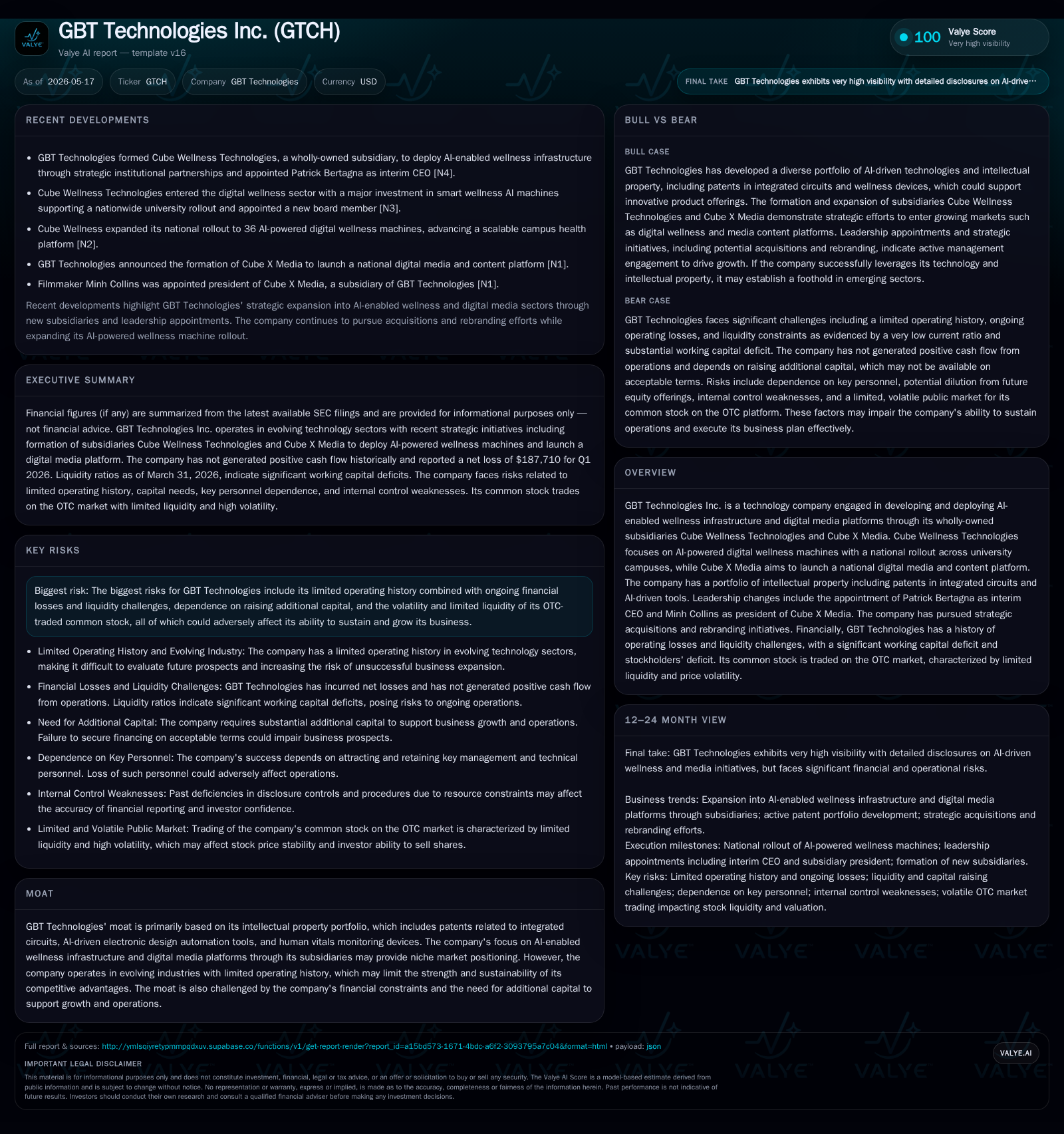
GBT Technologies Inc. reported continued net losses in Q1 2026, reflecting challenges in scaling its AI-driven wellness infrastructure and newly launched digital media subsidiary. The company operates chiefly through its subsidiaries Cube Wellness Technologies, targeting campus rollouts of wellness machines, and Cube X Media, focusing on digital advertising and content platforms. Despite a robust intellectual property portfolio, GBT faces critical liquidity constraints with a stark working capital deficit and reliance on capital raises. Its competitive moat is niche but overshadowed by financial fragility, making execution and adequate funding the main hurdles for profitable growth.
Recent Operating Update
In its latest quarterly filing dated May 15, 2026 ([S2]), GBT Technologies disclosed another quarter marked by continuing operating losses—the company recorded a net loss of $187,710 for the three months ended March 31, 2026. This update underscores ongoing negative cash flow dynamics; GBT has yet to generate positive cash flow from operations since inception. Despite these financial headwinds, management highlighted strategic progress including expansion efforts across its key business segments: AI-enabled wellness machines through Cube Wellness Technologies and the establishment of Cube X Media aimed at national digital media platforms ([S3],[N1],[N2]).
Notably, leadership changes were implemented early April 2026 with Patrick Bertagna serving as interim CEO while filmmaker Minh Collins was appointed president of Cube X Media subsidiary to intensify focus on content creation and digital advertising ventures ([S3],[N2]).
Business Model
GBT Technologies operates primarily through two wholly-owned subsidiaries: Cube Wellness Technologies and Cube X Media.
Cube Wellness Technologies develops AI-powered digital wellness machines designed to offer personalized health monitoring in public venues such as university campuses. The company aims for a national rollout attempting to tap into growing interest in preventive health tech accessible in community settings. Revenue streams here potentially derive from sales or leases of hardware devices combined with ancillary software services powering the AI-driven vitals monitoring tools. Margins are likely constrained currently by early-stage deployment costs and R&D expenditures.
Cube X Media represents GBT’s foray into digital content creation and advertising targeted toward capturing audiences via their interactive machine network. This subsidiary manages the development of targeted campaigns along with original short-form video series intended for vertical market segments. Revenue mechanisms consist mainly of advertising sales and content licensing within this nascent but fast-evolving media niche.
Device installation volume directly drives revenue potential at Cube Wellness Technologies by increasing the footprint for data gathering and user engagement that also enhances the media platform’s value proposition at Cube X. Both businesses remain heavily dependent on product development progress, client acquisition (e.g., universities), customer retention, and scaled technological infrastructure.
Industry Structure and Competitive Position
GBT operates within intersecting yet complex industries: AI-enabled health monitoring infrastructure intersects with digital health trends while Cube X Media engages a competitive digital advertising ecosystem that includes large incumbents as well as emerging niche platforms.
The company's intellectual property portfolio includes patents on integrated circuits tailored for electronic design automation (EDA) as well as human vitals monitoring devices driven by AI algorithms ([S1]). These assets provide some technological moat enabling a differentiated product offering against commoditized health kiosks or generic media platforms.
However, the industry is nascent with evolving consumer adoption patterns—especially around public acceptance of AI-powered wellness devices—and competition from more established health tech firms or large-scale advertising entities complicates GBT's growth path.
Additionally, limited operating history constrains ability to build strong customer switching costs or scale network effects necessary to dominate either wellness infrastructure or digital media verticals ([S1],[S2]).
Growth Drivers
Key growth levers identified include:
- National Rollout Expansion: Accelerating deployment of wellness machines across more university campuses nationwide increases hardware unit volumes driving revenue growth for Cube Wellness Technologies ([N1],[S1]).
- Media Platform Launch: Building audience engagement through Cube X Media’s original content and advertising services provides upside via diversified revenue streams leveraging installed device base ([N1],[N2],[S3]).
- Acquisition Integration: The company’s past acquisitions aim to consolidate technology capabilities and market access; effective assimilation would improve operational scale ([S1]).
- Intellectual Property Utilization: Leveraging patented integrated circuits and AI algorithms to refine products strengthens competitive positioning potentially allowing premium pricing or unique features ([S1]).
- Management Focus: New leadership appointments focused on media programming may enhance growth execution in the content marketplace segment ([N2]).
Risks and Growth Constraints
GBT’s trajectory faces several substantial risks:
- Financial Fragility: Persistent operating losses coupled with working capital deficits exceeding $10 million (current ratio circa 0.01) curb flexibility; ongoing dependency on dilutive equity or restrictive debt financing poses execution risk ([S6],[F1]).
- Limited Operating History: Inability to reliably forecast financial outcomes given early-stage operations impairs strategic planning effectiveness ([S1],[S2]).
- Market Acceptance Uncertainty: Consumer trust in AI wellness technology deployed publicly remains unproven at scale; similarly digital content monetization may face fierce competition from entrenched players ([S1],[S2]).
- Human Capital Dependencies: Retention of key executives including CEO Bertagna is critical; loss of management talent could materially disrupt business operations ([S11],[S16]).
- Trading Market Illiquidity: OTC profile reduces stock liquidity impacting investor confidence and ability to raise future capital efficiently ([S15]).
- Regulatory and Technological Evolution: Rapidly changing standards in health tech regulation or advances by competitors could mandate costly pivots undermining current strategy ([S1]).
What to Watch Next
Investors should monitor several forthcoming indicators:
- Pace of additional campus installations by Cube Wellness Technologies.
- User engagement metrics from Cube X Media’s newly launched content platform reflecting ad monetization potential.
- Fundraising milestones given stated need to secure approximately $10–12 million annually for continued operations ([S6],[S16]).
- Progress reports on integration outcomes from concurrent acquisitions.
- Internal control enhancements relating to financial reporting accuracy noted as ongoing focus post prior disclosures ([S15],[S27],[S28]).
- Any management updates signaling turnover or restructuring impacting operational continuity.
Financial Profile Summary
Latest financial snapshot
| Metric | Value | Period |
|---|---|---|
| Current assets | $83922 | |
| 2026-03-31 | ||
| Current liabilities | $11mm | |
| 2026-03-31 | ||
| Current ratio | 0.01x | |
| 2026-03-31 |
Source: SEC companyfacts cache [F1].
GBT's latest available balance-sheet snapshots reveal current assets of approximately $83,922 against current liabilities near $10.7 million resulting in a kritical working capital deficit (> $10 million) reflecting significant liquidity constraints ([F1],[S2],[S6]). The company carries total debt estimated at roughly $3.75 million versus cash holdings around $93k yielding net debt close to $3.65 million ([F1]). The capital structure relies heavily on frequent equity issuance alongside convertible debt instruments per historical filings ([S7],[S11],[S16]).
Revenue recognition remains minimal with reported top-line around $90k (as of end 2022) emphasizing the early stage commercialization phase ([F1]). Operating losses persisted through fiscal year 2025 amounting to approximately -$315k with net losses near -$718k reinforcing the pre-profitability state ([F1],[S24],[S20]). These figures further confirm that profitability depends heavily on operational scaling alongside successful capital raising initiatives.
This analysis is based solely on publicly filed SEC documents dated up to May 15, 2026, supplemented by recent Nasdaq news releases referenced herein. All financial figures are cited explicitly from validated SEC sources or company facts database entries without extrapolation. No investment advice or price forecasts are offered.
Disclaimer: This is research-only, informational analysis and not investment advice. It may include AI-generated interpretation and general industry context. Always verify important details using primary sources.

Comments