
Gates Industrial Corp: Sustaining Growth Through Legacy Brand Strength and Aftermarket Excellence
Gates Industrial leverages its century-old premium reputation and diversified power transmission and fluid power offerings to deliver resilient recurring revenue amidst industrial cyclical challenges.
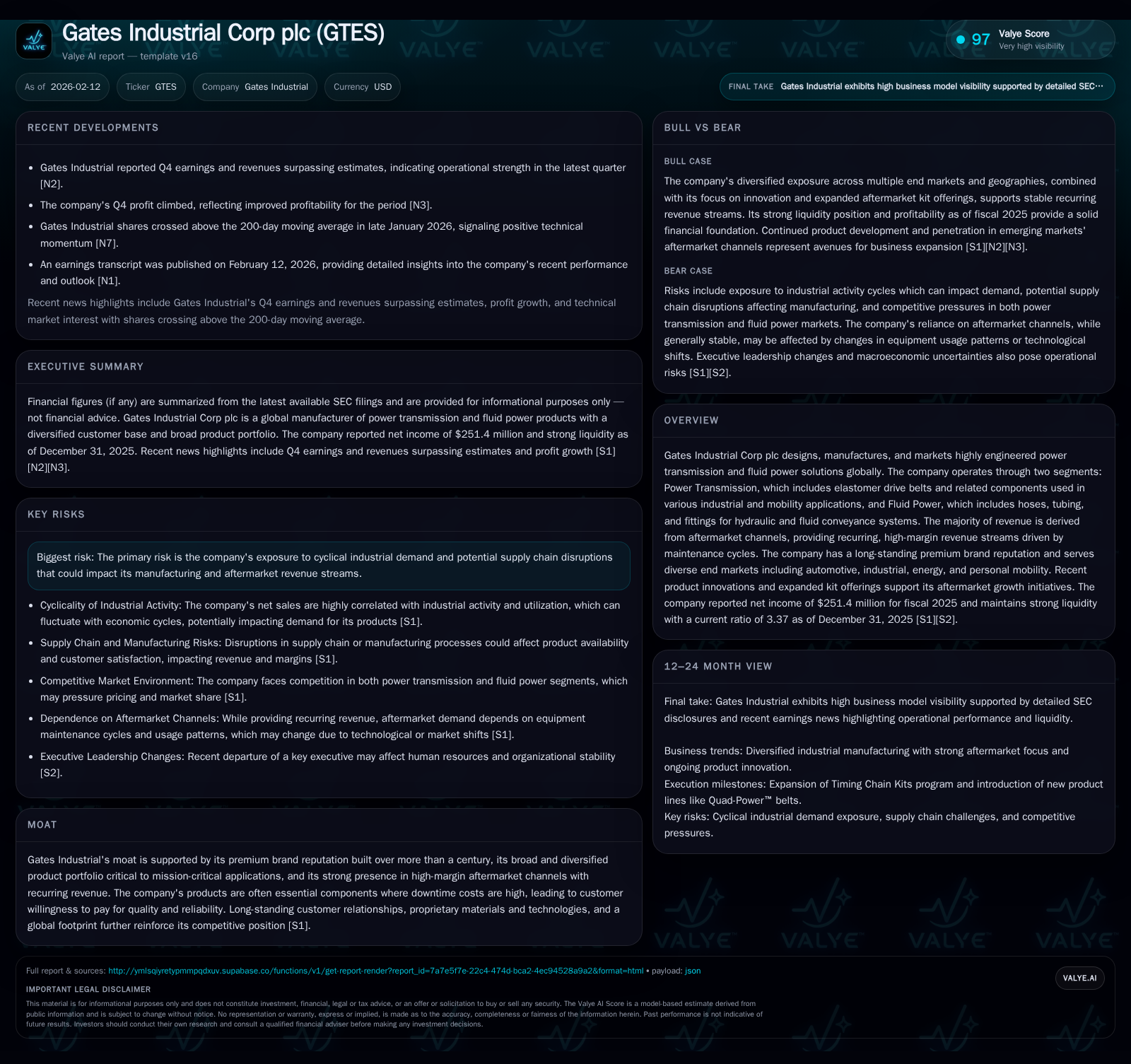
Gates Industrial Corp plc stands as a century-old pillar in engineered power transmission and fluid conveyance products, renowned for its premium brand and critical role in high-stakes industrial applications. Its diversified two-segment portfolio—Power Transmission and Fluid Power—serves broad end markets, with a strategic focus on aftermarket channels driving high-margin, recurring revenues from maintenance cycles. The company’s fiscal 2025 financials reflect solid net income, strong liquidity, and operational execution that exceeded market expectations, despite industrial cyclicality and supply chain pressures. Going forward, Gates’ innovation pipeline, disciplined management, and governance will be pivotal in navigating sector volatility while sustaining growth momentum.
Legacy Meets Innovation: The Backbone of Gates Industrial’s Brand
Since its founding in 1911 by Charles Gates Sr., Gates Industrial Corp has woven over a century's worth of heritage into a premium brand synonymous with quality and reliability. The company's origins trace back to innovations like the commercialized V-belt that replaced traditional rope belts with elastomeric materials – a leap forward that laid the groundwork for its reputation as a pioneer in engineered motion components. This legacy is not merely a historical footnote but a living foundation of trust that underpins Gates' market moat, enabling it to command premium pricing driven by customer willingness to pay for minimized downtime risks in mission-critical applications [S1].
In essence, this enduring brand equity enables Gates to transcend cyclicality more effectively than peers lacking such a storied identity. Customers in industries where equipment failures translate into significant operational losses often opt for Gates’ products despite alternatives at lower cost. This fundamental value proposition—rooted deeply in trust earned over decades—remains central as the company drives innovation in parallel with traditions.
Power Transmission & Fluid Power: Dual Engines Driving Diverse Markets
Gates’ operations unfold along two core business segments: Power Transmission and Fluid Power [S1]. The Power Transmission segment includes elastomer drive belts, tensioners, pulleys, and related parts essential to both automotive OEMs and diverse industrial machinery. Meanwhile, the Fluid Power segment focuses on hoses, tubing, fittings, and comprehensive hydraulic conveyance systems that support machinery across construction, energy extraction, agriculture, and personal mobility sectors.
This dual-segment structure offers both complementary technology synergies and risk diversification benefits. By serving an array of end markets—from automotive aftermarket to energy infrastructure—Gates cushions itself against concentration risks prevalent in more single-industry focused companies. Its geographic breadth further balances exposure.
According to the fiscal year 2025 revenue data ($3.44 billion total sales), aftermarket channels account for the majority share across both segments—a deliberate strategy harnessing inherently recurring maintenance cycles triggered by normal product degradation or preventive upkeep [S1]. This mix stabilizes top-line flows while preserving margin profiles typically more attractive than original equipment sales.
Aftermarket Advantage: Recurring Revenue Through Maintenance Cycles
The heart of Gates’ profitable resilience lies within its aftermarket business model. Products experiencing natural wear are replaced through established maintenance schedules that create dependable demand patterns largely independent of new build fluctuations [S1]. Unlike many capital equipment players reliant heavily on OEM volumes susceptible to economic swings, Gates secures high-margin cash flows through replacement parts essential to operational continuity.
Customer loyalty reinforces this dynamic; longstanding relationships coupled with proprietary materials technology (e.g., specialized elastomers) create switching costs that nurture repeat business [S1]. Incremental innovations and broadened kit offerings further incentivize customers to source bundled solutions entirely within the Gates ecosystem rather than fragment purchasing.
This aftermarket specialization yields formidable competitive advantage manifested not just in consistent revenues but also in stronger gross margins that underpin net income growth.
Q4 & Fiscal Year 2025 Performance: Surpassing Market Expectations
In its latest reporting cycle ending December 31, 2025, Gates delivered $251.4 million of net income alongside robust operating metrics that outpaced consensus forecasts [N2][N5][F1]. Revenue growth was underpinned by sustained momentum in both power transmission replacements and fluid power upgrades.
Market reception reflected confidence; shares crossed above key technical thresholds such as the 200-day moving average during early Q1 2026 signaling positive investor sentiment [N7]. Operational management emphasized efficient manufacturing execution despite ongoing supply chain constraints alongside targeted cost control measures contributing to profitability enhancement [N1].
Importantly, this financial outperformance occurred amidst macroeconomic headwinds characterized by cyclical softness in some industrial verticals demonstrating the inherent strength of their diversified end-market footprint and aftermarket orientation.
Navigating Cyclical Demand and Supply Chain Vulnerabilities
Management acknowledges significant risks stemming from exposure to cyclical industrial activity given the correlation of their revenues with broader economic utilization rates rather than isolated sectors alone [S1][S2]. Additionally, global supply chain disruptions have intermittently impacted raw material availability and logistics timing – challenges common across industrial manufacturers post-pandemic.
To mitigate these factors, Gates maintains extensive inventory buffers for critical raw inputs while partnering closely with suppliers to ensure capacity flexibility [S1]. Their credit risk management practices limit exposure concentrated among few customers or counterparties without diluting key client relationships.
Historically, the diversified revenue base smoothens volatility reducing earnings shocks linked purely to single-market downturns.
Fiscal Discipline and Strong Liquidity: Financial Stability Insights
Gates concluded fiscal 2025 with notably strong liquidity metrics marked by cash and equivalents totaling approximately $812 million and a current ratio of 3.37 (current assets at $2.48 billion vs current liabilities at $735 million), reflecting conservative working capital management [F1]. These parameters project ample short-term solvency cushion amid fluctuating market conditions.
Further reinforcing confidence is management’s disclosure on effective internal controls over financial reporting evaluated pursuant to integrated frameworks – affirming disclosures are timely, complete, and reliable [S1]. Such governance rigor fortifies transparency standards central to maintaining stakeholder trust.
Leadership Movements and Governance: Preparing for Future Challenges
October 2025 saw the departure announcement of Executive Vice President Chief Human Resources Officer Gwendolyn Ann Montgomery effective December 1st after notable tenure overseeing talent management during strategic transformation phases [S2]. The exit was characterized as voluntary without cause; severance arrangements align with standard executive provisions designed to smooth transitions.
While leadership turnover injects some near-term uncertainty into cultural stewardship functions amid ongoing growth initiatives, no indication suggests disruption severe enough to impede operational continuity or strategic execution.
Comparative Industry Positioning Amid Peer Earnings Landscapes
Within the broader industrial component sector backdrop where peer firms like Watts Water (WTS) [N3][N6] and Regal Rexnord (RRX) [N4] posted recent quarterly earnings beats reflecting sector-wide momentum; Gates’ unique positioning leverages deeper aftermarket penetration yielding arguably more stable revenue streams.
Unlike some competitors more dependent on volatile new equipment sales or narrow geographic footprints, Gates' combination of historical brand strength plus dual-segment product diversity offsets cyclicality more effectively. This blend enhances resilience against varied economic scenarios while offering tailored technological solutions across industries uncommon among peers.
Outlook: Innovation, Product Development, and Market Expansion Strategies
Looking ahead, management discusses continued investment in R&D targeting new product introductions aimed at enhancing system reliability while broadening kit solutions bundling multiple components into single-source purchases [S1][N1]. Geographic expansion into emerging markets remains on agenda supported by local partnerships driving penetration beyond legacy regions.
Innovation not only consolidates existing market positions but also opens doors for incremental aftermarket share gains against competitive alternatives through superior performance characteristics aligned with rising industry standards.
This ongoing commitment reflects Gates’ ethos marrying heritage craftsmanship with cutting-edge engineering — ensuring relevance well into future industrial cycles.
Disclaimer: This analysis is intended solely for informational purposes based on publicly available data as of February 12, 2026. It does not constitute investment advice or recommendations. Readers should conduct their own research or consult professional advisors before making financial decisions.
Disclaimer: This is research-only, informational analysis and not investment advice. It may include AI-generated interpretation and general industry context. Always verify important details using primary sources.

Comments