GitLab Inc: Navigating DevSecOps Leadership Amid Growth and Market Challenges
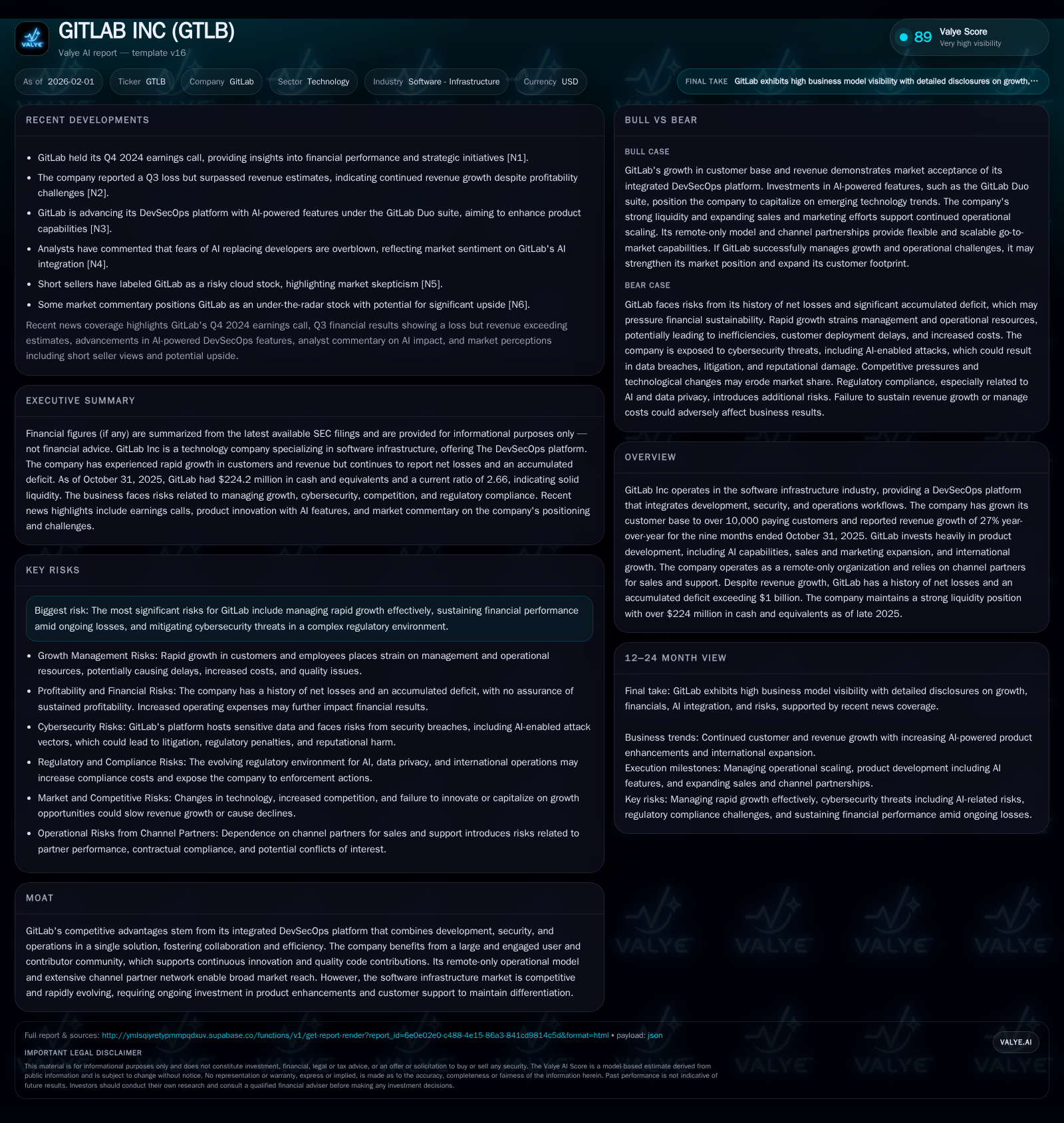
GitLab Inc leverages an integrated DevSecOps platform and a remote-first model to drive growth while managing financial losses and competitive pressures in software infrastructure.
GitLab continues expanding its DevSecOps platform, integrating AI capabilities and broadening its global footprint through direct and channel sales, supported by a remote-only workforce. Despite 27% revenue growth and over 10,000 paying customers, the company operates at a loss with an accumulated deficit exceeding $1 billion, necessitating efficient growth management and innovation. Its competitive edge lies in platform integration and community collaboration, but risks from market competition, regulatory complexities, and execution on channel partnerships remain significant.
What Changed Recently
GitLab reported its Q3 2025 results with revenue growth exceeding analyst expectations, reaching a 27% year-over-year increase and expanding its paying customer base to 10,475 from 9,519 a year earlier [N2][S7]. However, the company continues to run at a net loss, with an accumulated deficit exceeding $1 billion, reflecting sustained investments in product development and sales expansion [N2][S15]. Notably, GitLab has accelerated integration of AI-powered capabilities within its platform, launching the GitLab Duo AI suite designed to streamline DevSecOps workflows and enhance developer productivity [N4]. This move aligns with broader industry trends but also introduces new regulatory and operational risks [S12]. Meanwhile, Morgan Stanley downgraded the stock citing concerns over execution risks and competitive pressures despite the company's growth [N9][N10]. Short sellers have highlighted GitLab as one of the more vulnerable cloud stocks given its ongoing losses and competitive environment [N3]. These recent developments underscore the tension between growth ambitions, profitability challenges, and market skepticism.
Business Model as a System
GitLab operates an integrated DevSecOps platform that consolidates software development, security, and operations into a single solution, designed to improve collaboration and efficiency across the software delivery lifecycle [S1]. The platform is offered primarily via subscription, targeting enterprise, government, and international customers.
A key structural element of GitLab's business model is its remote-only workforce, which reduces fixed-cost overhead but introduces challenges in maintaining culture and operational coordination [S4]. Sales and support are conducted through a mixed model of direct sales and an extensive network of channel partners [S1][S3]. These partners are critical for enterprise and international reach but pose risks related to inconsistent customer experience and potential conflicts of interest since they may also represent competing vendors [S3].
Product development accounts for a significant portion of expenditures, particularly investments in AI and platform compatibility with emerging infrastructure technologies. This ongoing R&D is essential to maintaining feature parity and innovation in a fast-evolving market [S1][S6][S25].
GitLab also engages team members under various employment models, including direct hires, Professional Employer Organizations (PEOs), and independent contractors, introducing compliance complexities across jurisdictions [S2][S4].
Financially, GitLab's monetization depends on growing its user base, converting free users to paying customers, and upselling additional capabilities. Pricing strategies have included tiered subscription increases, although this risks customer churn or migration to free tiers [S12]. The company’s liquidity remains solid with over $224 million in cash and equivalents, supporting sustained operating losses and investments [S15].
Industry Map & Competitive Battlefield
The software infrastructure industry, particularly DevSecOps, is characterized by rapid technological innovation, intense competition, and evolving customer demands. GitLab competes with legacy software development platforms, cloud providers offering integrated developer tools, and emerging AI-driven workflow enhancers.
GitLab's integrated approach to combining development, security, and operations contrasts with competitors who may offer siloed or less comprehensive toolchains. This integration can yield productivity and security benefits, positioning GitLab favorably for enterprises seeking streamlined workflows [S1].
However, the field is crowded with well-resourced incumbents (such as Atlassian, Microsoft’s GitHub, and Broadcom’s CA Technologies) and cloud giants continuously launching new developer tools. The pace of AI integration is particularly critical, as generative AI capabilities are becoming a baseline expectation, not an add-on [N4][N5][S25].
GitLab’s remote-only model and open-source community engagement foster innovation and global talent access but also introduce operational complexity and potential cultural dilution as the company scales [S4][S25].
International growth exposes GitLab to regulatory, cultural, and competitive challenges, including export controls, data privacy laws (e.g., GDPR), anti-corruption statutes, and localized competitors [S11][S20][S22]. The joint venture model in China adds complexity around financial integration and reputational risk [S17].
Where the Economics Become Real
Unit economics hinge on customer acquisition and retention, subscription pricing, cost of sales (including channel partner commissions), and R&D investment efficiency. GitLab’s sales cycle is notably long and variable, reflecting enterprise customers' scrutiny and complexity of deals, which complicates near-term revenue forecasting [S14]. Channel partners amplify reach but reduce direct control over sales effectiveness and customer experience, introducing variability in renewal rates and expansion opportunities [S3][S14].
Subscription pricing has been increased in some tiers, potentially driving churn or migration to free tiers, which would pressure revenue growth [S12]. The company must balance price increases with value delivery through new features, particularly AI enhancements, to maintain and grow revenue per customer.
R&D investments are substantial and necessary to keep pace with technological evolution, especially in AI capabilities and support for new infrastructure platforms. Delays or defects in product releases could impair competitive positioning and customer satisfaction [S1][S6].
Operating expenses include distributed global headcount costs, PEO-related employment complexities, and compliance overhead, which could increase as the company scales internationally [S2][S4][S11].
Liquidity is currently sufficient to support operations and growth initiatives, but continued net losses underline the importance of managing cash burn and securing efficient capital if needed [S15][S16].
Diligence Questions / Disconfirming Signals
- How effective are GitLab’s channel partners in driving enterprise and international sales? Are there metrics on partner-driven customer satisfaction, renewal rates, and upsell success?
- What is the attrition rate post-implementation of recent subscription price increases? How has customer behavior shifted between free, mid-tier, and premium offerings?
- How mature and differentiated are the AI capabilities within GitLab Duo compared to competitors’ offerings? What regulatory and IP risks are associated with these AI features?
- How does GitLab manage and monitor compliance risks stemming from its diverse employment models (direct hires, PEOs, contractors) across jurisdictions?
- What are the specific operational and reputational risks tied to the joint venture in China and how does GitLab mitigate potential issues?
- Given the long and variable sales cycle, what improvements are being implemented in sales forecasting and pipeline management?
- How does GitLab plan to maintain its corporate culture and innovation capacity amid rapid scaling in a fully remote setting?
- What contingencies exist for cybersecurity incidents impacting GitLab’s or its customers’ IT systems?
- How exposed is GitLab to macroeconomic pressures affecting customer IT budgets, and how does it adapt sales and marketing investment accordingly?
- Are there any indications from customer feedback or market trends that incremental platform enhancements are failing to meet evolving requirements?
This analysis is based on publicly available information and company disclosures as of early 2026. It is intended for informational purposes and does not constitute investment advice. Given the dynamic nature of the technology sector and GitLab’s particular growth stage, continued monitoring of operational execution, competitive developments, and regulatory environment is advised.
Disclaimer: This is research-only, informational analysis and not investment advice. It may include AI-generated interpretation and general industry context. Always verify important details using primary sources.

Comments