
Greenwave Technology Solutions Struggles with Liquidity and Market Cyclicality in Scrap Metal Recycling
Greenwave’s latest quarter highlights operational challenges and regulatory risks amid industry price volatility and financial constraints.
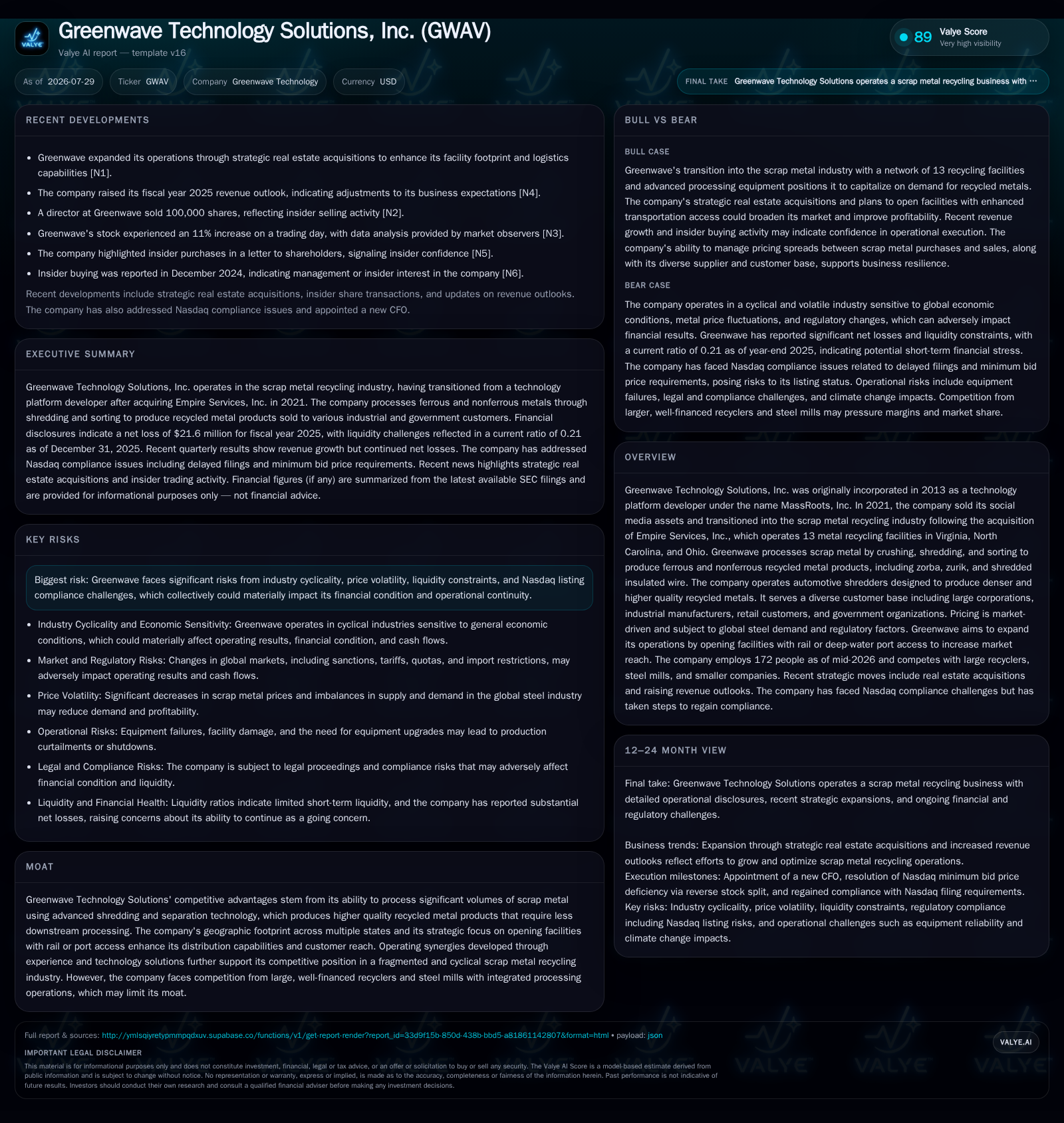
Greenwave Technology Solutions, Inc. continues to operate primarily as a scrap metal recycler following its 2021 pivot from technology platforms. The company processes ferrous and nonferrous metals through shredding and separation facilities mainly across Virginia, North Carolina, and Ohio. Its competitive positioning is bolstered by its advanced automotive shredders and geographic footprint, though it faces fierce competition from larger integrated steel producers and well-funded recyclers. The latest quarterly filing reveals persistent liquidity issues, continued operational losses, substantial customer concentration, and compliance risks related to Nasdaq listing standards. Greenwave’s potential growth hinges on expanding facility capacity—particularly with rail or port access—but financial constraints and industry cyclicality pose material hurdles.
Recent Operating Update
Greenwave Technology Solutions, Inc. continues to operate primarily as a scrap metal recycler following its acquisition of Empire Services in late 2021, which added 13 processing facilities across Virginia, North Carolina, and Ohio—regions with established scrap metal supply chains [S1]. Central to its operations are two automotive shredders located in Kelford, NC, and Carrollton, VA, which enable the company to convert durable goods such as end-of-life vehicles and industrial scrap into dense, high-quality recycled metal products suitable for steel mills and foundries [S1]. These shredders, combined with advanced metal separation technology, allow Greenwave to produce differentiated products including zorba (predominantly aluminum), zurik (stainless steel), and shredded insulated wire (copper and aluminum) [S1]. Despite these technological capabilities, Greenwave continues to face challenges in achieving sustained profitability amid volatile scrap metal prices and competitive pressures [S1][S5].
Business Model
Greenwave operates midstream in the scrap metal recycling value chain by sourcing raw scrap materials—such as end-of-life vehicles, appliances, construction debris, boats, and industrial machinery—and processing them into categorized ferrous and nonferrous metal products [S1]. The company’s revenue is primarily generated through the sale of these recycled metal grades to intermediaries including steel mills, foundries, and industrial manufacturers that value high-grade inputs to reduce their downstream refining costs [S1]. The use of automotive shredders enhances product density and quality consistency, which are critical factors influencing pricing power in a commodity-driven market where incremental improvements in metal grade can command meaningful price premiums.
Pricing is entirely market-driven and closely tied to global steel demand cycles. Factors such as international trade policies including tariffs and quotas, fluctuations in the U.S. dollar exchange rate, supply-demand imbalances in scrap availability, and regulatory changes affecting scrap sourcing and processing costs all contribute to price volatility [S2][S5]. Consequently, Greenwave’s revenue is sensitive not only to the volume of scrap metal processed but also to the average selling price per ton of recycled metal, which can vary significantly quarter to quarter, impacting gross margins.
Customer concentration is a notable risk factor. In Q1 2026, the top five customers accounted for approximately 65% of revenues, exposing the company to potential revenue volatility if any major customer reduces orders or renegotiates contract terms [S7]. On the supply side, Greenwave relies on a limited number of key suppliers for scrap feedstock, with one supplier accounting for over 5% of cost of goods sold in the latest quarter, highlighting potential vulnerability to supply disruptions [S7].
Logistics and distribution efficiency are critical operating variables. Greenwave’s strategic priority is to establish a new facility with rail or deep-water port access, which would reduce transportation costs and expand the addressable market by enabling efficient shipment to domestic steel mills and overseas foundries [S1]. Such infrastructure improvements typically increase facility utilization rates and lower operating costs per ton processed, thereby enhancing margins and enabling sales diversification beyond the company’s current regional footprint [S1][S5].
Industry Structure & Competitive Position
The scrap metal recycling industry is fragmented but dominated by large integrated steel producers such as Nucor Corporation and Steel Dynamics, Inc., which operate proprietary scrap processing facilities that provide scale advantages in cost structure and pricing leverage [S5]. Greenwave competes as an independent recycler with a geographic footprint focused on the mid-Atlantic region, leveraging its 13 facilities and advanced shredding and separation equipment to produce higher-quality recycled metal products.
Greenwave’s technological capabilities, including its automotive shredders and metal separation systems, position it competitively relative to smaller local recyclers that may lack such equipment and thus cannot consistently deliver premium-grade zorba or shredded wire products [S1][S5]. However, these advantages are offset by scale disadvantages compared to large integrated players who benefit from fixed cost dilution and integrated supply contracts tied directly to steel mill demand pipelines.
Regulatory compliance presents ongoing challenges. Environmental regulations related to hazardous waste handling and emissions impose significant compliance costs and operational risks. Greenwave has faced prior environmental violations resulting in fines and remediation liabilities, underscoring the importance of effective environmental management in maintaining operational continuity and controlling costs [S25]. These regulatory factors also differentiate independent recyclers from integrated steel producers, who may have more resources to manage compliance and invest in equipment upgrades.
Growth Drivers
Structural growth drivers underpin Greenwave’s long-term prospects despite cyclical headwinds. Increasing global demand for recycled metals, driven by environmental policies promoting recycling and supply chain resilience strategies, supports expanding volumes of scrap metal processed [S1]. Improvements in product yield rates—the percentage of usable metal output from raw scrap—and enhancements in metal grade consistency can strengthen pricing power and margins amid volatile market conditions.
The planned development of a rail- or port-accessible facility is a key growth catalyst. Such a facility would enable Greenwave to tap into export markets by efficiently shipping recycled metals to overseas foundries, capturing international arbitrage opportunities created by tariff differentials and foreign demand surges [S1]. This expansion would also diversify the customer base and reduce reliance on regional buyers.
Additionally, growth in automotive scrappage volumes, driven by aging vehicle retirements, increases feedstock availability. Greenwave’s two automotive shredders position it well to capitalize on this trend within its operating regions. Infrastructure development and construction activity further contribute to scrap supply from ferrous materials, supporting throughput growth if operational scaling is successful.
Management’s recent appointment of Chelsea Pullano as Chief Financial Officer and engagement of MACK Financial Solutions to oversee financial reporting and SEC compliance reflects a strategic focus on strengthening governance and financial controls, which may be critical for securing capital needed to fund expansion and stabilize operations [S5][S16].
Risks & Watchpoints
Key risks include:
- Industry cyclicality and price volatility: Scrap metal prices are highly sensitive to global steel market supply-demand imbalances, trade tensions, and currency fluctuations, which can cause sharp revenue and margin swings [S2][S5].
- Nasdaq listing compliance: Repeated delays in SEC filings have led to Nasdaq delisting notices, with a compliance plan due by June 22, 2026, and a final resolution deadline of October 12, 2026. Failure to regain compliance risks delisting and impairs capital raising ability [S3][S6].
- Customer concentration: Dependence on a small number of large customers (top five representing ~65% of revenues) exposes Greenwave to significant revenue risk if contracts are lost or terms deteriorate [S7].
- Regulatory and environmental compliance: Handling hazardous materials entails ongoing compliance costs and potential liabilities, with prior violations highlighting exposure to fines and remediation expenses [S25].
- Capital intensity and liquidity constraints: Continuous equipment upgrades and facility expansion, particularly for rail/port access, require substantial capital expenditures. Current liquidity challenges, including a working capital deficit near $18 million and accumulated deficits exceeding $500 million as of March 2026, constrain investment capacity [S9].
- Management dependence: The company’s limited operating history and reliance on key executives, including CEO Danny Meeks, present risks if leadership changes occur without adequate succession planning [S18].
What to Watch Next
Upcoming developments to monitor include:
- Progress on Nasdaq compliance filings and any relief granted, which will affect the company’s ability to maintain its listing and access capital markets [S3][S6].
- Announcements regarding the development or financing of a rail- or port-accessible facility, a strategic initiative with potential to materially increase volumes and margins [S1].
- Quarterly operating metrics such as average selling price per ton and volume processed, which will indicate market cycle impacts and operational performance.
- Customer retention and contract renewals, given the high concentration risk.
- Outcomes of ongoing legal proceedings, including the lawsuit filed by Arena Special Opportunities Fund, which may affect financial condition depending on contingent liabilities [S25].
Financial Profile Discussion
Greenwave’s financial condition remains strained. The company reported an operating loss of approximately $1.07 million in Q1 2026, reflecting ongoing challenges in achieving profitability amid market pressures [S2]. Liquidity is constrained, with a working capital deficit near $18 million and accumulated deficits exceeding $500 million as of March 31, 2026 [S9]. Cash and equivalents stood at approximately $1.46 million at quarter-end, while current liabilities significantly exceeded current assets, resulting in a current ratio well below 1.0, indicative of short-term liquidity stress [S2][S9].
The appointment of a part-time CFO and outsourcing of financial reporting functions represent efforts to improve internal controls and SEC compliance, which have been areas of concern given prior filing delays and material weaknesses in financial reporting [S5][S16]. These governance improvements may be necessary to restore investor confidence and facilitate access to capital required for operational scaling and strategic initiatives.
In summary, Greenwave operates in a cyclical and capital-intensive segment of the scrap metal recycling industry, with competitive positioning supported by advanced shredding technology and a regional footprint. However, the company faces significant financial and operational risks including liquidity constraints, customer concentration, regulatory compliance, and market volatility. The successful execution of its strategic priority to open a rail- or port-accessible facility and resolution of Nasdaq compliance issues will be critical factors influencing its near-term operating results and longer-term viability.
Disclaimer: This is research-only, informational analysis and not investment advice. It may include AI-generated interpretation and general industry context. Always verify important details using primary sources.

Comments