
Gaxos.AI Advances Multi-Sector AI Innovations Amid Intensifying Regulatory Spotlight
Gaxos.AI pushes product launches and extends equity offering amid evolving telehealth rules and competitive AI market pressures.
In its latest quarterly filing, Gaxos.AI extended its at-the-market equity offering authorization, highlighting a need to fuel ongoing growth initiatives across its portfolio of AI-powered solutions. The company continues rolling out innovative products spanning gaming, health optimization, and digital faith sectors, while grappling with regulatory risks affecting its telehealth subsidiary. Despite a strong current asset position, Gaxos.AI remains an early-stage player facing execution challenges from limited scale and intensifying competition in emerging AI markets. Monitoring product adoption metrics and regulatory developments will be critical over the near term.
Latest Quarterly Update and Operational Highlights
Gaxos.AI Inc.’s May 14, 2026 10-Q filing reveals a significant near-term development extending the maximum aggregate offering price for its common stock under the existing At The Market (ATM) Sales Agreement by $1,065,001 [S3], to bolster funding capacity for ongoing research, development, and commercialization efforts across its AI-driven business units. This extension follows approximately $5.6 million raised previously under the agreement since January 2026 [S3]. Such capital infusion flexibility is crucial given the company’s continued burn alongside investment in product innovation.
Operationally, Gaxos flagged continuing regulatory scrutiny impacting RNK Health LLC’s Medical Partner subsidiary's telehealth model. State-level legal challenges threaten the ability to provide physician-supervised medication management services nationwide [S2]. Given that RNK Health supports patient health through non-clinical administrative services aligned with these telehealth offerings [S2], any restrictions could materially affect revenue realization and overall operating results.
No material changes were noted in other risk factors versus the March annual report [S2]. The company confirmed continuity of previous disclosures about competition intensity and evolving AI governance complexities.
Comprehensive Business Model and Solution Portfolio
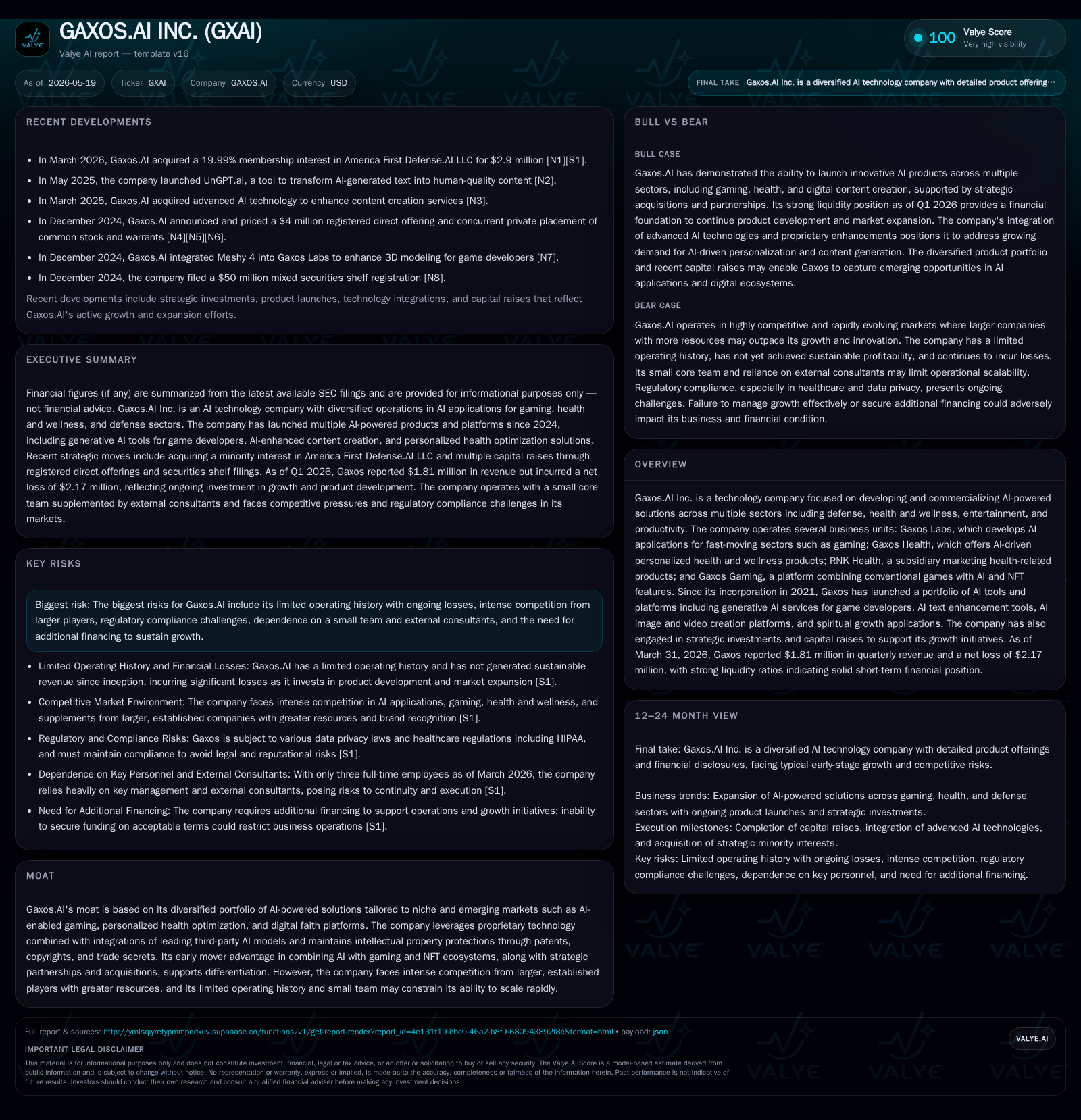
Gaxos.AI operates a diversified AI-centric business combining several specialized units: Gaxos Labs develops generative AI applications primarily targeting gaming developers; Gaxos Health focuses on personalized health optimization leveraging biometric data; RNK Health markets supplements and supports telehealth administration; Gaxos Gaming blends conventional games with AI-generated content and NFTs [S1].
Revenue is generated mainly via subscription licenses for API access in developer-focused tools (e.g., generative asset creation), sales of wellness products through RNK Health’s channels, and platform monetization within Gaxos Gaming by allowing users to mint unique NFT-based assets [S1]. Pricing levers include licensing fees tied to usage volume/feature tiers on Gaxos Labs’ UGAiC-powered platforms alongside direct-to-consumer supplement sales
The tech stack spans proprietary multi-pass transformation models (UnGPT.ai text enhancement), integration layers enabling plug-and-play interoperability with game engines like Unity and Godot, plus curated combinations of third-party state-of-the-art AI models—Google’s Imagen variants, Stability AI components among others—to accelerate image/video creation via Art-Gen.AI [S1][S26]. Switching costs derive from embedded IP protections (patents, copyrights), customized model tuning for clients’ needs, and complex backend integration pipelines.
Competitive Positioning Within AI and Adjacent Markets
Gaxos.AI occupies nascent yet fast-evolving segments marked by fierce competition from larger incumbents possessing extensive resource bases and established customer networks. Its moat principally relies on early-mover advantages integrating generative AI within gaming combined with blockchain-enabled NFTs [S1]. However, limited operating history coupled with a small internal team of three full-time employees as of March 2026 [S14] constrains rapid scalability relative to better-capitalized peers.
The fragmented nature of emerging AI application niches creates opportunities but also escalates risks around technology obsolescence or market preference shifts. Intellectual property protections partially insulate offerings but do not fully offset the risk posed by well-funded competitors potentially developing similar or superior solutions at lower cost or scale [S14][S18].
Telehealth-related operations face heightened regulatory complexity which adds another dimension of comparative hazard over companies fully entrenched in the healthcare sector.
Sector-Specific Considerations: Gaming, Health, and Digital Faith Platforms
In gaming, Gaxos Labs product studio emphasizes developer ease-of-use through APIs that seamlessly integrate with major engines like Unity/Godot—a critical adoption factor given developers’ preference for minimal friction tooling deployment [S16]. The proprietary User-Generated-AI-Content (UGAiC) system enables end-users (gamers) dynamic content creation during gameplay which may boost user engagement metrics.
In health/wellness spheres via RNK Health’s partnership with the Medical Partner, delivery depends heavily on compliance with diverse state laws governing physician-supervised telehealth medication management; asynchronous versus synchronous communication requirements further complicate operational consistency [S2]. This regulatory patchwork impacts both service availability breadth and cost structures.
Spiritual and personal growth is addressed with Bible Pray AI launched December 2025—a niche digital faith platform aiming to tap into a growing segment seeking guided daily devotionals backed by AI curation [S26]. While ancillary to core revenue streams currently, it represents strategic diversification into mental wellness ecosystems supported by hundreds of millions globally.
Key Growth Drivers Fueled by Innovation and Strategic Partnerships
Growth is tied closely to accelerating adoption of core product lines:
- Increasing API subscription uptake driven by enhanced feature sets such as customizable AI models for game publishers reduces creative cycle times substantially [S1];
- Expansion in telehealth administrative support contingent upon stabilizing regulatory frameworks would unlock broader market reach for health-related products via RNK Health [S2];
- Penetration into creative content markets via Art-Gen.AI promises cost/time advantages spurring user acquisition; parallel momentum in Bible Pray AI is anticipated through targeting expanding digital faith demographics [S26];
- Strategic investments like acquiring 19.99% membership interest in America First Defense.AI LLC (March 2026) show pursuit of adjacent sector synergies enhancing defense-related AI capabilities [S11].
Key performance indicators include new subscriptions added monthly/quarterly for APIs, active user counts on gaming platforms integrating User-Generated-AI-Content features, renewal rates on wellness products marketed via RNK Health distribution channels, plus early engagement metrics on Bible Pray AI.
Risks, Regulatory Challenges, and Operational Constraints
Known risks remain pronounced:
- Ongoing net losses fueled by R&D investments necessitate frequent capital raises risking shareholder dilution; ATM offering increase underscores this financing pressure [S3][F1];
- Legal/regulatory challenges chiefly around telehealth service delivery pose material revenue uncertainty—state law variability complicates uniform expansion strategies [S2];
- Emerging global legislative frameworks regulating use of artificial intelligence add compliance layers increasing operational costs alongside potential fines/non-compliance sanctions (e.g., EU’s AI Act enforcement starting August 2026) [S4][S6];
- Vulnerabilities inherent in small management team size limit capacity to keep pace with technological shifts/competitive responses or rapidly evolve internal controls/systems adequately amidst growth demands [S14];
- Competitive pressure from entrenched players with far greater scale exposures threatens market traction especially if incumbents pivot aggressively toward integrating advanced generative AI within their platforms.
Near-Term Milestones and What to Monitor Going Forward
Monitoring critical execution markers will be essential:
- Subscription volume growth trends on Gaxos Labs’ developer services indicating adoption velocity;
- Regulatory outcomes impacting RNK Health’s Medical Partner’s ability to provide wide-ranging telehealth services nationally;
- Results from ATM equity sales activity reflecting liquidity replenishment success;
- New partnership announcements or contract wins providing validation signals;
- User engagement metrics on recently launched Bible Pray AI to assess resonance within digital faith markets;
- Product roadmap achievement timings such as incremental enhancements to core generative tools or new integrations supporting content creators.
Given the limited operating history documented by March 2026 filings [S1], these KPI-linked events will help substantiate or challenge growth hypotheses underlying Gaxos.AI’s business strategy.
Financial Health and Liquidity Overview
As of quarter end March 31, 2026, Gaxos.AI held approximately $1.5 million in cash and equivalents against current liabilities just under $570 thousand resulting in a robust current ratio above 21x—indicating sufficient short-term asset coverage relative to obligations [F1]
Despite these positive working capital signals, the company reported an operating loss nearing $4.9 million for the latest annual period ended December 31, 2025 alongside net losses close to $3.9 million supported by total revenues slightly over $1.9 million—highlighting ongoing unprofitability typical of early-stage innovation firms heavily investing in R&D prior to scaling revenues sustainably [F1]
These dynamics imply adequate runway in the immediate term but underscore reliance on continued successful equity issuance programs like the recent ATM extension to fund expansion efforts while navigating competitive challenges.
This analysis synthesizes recent SEC filings through May 2026 combined with domain-relevant industry context to provide a detailed evaluation of Gaxos.AI Inc.’s operating environment without extrapolating beyond disclosed information or issuing investment guidance. Readers should consider that rapid developments characteristic of emerging AI companies necessitate continuous monitoring of regulatory landscapes and commercial execution capabilities when evaluating future prospects.
Disclaimer: This is research-only, informational analysis and not investment advice. It may include AI-generated interpretation and general industry context. Always verify important details using primary sources.

Comments