
HCM IV Acquisition Corp. (HACQ) Company Analysis: Navigating SPAC Challenges and Opportunities
HCM IV Acquisition Corp. is a recently IPO-ed blank check company aiming to acquire an established business with growth potential. This analysis explores its business model, competitive dynamics, and the critical milestones shaping its pathway toward a successful initial business combination.
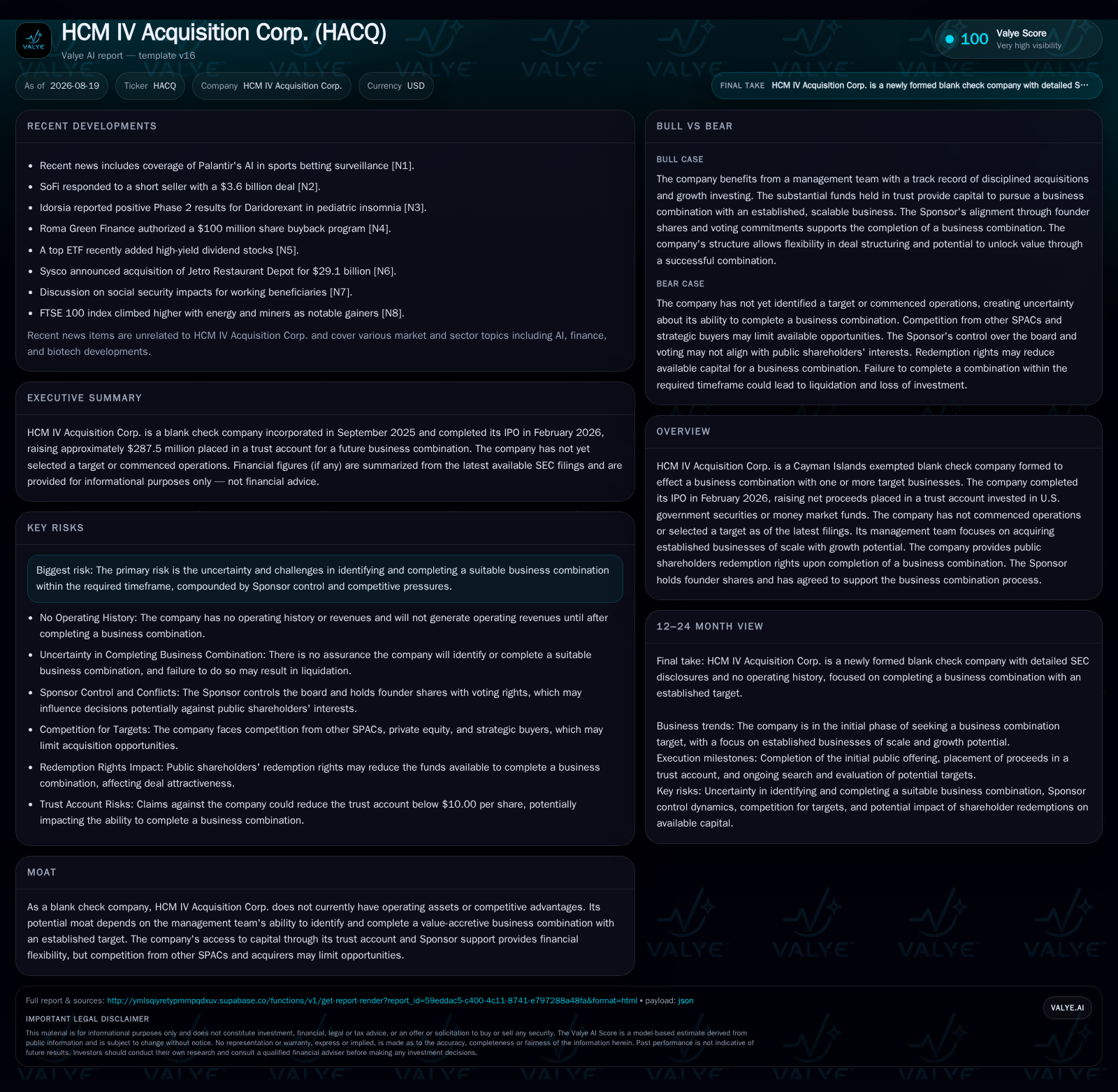
HCM IV Acquisition Corp. operates as a special purpose acquisition company (SPAC) with no current operations or revenues. It holds over $287 million in trust, managed by a Sponsor team with a disciplined acquisition record. The success of HACQ hinges on timely identification and consummation of a value-accretive business combination amid intense competition. Sponsor alignment, capital structure, redemption dynamics, and deal execution capabilities form the core drivers of future value creation or erosion.
HCM IV Acquisition Corp. (HACQ) stands as a new entrant in the competitive SPAC landscape, having completed its IPO in early 2026 with $287.5 million raised and secured in a trust account. As a blank check company, HACQ’s business model centers on deploying this capital to acquire an established, scalable business with growth prospects. The Sponsor’s management team brings experience in disciplined acquisitions, intending to leverage this expertise to create value. However, the absence of a current target and the intense competition from other SPACs and strategic buyers inject significant uncertainty into HACQ’s path. Critical to its success will be balancing shareholder redemption rights, governance dynamics, and execution timing to complete a compelling business combination.
Latest Operating Snapshot
As of mid-2026, HCM IV Acquisition Corp. had completed its IPO in February 2026, raising approximately $287.5 million, which is held in a trust account invested in U.S. government securities and money market funds. This trust account safeguards investor capital pending a business combination and underpins the company’s acquisition capacity [S1]. The Sponsor simultaneously sold private placement warrants generating an additional $7 million, further bolstering available capital.
The company remains a shell entity with no operating revenues or ongoing business activities as of the latest filings. It has not identified or engaged in substantive discussions with any potential business combination targets. Governance is controlled by the Sponsor, which holds founder shares with voting rights and has committed to support an initial business combination [S1]. Public shareholders retain redemption rights to reclaim their pro rata trust account value upon deal completion, injecting a key dynamic into capital availability and deal structuring.
Business Model and Unit Economics
HACQ’s business model is typical of a SPAC: raise capital through an IPO, place proceeds in a trust, then seek to merge with or acquire a private company to create a publicly listed operating entity. Revenue generation only begins post-combination, when the acquired company’s operations drive cash flow and earnings. Until then, HACQ’s economics derive solely from interest income on trust account investments and fair value movements on warrants, which are minimal and non-recurring [S1].
The capital structure includes founder shares, public shares, and warrants, with public shareholder redemption rights representing a significant variable impacting the ultimate deal proceeds. The Sponsor’s control over deal terms and board composition introduces potential governance and agency costs. Operating leverage will emerge only after the business combination when fixed costs are absorbed by scaled revenues. Prior to that, capital intensity is low but the cost of time and opportunity is high. The key economic lever is securing a target whose valuation and growth trajectory justify an accretive deal despite redemption-induced dilution.
Moat, Competition and Counterforces
Currently, HACQ possesses no intrinsic moat as a blank check company without operating assets or proprietary technology. Its competitive advantage depends on the Sponsor team's track record and ability to identify attractive acquisition targets at disciplined valuations. The Sponsor’s alignment via founder shares and voting commitments helps mitigate deal execution risk but presents potential conflicts versus public shareholders whose interests may diverge, especially regarding deal pricing and redemption thresholds [S1].
The SPAC market remains intensely competitive, with numerous sponsors chasing a limited pool of high-quality targets. Strategic acquirers and private equity firms also compete aggressively, potentially driving up valuation multiples and compressing deal returns. Public shareholder redemption rights create a counterforce by reducing the capital pool available for acquisition, impacting deal structuring complexity. Regulatory and timing constraints further increase execution risk. HACQ’s moat, if any, will be transient and highly execution-dependent.
Bull Case
In the bull case, HACQ leverages its Sponsor’s disciplined investment approach and capital strength to secure a high-quality, scalable business at an attractive valuation. The Sponsor’s voting control and founder shares align to overcome potential shareholder redemptions, enabling a deal structure that balances liquidity needs with growth upside. The acquired business benefits from operational improvements and strategic guidance, unlocking significant value post-combination. Successful deal execution and market reception drive share price appreciation, validating the Sponsor’s approach and attracting institutional interest.
Confirming evidence would include disclosure of an identified target with strong fundamentals, clear growth catalysts, and attractive valuation metrics. Early indications of shareholder support and manageable redemption rates would reinforce deal viability. Falsification would arise if no credible targets emerge, if redemption rates exceed manageable levels, or if governance conflicts stymie deal approval. Failure to complete a business combination within mandated timelines would also invalidate the bull thesis.
Base Case
The base case envisions HACQ completing a business combination within the required timeframe but with moderate challenges. The company finds a suitable target, though competition forces payment of near-market valuations limiting immediate upside. Shareholder redemptions reduce the effective deal capital, diluting post-merger ownership and constraining growth investments. The Sponsor’s control helps navigate governance hurdles but public shareholders remain cautious, limiting share price gains in the near term.
Post-combination, the new entity operates with modest revenue growth and margin improvement driven by incremental operational discipline but faces typical market headwinds. The company delivers acceptable returns relative to broader market benchmarks but does not generate outstanding alpha. Confirmation arises from mid-range redemption levels, completion of a business combination with disclosed financials showing moderate growth potential, and stable governance dynamics. Falsification would occur if deal execution fails or if post-merger performance significantly underperforms expectations.
Bear Case
The downside scenario involves HACQ failing to identify and consummate a suitable business combination within the regulatory timeframe, triggering liquidation and return of trust account proceeds net of fees—likely at or near IPO price but excluding warrants premium and any upside. Intense competition and market saturation reduce available target quality and increase valuations beyond Sponsor comfort. High redemption rates deplete deal capital, deterring target engagement. Sponsor control dynamics create governance friction, undermining shareholder confidence.
Additional risks include reputational damage to the Sponsor team, regulatory scrutiny or adverse market conditions that impede deal closure. Confirmation of this scenario would be prolonged absence of disclosed targets, repeated extensions or delays, and shareholder vote outcomes rejecting proposed deals. Falsification would be early deal announcements, successful completion within timelines, and shareholder approval with manageable redemption.
What Matters Next
Key investor watchpoints include (1) announcement of a potential business combination target and details of its financial and operational profile, (2) the indicated valuation and deal structure, especially the proportion of founder shares and public shareholder dilution, (3) redemption rates announced upon shareholder vote or tender offer, which directly affect deal capital, (4) any extensions filed to allow additional time for deal completion, (5) governance disclosures clarifying Sponsor and public shareholder alignment or conflicts, (6) market reception to announcement reflected in share price and trading volume, and (7) regulatory developments impacting SPAC deal frameworks.
Additional useful metrics would be the Sponsor’s history of deal success and post-merger performance for context, though not currently disclosed. Monitoring competitor SPAC deal announcements and valuations also provides a comparative benchmark. Ultimately, completion of the initial business combination within the targeted timeframe remains the most critical milestone.
Disclaimer: This is research-only, informational analysis and not investment advice. It may include AI-generated interpretation and general industry context. Always verify important details using primary sources.

Comments