
HCI Group Capitalizes on Investment Income to Outperform Revenue Growth
The company's net income surged far beyond revenue growth in FY2025, underscoring the strength of its diversified portfolio and operational efficiency.
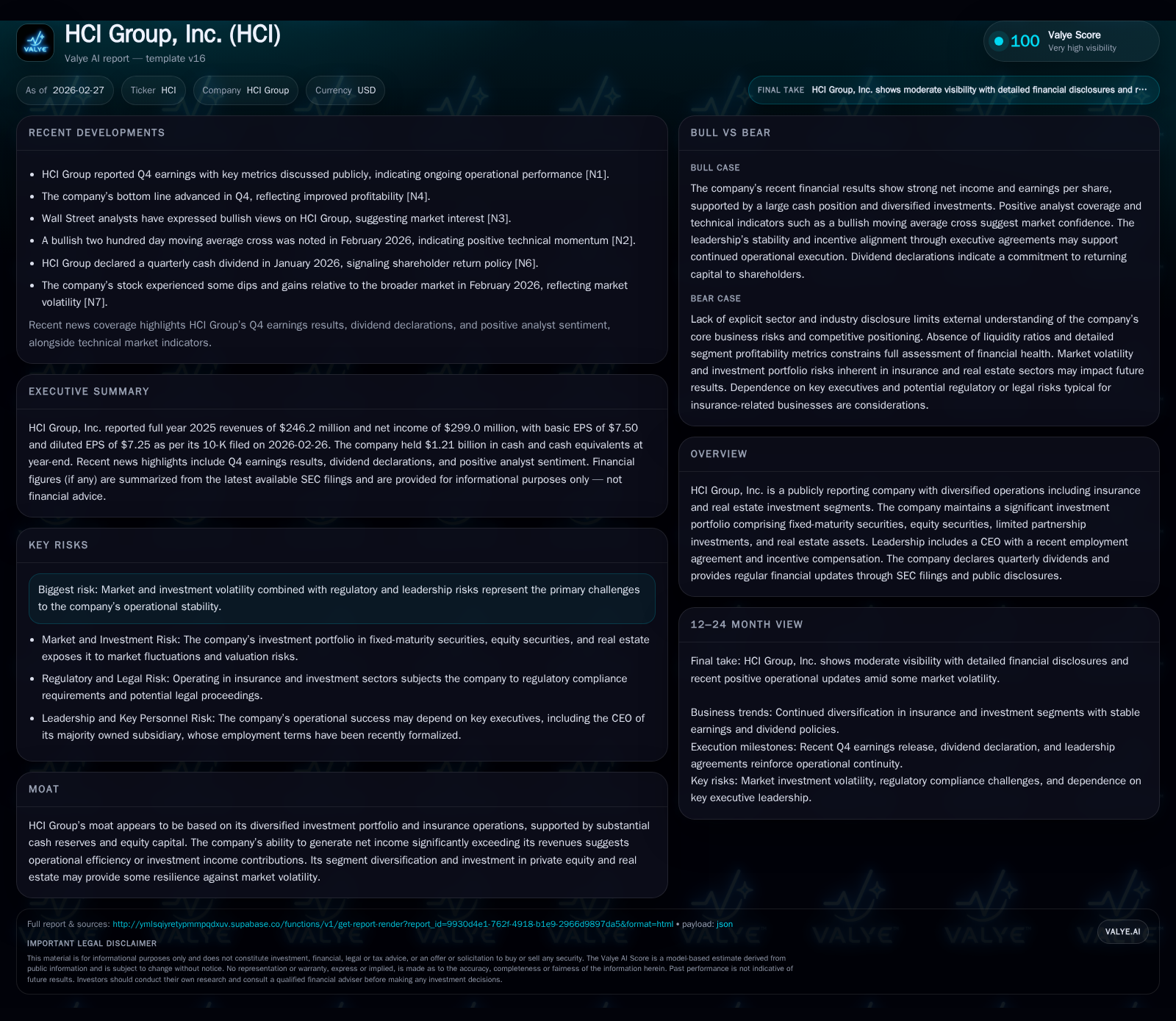
HCI Group, Inc. demonstrated remarkable financial performance in fiscal year 2025, reporting a 52.1% increase in revenues accompanied by an outsized 171.9% rise in net income. This divergence highlights how investment income and insurance underwriting successes drive profitability beyond core revenue generation. The company’s diversified investment holdings across fixed-maturity securities, private equity, and real estate underpin stable earnings and operating cash flow growth, while disciplined capital allocation supports shareholder returns. Risks remain from market volatility and regulatory scrutiny, necessitating close monitoring of key operational metrics in upcoming periods.
From Modest Revenues to Exceptional Profitability: Examining FY2025 Results
HCI Group delivered a stellar financial performance for the fiscal year ending December 31, 2025. Revenues expanded from approximately $161.9 million in FY2024 to $246.2 million in FY2025 (+52.1%), as shown in [F1]. However, the standout figure is net income, which surged from roughly $110.0 million to $299.0 million—a remarkable 171.9% increase—more than tripling profits within a single year [F1]. This disproportionate jump signals that profitability drivers extend well beyond pure revenue growth.
The company’s operating cash flow likewise improved significantly, rising nearly one-third (33.9%) from $331.8 million to $444.4 million [F1]. Notably, capital expenditures edged down by about 10%, reaching just over $3.6 million in FY2025 compared to $4.1 million the prior year [F1]. This combination indicates strategic capital discipline alongside expanding cash-generative capacity.
Historical performance (annual)
| FY | Rev ($mm) | Net ($mm) | CFO ($mm) | Capex ($mm) | Rev YoY | Net YoY |
|---|---|---|---|---|---|---|
| 2025 | 246 | 299 | 444 | 4 | +52.1% | +171.9% |
| 2024 | 162 | 110 | 332 | 4 | -0.5% | +39.1% |
| 2023 | 163 | 79 | 231 | 7 | +35.6% | +235.1% |
| 2022 | 120 | -59 | 0 | 6 |
Source: SEC companyfacts cache [F1].
Capital returns and efficiency (annual)
| FY | Div ($mm) | Buybacks ($mm) | FCF ($mm) |
|---|---|---|---|
| 2025 | 2 | 441 | |
| 2024 | 17 | 1 | 328 |
| 2023 | 14 | 1 | 224 |
| 2022 | 15 | 71 | -6 |
Source: SEC companyfacts cache [F1].
The exceptional jump in net income relative to revenue merits a closer look at HCI’s operational composition.
Diversification Across Insurance and Real Estate Investments: How Portfolio Composition Impacts Stability
Per recent SEC filings [S1][S7], HCI Group leverages diversified operations primarily across insurance underwriting and real estate investment segments supported by a broad investment portfolio comprising fixed-maturity securities—such as corporate debt instruments and asset-backed securities—alongside equity securities and limited partnership interests including private equity funds targeting mature portfolios.
Insurance operations generate underwriting revenues while the sizeable fixed-income portfolio stabilizes earnings through yield generation amid interest rate fluctuations typical for such portfolios.[S7] The mix includes commercial mortgage-backed securities (CMBS), enhancing exposure to real estate debt markets.
This blend of asset classes creates natural hedges against cyclical swings; while equity stake valuations can fluctuate with market sentiment, fixed-income allocations provide steady coupon income serving as a buffer against volatility.[S1] Additionally, subscriber surplus contributions—a form of statutory capital supporting insurance subsidiaries—augment financial solidity allowing regulatory compliance without undue leverage risk.[S7]
However, active management is integral given varied risk profiles across segments—private equity interests require valuation expertise distinct from public securities or insured loss reserves.[S1][S7]
Investment Income as a Core Driver: Breaking Down Profit Sources
Dissecting profitability components reveals that net income benefits substantially from investment income streams beyond core underwriting gains.[S1][S2][F1] Equity investments and corporate debt securities yield recurring returns while realized gains from asset sales contribute episodically.
This diversified investment contribution explains the surge in net earnings surpassing top-line increases—a reflection of both operational efficiency within insurance underwriting and skillful portfolio management capturing non-operating gains.
High capital efficiency manifests through an implied return on equity around 28.7% for FY2025 ($299M NI / $1,041M Equity) [F1], affirming effective utilization of shareholder funds relative to other industry comparables where double-digit ROEs are markers of success.
Outlook and Growth Opportunities: What Management’s Recent Comments Suggest
In its latest earnings release and conference call held February 25, 2026 [N1][S3], HCI’s management underscored their confidence in sustaining growth driven by continued expansion in insurance premiums alongside accretive real estate acquisitions aligned with core competencies.
Leadership remains incentivized under recent employment agreements emphasizing profitable growth metrics combined with prudent risk controls [S3]. However, management remarks were circumspect regarding macro uncertainties including potential regulatory shifts or market fluctuations for private equity valuations.
Thus, available guidance stresses cautious optimism anchored by demonstrated historical resilience rather than aggressive projections.
Capital Allocation Discipline: Dividends, Buybacks, and Returns on Equity
HCI maintains steady quarterly dividends evidenced by consistent payments totaling circa $16.6 million during FY2024 [F1]. During FY2025 buybacks remained modest at approximately $1.5 million but signal ongoing focus on capital return balanced with reinvestment capacity [F1][S4][S6].
Free cash flow generated roughly $440.8 million in FY2025 (operating cash flow minus capex) providing ample coverage for dividend commitments and discretionary share repurchases [F1]. The company also factors stock-based compensation and subscriber surplus contributions into their capital structure management supporting long-term operational stability [S4][S6].
Given the ~28.7% ROE calculated for FY2025 [F1], shareholder returns derive not only from dividends but also significant profit reinvestment driving equity base expansion.
Risks in Market Volatility and Regulatory Environment: Navigating Operational Challenges
The company’s SEC filings detail concentrated risks around market volatility impacting investment valuations, particularly equities and private placements susceptible to price swings under stressed conditions [S5][S16]. Interest rate risk inherent to fixed-income holdings adds further sensitivity.
Regulatory risks encompass evolving insurance compliance frameworks which could affect required capital levels or permissible business practices.[S5] Litigation exposures also feature among documented contingencies though specifics remain undisclosed.
Diversified portfolio construction acts as partial mitigation yet shareholders must monitor these dimensions closely given potential amplified effects during economic downturns or abrupt policy changes.
Key Metrics to Watch in Upcoming Quarters
Looking ahead investors should track sustained top-line improvement reflecting premium growth alongside stable or enhanced net investment income streams per quarterly updates [N7][N8][S3]. Operating cash flow trends versus past robust levels will inform underlying business health.
Dividend payout ratios relative to free cash flow will reveal whether current distributions remain sustainable amid possible shifts in capital allocation priorities.[N7] Additionally, watch for any share repurchase program adjustments or equity issuance impacts following recent senior note conversions influencing dilution dynamics.[N7][S4]
Maintaining focus on insurance loss ratios vis-à-vis underwriting segments alongside real estate asset performance will help assess operational efficacy.[S3]
This analysis draws exclusively upon company-provided data sources without projection beyond recorded disclosures or explicit management commentary through February 27, 2026.
Disclaimer: This report is for informational purposes only and does not constitute investment advice or recommendations.
Disclaimer: This is research-only, informational analysis and not investment advice. It may include AI-generated interpretation and general industry context. Always verify important details using primary sources.

Comments