
Home Depot’s Q1 Momentum and Omnichannel Edge Amid Market Challenges
Home Depot’s latest quarterly results underline robust operational execution and strategic investments in digital and supply chain capabilities that support resilience in a complex retail environment.
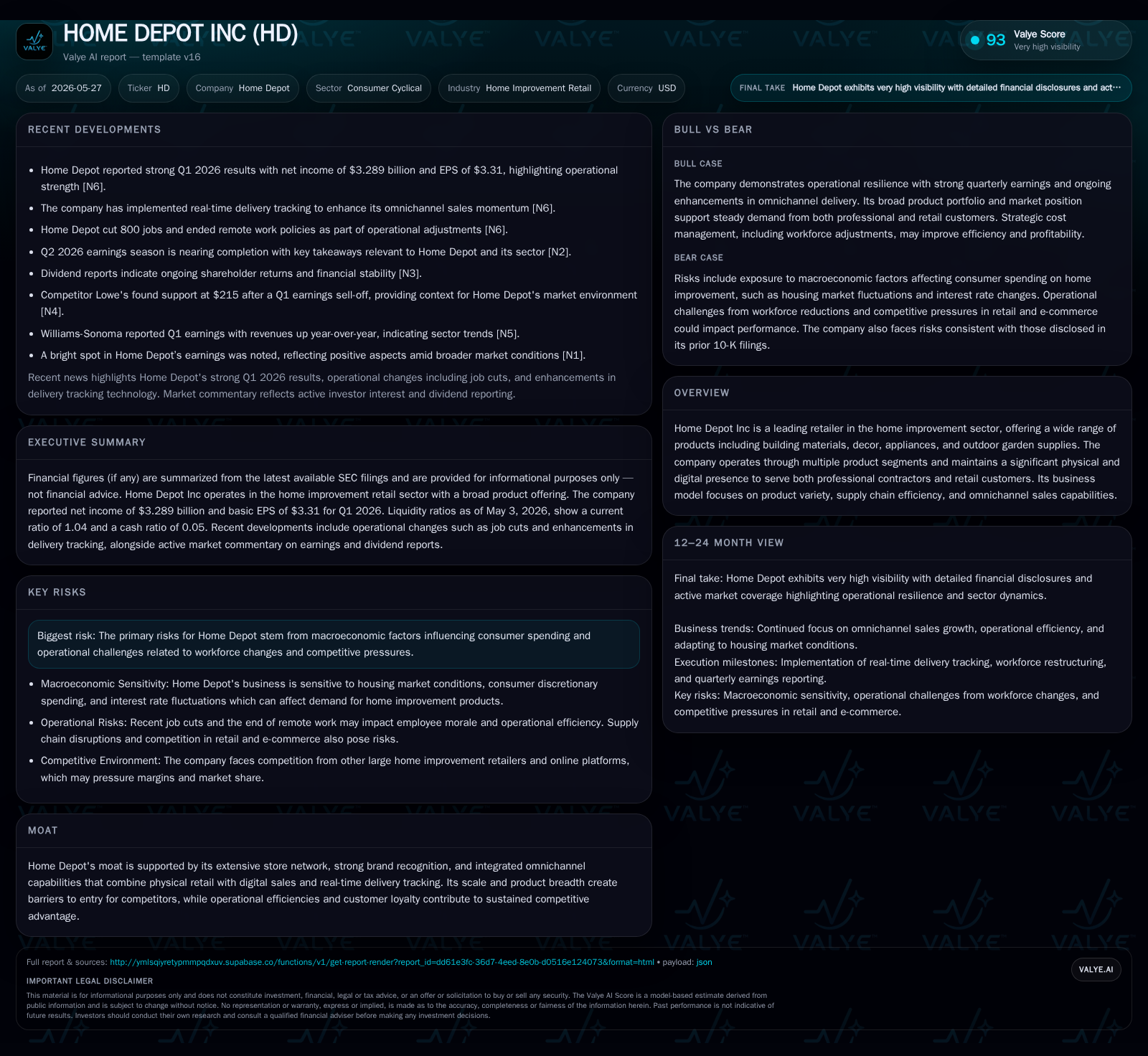
In its fiscal first quarter ending May 2026, Home Depot demonstrated solid sales and margin performance driven by a balanced product mix and inventory management despite macroeconomic pressures. The company continues to leverage its integrated omnichannel platform, extensive store network, and targeted service offerings to professional contractors and DIY consumers. Key growth drivers include advances in digital tools, supply chain optimization, and focused Pro customer initiatives, while labor market dynamics and discretionary spending uncertainty remain headline risks. Financially, Home Depot sustains strong operating income levels with a manageable liquidity position enabling ongoing investment.
Latest Quarterly Operating Performance and Strategic Developments
Home Depot's fiscal first quarter ending May 3, 2026, disclosed in the May 27 10-Q filing [S2], reflects resilient operational momentum during ongoing macroeconomic headwinds in the home improvement retail sector. The company reported sustaining solid revenue streams supported by stable comparable sales performance. Pricing strategies coupled with an advantageous product mix — emphasizing professional-grade building materials alongside high-margin decor items — contributed to gross margin resilience despite inflationary cost inputs.
Inventory management showed improvement via reduced markdown incidence and tighter control of stock levels facilitating favorable turns. Notably, the integration of supply chain technology continued to enhance product availability while mitigating overstock risks.
Governance changes ratified during the May 21 Annual Meeting included amendments limiting officers' monetary liabilities under defined conditions per Delaware law [S3]. While these adjustments do not affect day-to-day operations directly, they potentially reduce legal risk exposure for management.
Market commentary from recent Nasdaq analysis recognizes Home Depot’s Q1 performance as a 'bright spot' within a competitive earnings season marked by cautious consumer expenditure patterns [N5]
Business Model and Customer Value Proposition
Home Depot monetizes through wide-ranging sales of home improvement products including building materials, appliances, garden supplies, decor products, and associated installation services [S1]. This broad SKU assortment is delivered through a vast network of approximately 2,359 stores averaging over 100,000 square feet plus expanded online channels spanning the U.S., Canada, and Mexico
The company segments its customer base into two principal groups: Pros (professional contractors such as remodelers, roofers, landscapers) who require specialized products often bought in bulk or on credit terms; and DIY consumers prioritizing convenience and value for smaller-scale projects.
Strategically, differentiated service models target Pros through dedicated sales forces, credit facilities (including Pro Trade Credit), loyalty programs (Pro Xtra), tailored fulfillment options including local delivery from stores or distribution centers operated via subsidiaries like SRS/GMS [S15]
Home Depot's omnichannel strategy integrates in-store experience with e-commerce platforms allowing customers to research products digitally then purchase either online or in-store. Tools such as real-time inventory tracking enable transparency for clients while internal applications like hdPhones coupled with Sidekick help associates prioritize high-value tasks enhancing customer service efficacy [S1].
Competitive Environment and Industry Structure
Within home improvement retailing dominated broadly by Home Depot and Lowe's as top competitors, Home Depot exhibits key structural advantages tied to scale of physical stores combined with robust digital infrastructure. While Lowe’s recently faced share price pressure post-Q1 earnings report citing weaker-than-expected demand signals [N3], Home Depot has maintained steadier pricing power bolstered by differentiated product breadth.
The industry remains sensitive to macro factors like residential housing starts trends which historically influence demand for building materials. Home Depot's acquisition of SRS—which further acquired GMS—extends its footprint into specialty trade distribution sectors such as drywall and roofing providing more comprehensive coverage of building project stages relative to some peers [S1][N13].
Moreover, efficient supply chain management practices allow Home Depot to achieve higher inventory turns with less discount-driven sales erosion than smaller competitors might endure. This enhances margin durability even in a promotional retail climate where balancing price competitiveness is essential.
Key Growth Drivers: Digital Innovation, Supply Chain Efficiency, and Product Mix
Investment themes driving growth concentrate heavily on digitization at both front-end customer engagement touchpoints and back-end operational logistics. Enhancements like mobile-enabled associate devices guide store employees effectively reducing task redundancy while improving aisle-level availability insights [S1].
Labor modeling supported by merchandising execution teams frees frontline staff to focus on upselling or complex service needs rather than routine restock responsibilities. This organizational alignment improves shopper experience which positively correlates with ticket size.
Supply chain flexibility enables rapid response amid inflationary pressures or tariff fluctuations by adjusting sourcing channels or freight flow strategies minimizing disruptions along the value chain.
Product mix improvements continue targeting categories that combine higher margins with enduring demand such as premium appliances alongside outdoor garden offerings catering to lifestyle trends.
Acquisitions in specialty markets (SRS/GMS) underpin strategic ambition to own more of the Pro customer's purchase journey—from roofing materials to interior build-out components—augmenting cross-selling opportunities within the professional ecosystem.
Risks and Constraints: Macroeconomic Pressures and Labor Dynamics
While Home Depot demonstrates resilience through portfolio diversity and operational excellence, prevailing risks are notable. Consumer discretionary spending patterns remain volatile given inflationary trends affecting household budgets which can constrain DIY project initiation rates impacting sales variability.
Labor markets exhibit tightness nationwide driving wage inflation that elevates operating expenses particularly in hourly retail roles critical for store functioning. These pressures could compress margins absent offsetting productivity gains.
Competitive pricing tactics in the sector may force increased promotional activity that further pressures gross margins unless balanced by volume or mix shifts. Continued macro uncertainties—including housing affordability constraints—constitute external constraints on organic demand growth rate.
No material new risk factors were introduced in the latest filing but ongoing monitoring is warranted around these economic vectors given their outsized influence on Home Depot’s end-market fundamentals [S2][S1].
Upcoming Catalysts and What to Monitor Next
Investors should watch for updates regarding incremental digital platform rollouts aimed at further streamlining customer journeys both online/offline; announcements expanding merchandising categories reflecting emerging home improvement trends; sustained share repurchase activities serving as signals of confidence in capital allocation priorities; and progress on environmental sustainability disclosures aligned with broader regulatory expectations [S3][N7][N11].
Operational KPIs such as comparable store sales growth rates particularly within the Pro segment will remain critical barometers given their direct link to recurring revenue streams efficacy of credit offerings; likewise inventory turnover metrics provide insight into supply chain health amid fluctuating market conditions.
Concise Financial Overview Supporting Operational Insights
At approximately $66 billion in revenue with operating income around $20.9 billion reported at fiscal year-end January 2026 (latest available) [F1], Home Depot sustains robust profitability indicative of effective cost management paired with strong product assortments.
Liquidity profiles show cash equivalents near $1.6 billion against total debt about $44.8 billion yielding net debt roughly $43.2 billion while maintaining a current ratio marginally above unity at 1.04 signaling adequate short-term balance sheet flexibility [F1]. This financial foundation supports continued capital expenditure programs focused on store maintenance/expansions alongside technology investments designed to secure future competitive positioning.
This analysis is based on filings from The Home Depot Inc., including the Q1 2026 Form 10-Q ([S2]), the Annual Meeting disclosures ([S3]), FY2025 Form 10-K ([S1]), supplemented by sector news commentary () up to May 2026. It aims to provide an informed perspective grounded strictly in disclosed data without offering investment advice or forecasted projections.
Disclaimer: This is research-only, informational analysis and not investment advice. It may include AI-generated interpretation and general industry context. Always verify important details using primary sources.

Comments