
Hi-Great Group Holding Drives Dual Growth with Supplements and Agritourism Integration
The company’s latest quarterly update underscores execution challenges amid ongoing agritourism resort development and nutritional supplement expansion.
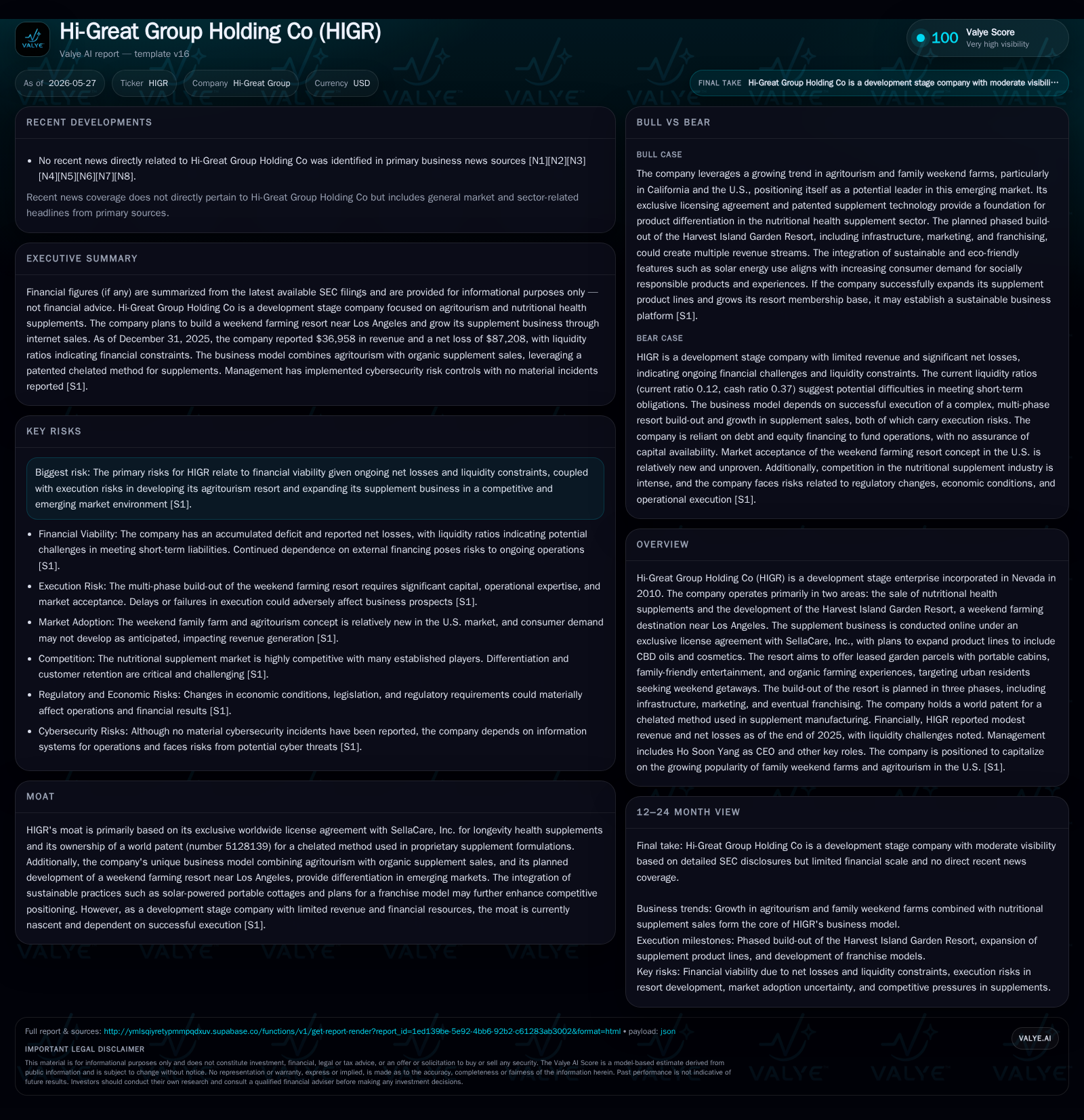
Hi-Great Group Holding Co (HIGR) remains a development-stage company operating a two-pronged business model focused on online nutritional health supplements and an emerging agritourism resort near Los Angeles. Its latest quarterly filing reveals steady progress in governance but no revenue growth inflection, with 2025 revenues declining by nearly half year-over-year. The firm’s exclusivity license agreement and patented chelated method underpin its supplement strategy, while the Harvest Island Garden Resort aims to tap into experiential organic farming for urban weekenders. Financial viability concerns persist due to liquidity strain and sustained net losses, making operational execution and capital raises critical for future growth prospects.
Recent Operating Update: Quarterly Insights and Implications
Hi-Great Group Holding’s latest quarterly filing dated December 15, 2025 ([S2]) provides the freshest operational snapshot ahead of its recent annual disclosure. The Form 10-Q was reviewed by an independent auditor, signaling some governance and transparency improvements amid ongoing development-stage challenges. However, this quarterly update offers little indication of revenue inflection or material progress in reversing prior declines. Cash flow pressures remain elevated with a starkly low current ratio of 0.12 as per year-end metrics ([F1]), underscoring severe short-term liquidity constraints.
While the company is progressing through foundational steps in both its supplement sales platform and agritourism resort buildup, the quarterly data suggest that meaningful commercial traction remains elusive so far. Importantly, management continues to focus on internal controls and compliance as prerequisites for scaling operations.
Business Model Overview: Supplement Sales and Agritourism Synergies
Hi-Great Group operates a distinctly bifurcated business model combining two complementary but separate pillars:
Nutritional Health Supplements: Conducted primarily through an exclusive worldwide license agreement with SellaCare Inc., HIGR sells dietary supplements online using proprietary formulations anchored by patent #5128139. This patent covers a chelated method believed to enhance mineral bioavailability—a technical differentiation intended to carve out competitive advantage in the saturated health supplement sector ([S1]). New products are cautiously withheld during a current year-long period while management redesigns its e-commerce platform and undertakes branding refresh efforts to boost customer engagement.
Harvest Island Garden Resort: This initiative represents a novel agritourism venture near Los Angeles targeting city dwellers seeking organic farming experiences combined with portable cabin lodging for weekend getaways. The build-out is planned over three phases encompassing infrastructure development (solar-powered cottages), ramping marketing campaigns highlighting family-friendly amenities, and eventual franchising schemes for scalability ([S1]). The synergy envisaged lies in cross-promoting organic health lifestyles through both consumable supplements and experiential resort stays.
This duality allows HIGR to differentiate itself by integrating sustainable agricultural tourism with scientifically backed supplement offerings. However, as a development stage entity, it must overcome several sequential milestones before commercial scalability.
Market Position and Industry Context: Health Supplements and Agritourism Competitors
Within the online nutritional supplement space—characterized by fierce competition from established incumbents—HIGR’s competitive moat rests narrowly on its world patent covering chelated supplement methods plus exclusivity rights granted by SellaCare. These intellectual property elements provide some pricing latitude compared with commodity supplements where pricing pressures are typically acute. Nonetheless, customer switching costs remain low industrywide given abundant alternatives available digitally.
The company's forthcoming expansion into CBD oils and cosmetics introduces regulatory complexity as well as volatile supply chain dynamics complicated by varying state-level cannabis legislation ([S1]). Successful navigation requires compliance acumen and robust sourcing strategies.
On the agritourism front, the Harvest Island Garden Resort targets an increasingly trendy experiential travel sector focused on sustainability-conscious consumers. Using solar-powered portable cottages showcases eco-friendly architectural concepts potentially creating defensible barriers versus traditional resort models reliant on fixed infrastructure. Geographically situating near Los Angeles taps into large metropolitan demand pools but also exposes HIGR to higher land costs and regulatory hurdles associated with recreational agricultural usage.
Together these markets comprise fragmented competitive arenas where scale economies favor incumbents; thus HIGR must leverage innovation-driven marketing plus operational discipline to establish footholds.
Growth Drivers: Product Expansion, Branding Refresh, and Resort Build-Out
HIGR outlines several key growth vectors shaping its near- to medium-term trajectory:
Product Line Expansion: After a strategic year-long hiatus on new product introductions following the annual filing date ([S1]), plans include rolling out novel formulations incorporating multiple CBD oil strains targeting both health wellness supplements and cosmetic applications. This extension aligns with broader industry trends merging wellness lifestyle brands with cannabinoid-derived ingredients.
Digital Platform Upgrade: The company actively redevelops its retail website aiming to enhance internet traffic acquisition capabilities alongside improved customer retention via richer content like expert videos focusing on alkalization methods, amino acid benefits, mineral supplementation efficacy—all revolving around their patented chelated approach ([S1]). Success here can translate directly into improved conversion metrics boosting revenue capture without commensurate increases in fixed marketing spend.
Harvest Island Garden Resort Development: Progress through three defined phases—installation of eco-friendly infrastructure including solar-powered cabins; targeted marketing emphasizing family-friendly organic farming experiences; followed by scalable franchising rollouts designed to monetize brand equity rapidly across broader geographies near major urban centers ([S1]). Each phase completion serves as a discrete milestone unlocking incremental capacity and revenue potential.
Effectively coordinating these growth initiatives demands tight budget control given limited cash runway combined with validated traction metrics such as website conversion rates or early resort booking volumes.
Risks and Constraints: Financial Viability and Execution Challenges
The dual-business model presents compounded risks stemming from fragile financial footing coupled with inherent execution complexities:
Liquidity Pressure: As of December 31, 2025 the current ratio stood at an alarming 0.12 ([F1]), reflecting current liabilities vastly exceeding current assets. This imbalance creates acute short-term risks regarding meeting operating obligations absent timely cash inflows or external financing injections.
Cumulative Deficit & Operating Losses: An accumulated deficit approaching $1 million with worsening net losses—$87,208 in 2025 versus $48,616 in prior year—spotlights ongoing negative earnings trend despite cost cutting in select areas such as professional fees ([S1], [F1]).
Execution Risks: Building out the Harvest Island Garden Resort involves capital-intensive infrastructure projects subject to timing delays or cost overruns amid construction market inflation trends documented inside general administrative expense increases ([S1]). Complementarily expanding into CBD product lines entails navigating evolving regulatory environments which could slow time-to-market or inflate compliance costs.
Competitive Pressures: Both supplement sales and agritourism are competitive sectors requiring differentiation beyond patents or location advantages alone; failure to cultivate strong brand loyalty or maintain pricing power may erode margins further.
Collectively these factors necessitate cautious operational scaling synchronized tightly with proven revenue gains or investor funding rounds.
What to Watch Next: Operational Milestones and Market Signals
Key forthcoming developments will provide insight into management's ability to break cycle losses while advancing strategic agendas:
- Completion status of next phases in Harvest Island Garden Resort build-out including cabin installations and initial franchise partner agreements if any;
- Launch timeline and early performance metrics following rollout of refreshed branding assets coupled with redesigned retail website;
- Introduction schedule for first CBD oil derived products backed by marketing campaigns targeting niche consumer segments;
- Quarterly cash flow trends reflecting any improvements linked directly to enhanced revenues or cost containment;
- Disclosure of new equity financing rounds or debt facilities providing additional operational runway.
Close monitoring on web traffic analytics post-redesign could act as leading indicator of potential uplift in online health supplement sales—a crucial KPI given lackluster historical revenue growth.
Financial Review: Performance Trends and Liquidity Overview
Historical performance (annual)
Capital returns and efficiency (annual)
A concise financial summary drawn from the latest annual data ([F1], [S1]) underscores fiscal challenges:
Revenues have contracted dramatically (-46.6% YoY) from $69k in 2024 down to under $37k in 2025 despite ongoing investments in branding upgrades. Operating losses widened substantially (net loss increased nearly 80%) while operating cash flow deteriorated significantly indicating heightened burn rate exceeding earlier periods.
The current ratio remains notably low at 0.12 ([F1]), reflecting current liabilities far exceeding current assets. Despite interest expense elimination reflecting debt restructuring efforts reported last year ([S1]), this easing provides only limited relief relative to scaling needs.
In sum, financial results align logically with developmental-stage status yet raise concerns regarding sustainability without immediate inflections either from successful capital raises or meaningful commercial breakthroughs.
This analysis does not constitute investment advice but aims to provide an informed assessment grounded exclusively on publicly filed disclosures.
Disclaimer: This is research-only, informational analysis and not investment advice. It may include AI-generated interpretation and general industry context. Always verify important details using primary sources.

Comments