
Health In Tech Advances Automated Health Insurance Underwriting with Latest Quarterly Gains
Health In Tech's Q1 2026 results underline the accelerating adoption of its AI-driven underwriting and expanding broker network, reshaping the digital insurance marketplace for self-funded health plans.
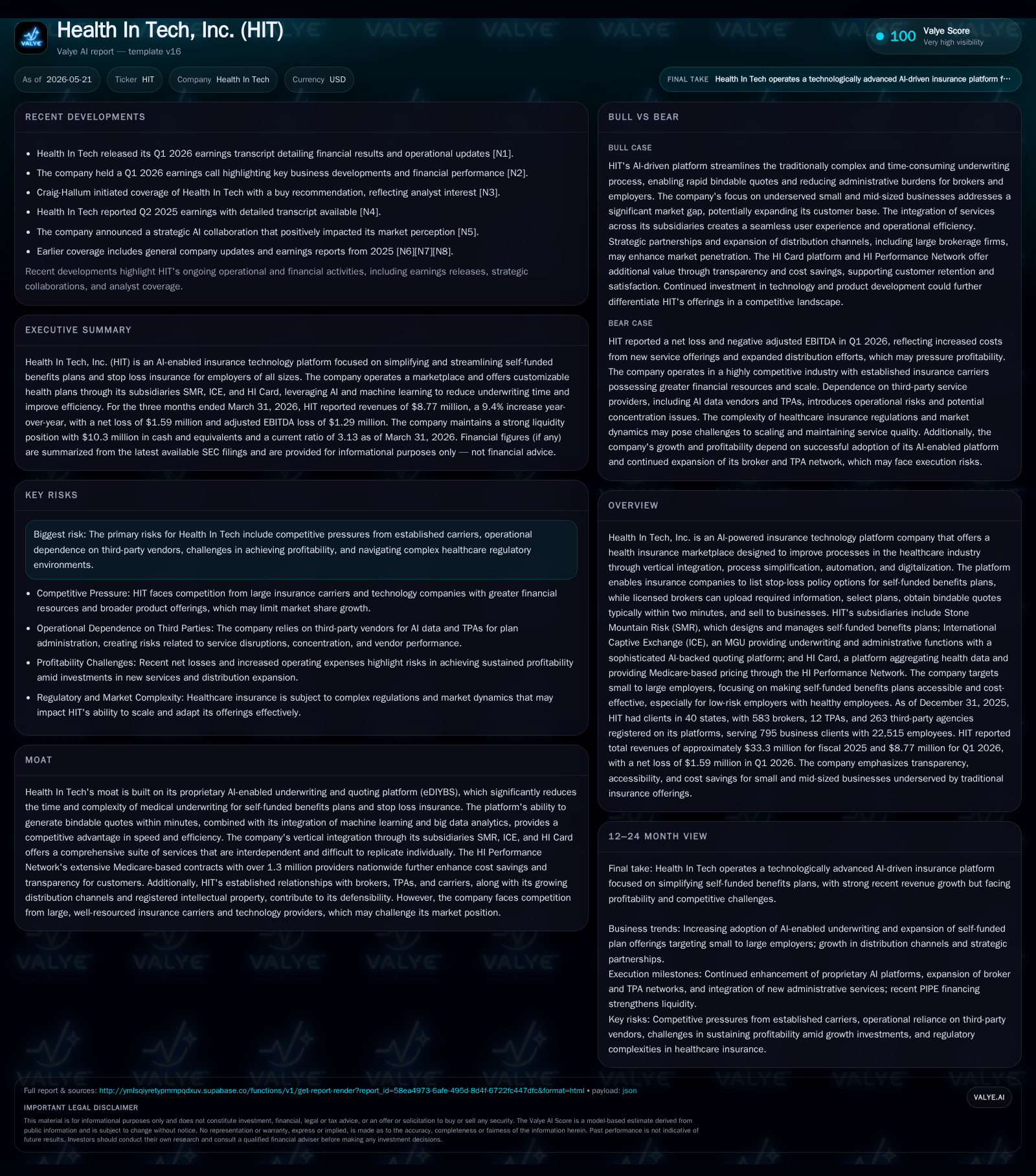
In Q1 2026, Health In Tech (HIT) demonstrated notable progress in scaling its AI-powered insurance platform, with a shift towards higher fee-based revenue through Stone Mountain Risk (SMR) and a corresponding decline in underwriting revenue from International Captive Exchange (ICE). The company continues to leverage its proprietary eDIYBS technology to provide bindable stop-loss quotes within minutes, enhancing broker productivity and customer accessibility. Vertical integration across subsidiaries SMR, ICE, and HI Card creates a differentiated position supported by data aggregation and Medicare-based pricing contracts. While competitive pressures and regulatory dynamics present risks, HIT’s expanding platform footprint and technology enhancements offer clear growth levers amid an evolving insurtech landscape.
Latest Quarter Operating Highlights: Accelerating AI-Enabled Underwriting
Health In Tech’s Q1 2026 10-Q filing highlights a continued pivot towards fee-driven revenue growth mainly from Stone Mountain Risk (SMR), which accounted for 83.3% of total Q1 revenues at $7.3 million, up from prior periods [S2]. Conversely, the International Captive Exchange (ICE) segment — focused on underwriting modeling using HIT's proprietary eDIYBS AI platform — experienced a decline to $1.47 million or 16.7% of total revenue from a higher base previously [S2]. Despite this relative decline in ICE revenue share, the platform continues to deliver technologically advanced capabilities enabling brokers to secure bindable stop-loss insurance quotes within approximately two minutes [S1].
This rapid quoting turnaround materially reduces sales cycle friction compared with legacy approaches that can require days or weeks for binding. The launch of SMR’s self-funded health benefit plan administration services effective January 2026 has propelled fee income growth and accounts receivable expansion—net receivables jumped nearly $3 million sequentially by Q1-end reflecting new onboarding successes [S21]. Additionally, distribution expansion efforts through registered brokers, TPAs, and third-party agencies maintain a positive trajectory with over 800 brokers now active on the platform [S1]. The company’s May 2026 earnings call reinforced confidence in continued automation of administrative processes aimed at further shortening underwriting timeframes while reducing manual overhead burdens on broker partners [N1][N2].
Business Model and Revenue Streams: Marketplace and Subsidiary Synergies
Health In Tech derives revenue primarily via two complementary streams: recurring fees from plan management services delivered by Stone Mountain Risk (SMR) and commissions or fees tied to underwriting modeling provided by International Captive Exchange (ICE) [S1]. SMR designs and manages self-funded benefits plans for businesses while ICE acts as a Managing General Underwriter (MGU) leveraging HIT's AI-powered quoting engine eDIYBS to underwrite stop-loss insurance policies digitally. This vertical integration allows HIT to internally coordinate core functions otherwise fragmented across multiple third parties in traditional markets.
The HI Card platform supplements these offerings by aggregating health data and enabling Medicare-based pricing through HIT’s HI Performance Network—a competitive advantage as it offers customers enhanced cost transparency through contracts covering over 1.3 million providers nationwide. This integration not only facilitates control over cost drivers but also enhances client stickiness through bundled service utility.
Brokers pay HIT for access to the streamlined quoting engine plus related administrative functionalities; volume is driven by agents uploading requisite customer information to generate customizable plan options rapidly. Switching costs arise as brokers embed HIT’s eDIYBS tools into their workflows alongside SMR’s administration services that require deep familiarity with client-specific benefit structures [S1]. Customer retention benefits from efficient product customization capabilities combined with ongoing vendor claims management under SMR.
Competitive Landscape and Industry Dynamics in Digital Health Insurance Platforms
Within the fragmented $5 trillion U.S. healthcare insurance ecosystem, self-funded benefits plans are gaining popularity among mid-size employers seeking cost savings but remain operationally complex due to underwriting intricacies and regulatory oversight [S1]. Traditional carriers have slower manual processes limiting responsiveness. HIT competes against established insurers and insurtech MGUs but differentiates itself through its proprietary AI underwriting technology (eDIYBS) capable of delivering near-instantaneous bindable quotes—a capability few peers fully emulate.
Regulatory complexity around healthcare insurance mandates both constant compliance diligence and navigation of emerging AI regulations potentially affecting underwriting algorithms [S1]. Brokers wield substantial gatekeeper power given their client relationships; hence HIT’s focus on building strong broker partnerships translates into distribution moats difficult for new entrants without similar vertical integration or technological depth.
Growth Catalysts: Enhanced Distribution and Platform Expansion
Key growth drivers include expanding the registered broker base—surpassing 800 agents plus multiple TPAs—and onboarding strategic partnerships with larger nationwide brokerage firms as outlined in the latest annual report [S1]. These actions support network effects whereby broader agent adoption drives more quote volume feeding SMR's plan administration demand.
Automation improvements around quoting speed not only expedite client acquisition but reduce churn risk; incremental enhancements planned through continuous R&D investments target further reducing policy quoting times below current ~2-minute benchmarks [N4][S15]. Additionally, America-wide Medicare-contract coverage embedded in HI Card gives customers cost advantages that can be marketed effectively alongside insurance products.
Together these address two critical friction points in selling self-funded plans: lengthy underwriting delays hindering client conversions, and opaque provider pricing restricting employer confidence.
Risks and Constraints: Regulatory, Competition, and Operational Challenges
HIT faces risks typical of insurtech innovators operating within highly regulated healthcare fields. While current AI-related regulations do not presently pose material risk, future regulatory interpretations could impact algorithmic underwriting models adversely requiring costly adjustments or reducing competitive advantage [S1]. The company also contends with intense competition from entrenched health carriers whose legacy systems contrast with HIT’s modern digital approach but who benefit from vast capital resources.
Operationally, reliance on third-party vendors—particularly for critical data services underpinning AI analytics—creates potential vulnerabilities if service interruptions occur or contracts shift unfavorably. Furthermore, scalability pressures drive elevated sales & marketing expenses necessary to accelerate broker/agency onboarding which have contributed to recent net losses despite increasing revenues [S2][S15]
Upcoming Milestones and Market Watchpoints
Strategic execution markers over upcoming quarters include the pace of registered agent additions on HIT’s platforms—a barometer of marketplace traction—as well as improvements in average quoting turnaround times derived from ongoing automation enhancements [S2][N1]. Progress in formalizing partnerships with major brokerage firms will serve as an inflection point for scaling premium volumes across SMR-managed plans.
Regulatory clarity regarding AI use in medical underwriting remains important; any shifts requiring system changes could affect timing or margins. Financial guidance relative to stabilizing net income amidst scaling investments will also merit close attention during quarterly disclosures [N4][S3]
Financial Overview: Current Liquidity, Profitability, and Expense Structure
HIT ended Q1 2026 with approximately $10.3 million in cash and equivalents and a current ratio exceeding 3x ($22.09 million current assets versus $7.05 million current liabilities), indicating solid liquidity for near-term operational needs [F1][S2]. Capital infusion totaling about $6.3 million via PIPE financing early in 2026 bolstered the balance sheet supporting continued technology development and distribution ramp-up.
However, the company incurred a net loss of $1.59 million during the quarter due principally to increased sales & marketing expenditures expanding distribution channels alongside sustained R&D spend focused on platform enhancements [S15]. Adjusted EBITDA reflected this shift with a negative $1.29 million result compared to positive performance last year. The operating expense mix shows growing investment consistent with scaling priorities though profitability remains pressured in the short term until fixed costs are absorbed.
This analysis reflects information publicly disclosed up through May 2026 filings without projection or investment advice. It synthesizes financial data with operating updates contextualized within Health In Tech's strategic positioning amid healthcare insurtech trends.
Disclaimer: This is research-only, informational analysis and not investment advice. It may include AI-generated interpretation and general industry context. Always verify important details using primary sources.

Comments