
Harley-Davidson's 2025 Revenue Decline and Tariff Impact Challenge Growth and Profitability
Harley-Davidson faces top-line pressure from declining motorcycle shipments and tariff headwinds, offset partially by financial services gains and cost reductions.
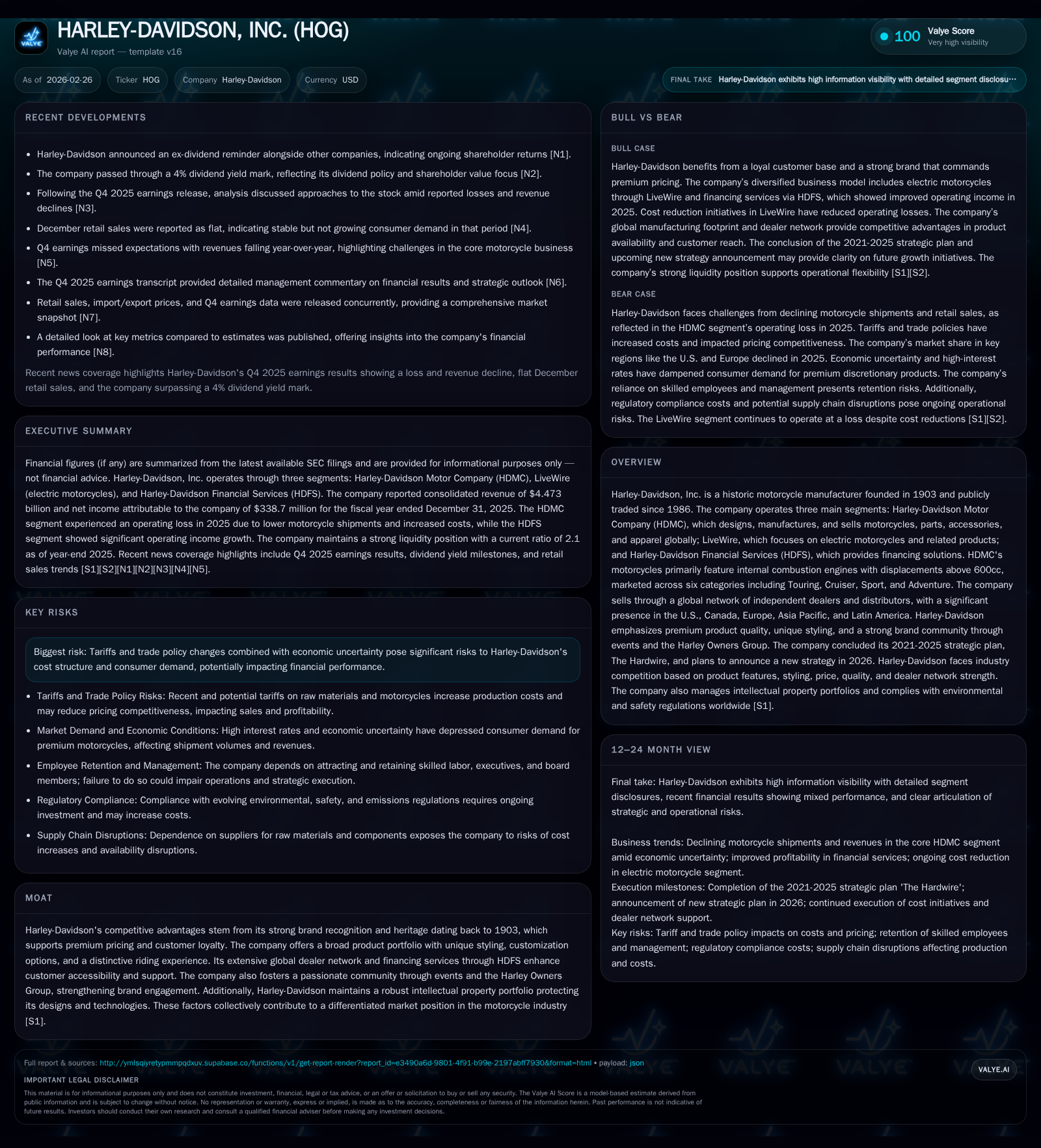
In 2025, Harley-Davidson's revenue fell nearly 14% due to lower motorcycle shipments amid a challenging economic environment with high tariffs impacting cost structures. Operating income dropped by 7%, driven primarily by the Motorcycle segment’s losses, despite improved results from Harley-Davidson Financial Services and cost reductions in the LiveWire electric segment. The company’s strategic focus shifts as it concludes the Hardwire plan, with a new strategy pending in early 2026. Capital allocation remains disciplined with ongoing share repurchases and dividends, supported by a solid liquidity position.
Company Overview
Harley-Davidson, Inc., established in 1903 and publicly traded since 1986, operates three segments: Harley-Davidson Motor Company (HDMC), LiveWire focusing on electric motorcycles, and Harley-Davidson Financial Services (HDFS). The company is renowned for its premium internal combustion engine motorcycles primarily above 600cc displacement marketed globally across six categories including Touring and Cruiser models [S1]. Products sell through over 1,170 dealership points worldwide supported by robust financing solutions via HDFS [S14][S23].
Historical Performance Summary
Harley-Davidson experienced a notable decline in financial performance in fiscal year 2025 against both 2024 and earlier periods as shown below. The overall consolidated revenue dropped by nearly 14%, driven mainly by lower motorcycle shipments amid subdued consumer demand from elevated interest rates and economic uncertainty [S1][F1]. Operating income contracted less sharply but still significantly (-7%), while net income fell approximately one-quarter year over year.
Historical performance (annual)
| FY | Rev ($bn) | Net ($mm) | CFO ($mm) | OpInc ($mm) | Rev YoY | Net YoY |
|---|---|---|---|---|---|---|
| 2025 | 4.5 | 339 | 569 | 387 | -13.8% | -25.6% |
| 2024 | 5.2 | 455 | 1064 | 417 | -11.1% | -35.6% |
| 2023 | 5.8 | 707 | 755 | 779 | +1.4% | -4.7% |
| 2022 | 5.8 | 741 | 548 | 909 |
Source: SEC companyfacts cache [F1].
Capital returns and efficiency (annual)
| FY | Div ($mm) | Buybacks ($mm) | FCF ($mm) |
|---|---|---|---|
| 2025 | 86 | 353 | 415 |
| 2024 | 91 | 460 | 867 |
| 2023 | 96 | 364 | 547 |
| 2022 | 93 | 339 | 397 |
Source: SEC companyfacts cache [F1].
Note: Figures rounded; all values per [F1].
Segment Analysis
Harley-Davidson Motor Company (HDMC)
Motorcycle sales declined sharply with wholesale unit shipments down notably, leading to an operating loss of $28.7 million in contrast to operating income of $277.8 million the prior year [S1]. This deterioration was attributed mainly to volume declines reflecting weak retail sales impacted by macroeconomic headwinds including higher interest rates depressing discretionary spending [S1]. Further margin compression arose from increased tariffs adding roughly $67 million in incremental costs during the year [S1], alongside unfavorable manufacturing leverage due to fixed costs being spread over lower production runs [S16]. Favorable pricing adjustments partially mitigated some cost pressures but did not counterbalance volume losses.
LiveWire Segment
LiveWire revenues were essentially flat at approximately $26 million but reduced operating losses meaningfully from about $110 million to $75 million as cost reduction programs took hold [S1][S16]. The company has slowed investment commitments amid an EV adoption climate slower than initially forecasted due to regulatory challenges and insufficient charging infrastructure proliferation [S7]. However, LiveWire continues to seek external capital under an At-The-Market program while recalibrating its product portfolio including planned mini-electric motorcycles aimed at urban riders.
Harley-Davidson Financial Services (HDFS)
HDFS delivered strong profitability growth with operating income nearly doubling from $248 million to over $490 million largely because of a one-time release of credit loss allowances tied to selling a significant portion of receivables via a transaction completed mid-2025 (the “HDFS Transaction”) [S1]. While interest expense increased due to debt extinguishment costs linked with this transaction [$72.6M], these were more than offset by reduced credit losses and other income improvements [S18]. Loan delinquencies ticked up reflecting macroeconomic stress but remained manageable.
Outlook & Growth Prospects
The Hardwire strategic plan that guided Harley-Davidson through five years emphasizing profitable core segments, expansion within product categories including electrification, customer experience enhancement, and stakeholder engagement concluded end-2025 [S23]. Management intends to unveil its next strategic framework alongside Q1-2026 results — a pivotal milestone given the changing motorcycle market dynamics.
Growth could be fostered by successful new product launches targeting premium niches while navigating tariff-related cost inflation; however, risks remain from uncertain consumer demand amid economic volatility and potential ongoing trade policy shifts affecting raw materials and components [S1][S2]. For electrification efforts via LiveWire, slower government incentive momentum constrains rapid scaling but targeted urban micro-EVs might tap new rider cohorts over time [S7]. Financial services should continue contributing solid profits if funded efficiently amid capital market conditions.
Financial Health & Capital Allocation
Liquidity is strong with more than $3 billion in cash and equivalents complemented by committed credit facilities exceeding $4 billion combined with commercial paper conduits providing flexible funding sources [S4][F1]. Cash flow from operations almost halved from prior year levels due to operational headwinds but remained robust at around $569 million yielding positive free cash flow above $400 million after modest capex spend focused on operational needs rather than expansion [F1].
The balance sheet is healthy with shareholders’ equity holding steady near $3.14 billion generating an approximate return on equity of ~11%, consistent with a premium brand manufacturer facing cyclical pressures [F1]. Opportunistic buybacks remained active although at reduced levels relative to previous years ($353 million repurchased in fiscal 2025 vs. ~$460 million prior) alongside stable dividend payouts approaching $86 million reinforcing commitment to shareholder returns [F1][S12][S29].
Industry Context & Competitive Positioning Analysis
Harley-Davidson maintains differentiated advantages through iconic brand heritage dating back over a century permitting premium pricing power rarely matched among powersports competitors [S1]. Its broad portfolio offers customizable motorcycles appealing across six segments ensuring diverse rider appeal while dealer networks across multiple regions enable geographic reach despite regional taste variability [S14][S17]. Harley effectively combines internal combustion models maintaining traditional enthusiasts alongside cautious expansion into electrics via LiveWire.
Yet industry trends pose challenges—the increasingly restrictive trade environment inflates input costs notably steel/aluminum tariffs linked since U.S.-EU disputes reverberate through pricing chains affecting margin sustainability; meanwhile macroeconomic cycles weigh on discretionary spending patterns crucial for premium motorbikes selling mostly into mature markets where consumer confidence drives purchase behaviors . Electrification remains embryonic within heavyweight bikes; sluggish government incentives coupled with infrastructure gaps postpone mass adoption delaying scale benefits for LiveWire versus conventional rivals focusing heavily on electric scooters or smaller EV two-wheelers.
Risks & Governance Considerations
Material risks center on tariffs and trade policies which can unpredictably shift cost structures while dampening demand if retail prices rise excessively or import restrictions emerge abruptly impacting supply lines [S1][S2]. Cybersecurity leadership transitions reflect managerial changes impacting risk oversight though existing committees remain vigilant addressing potential incidents promptly ensuring regulatory compliance continuity [S1]. Legal matters such as Japanese distribution investigations currently expected not materially costly are monitored cautiously [S1].
Furthermore, retail credit performance reveals stress signals: higher delinquency rates alongside diminished recovery values challenge HDFS’s underwriting discipline requiring sustained vigilance given dependency on consumer finance health amid broader interest rate pressures [S18]. Market acceptance of electric bikes remains slower than anticipated constraining the medium-term ramp-up potential for LiveWire [S7].
Monitoring & Key Milestones Ahead (Analysis)
- Watch Q1-2026 earnings release for clarity on updated strategic direction replacing Hardwire,
- Assess tariff developments—whether court rulings or legislative changes mitigate or exacerbate current costs,
- Track retail motorcycle sales recovery signals post-economic uncertainty,
- Monitor LiveWire's capital raising effectiveness plus product launch reception,
- Observe HDFS funding costs and loan portfolio credit quality stability amidst rising rates.
Conclusion
Harley-Davidson encounters significant headwinds underlying its flagship motorcycle business characterized by shipment declines exacerbated by tariff escalations that inflate input prices while consumer cautiousness curtails discretionary spending power amidst persistent macroeconomic uncertainty. Nevertheless, layered contributions from financial services buoy profitability somewhat offsetting operational weaknesses while disciplined expense controls trim LiveWire losses signaling incremental progress towards sustainable EV presence albeit challenged by structural delays in market adoption.
Together with healthy liquidity reserves and steady capital returns indicating financial prudence geared towards sustaining long-term shareholder value creation—Harley-Davidson stands at a strategic inflection point necessitating renewed growth initiatives shaped through upcoming management guidance gauges critical navigating evolving global trade landscapes shifting customer preferences towards electrification blended with classic brand loyalty.
This analysis is based solely on publicly available SEC filings and recent news transcripts as cited without any investment recommendation or forward-looking assurances beyond facts disclosed therein.
Disclaimer: This is research-only, informational analysis and not investment advice. It may include AI-generated interpretation and general industry context. Always verify important details using primary sources.

Comments