
Hovnanian's Strategic Growth and Margin Challenges in Q2 2026
Q2 2026 results reveal margin contraction amid backlog declines offset by international expansion and quick move-in home initiatives.
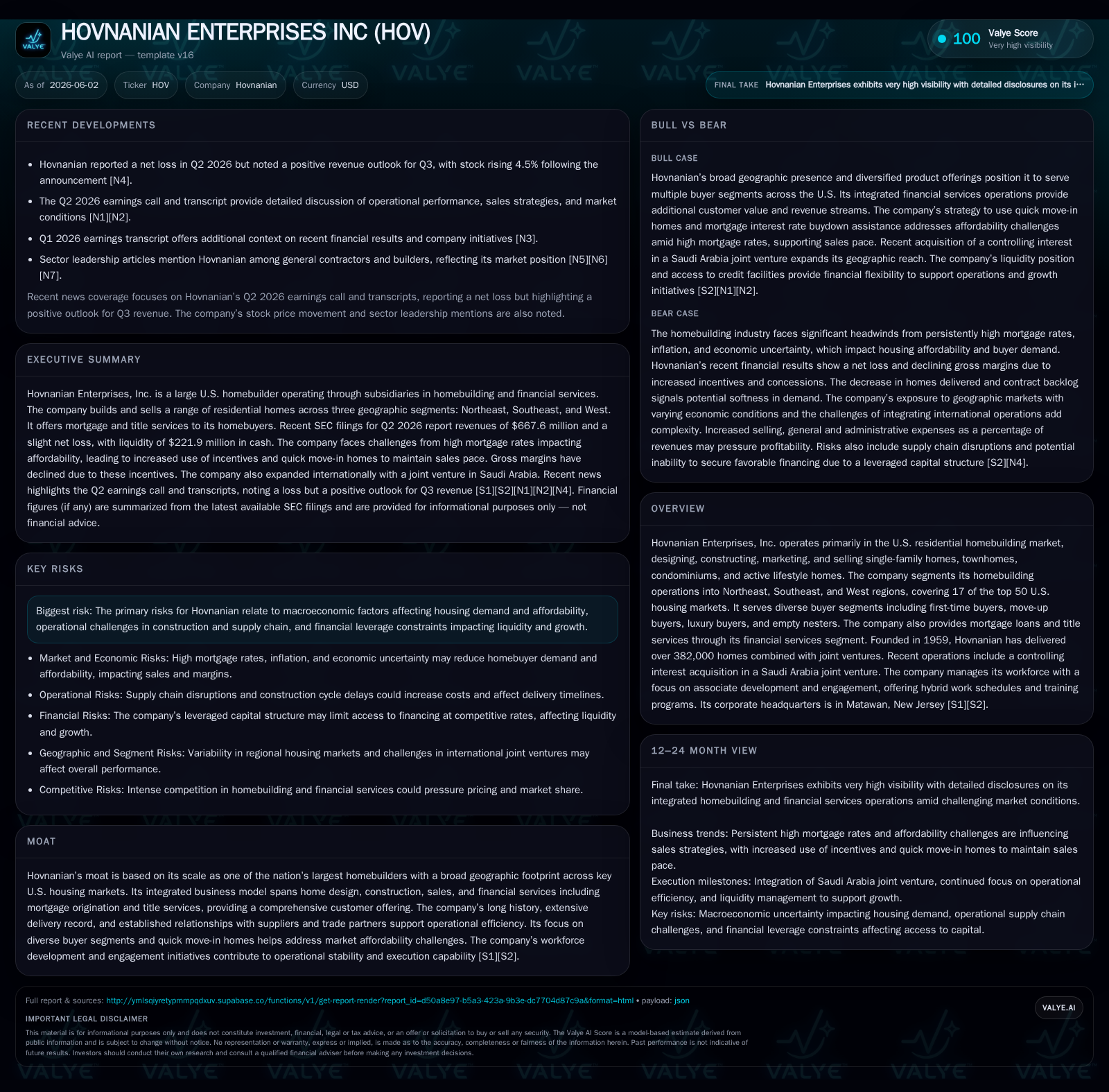
In Q2 2026, Hovnanian Enterprises faced meaningful homebuilding gross margin compression to 10.2%, down from nearly 14-15% a year ago, driven by product mix shifts and cost pressures. Domestic contract backlog decreased approximately 5%, signaling modestly softening demand amid persistent affordability challenges. However, the recent acquisition of a controlling interest in a Saudi joint venture introduces an international growth vector with efficient inventory management. The company’s vertically integrated model spanning design, construction, sales, and financial services remains strategically relevant but is tempered by tight leverage and elevated cancellation risks.
Q2 Margin Compression and Backlog Trends
Hovnanian's latest quarterly report for the period ended April 30, 2026, discloses notable pressure on homebuilding gross margins. The company’s total homebuilding gross margin percentage declined sharply to 10.2% from prior year periods of approximately 14% (13.8% for the three months ended April 30, 2025). Even on a basis excluding cost of sales interest expense and land charges—a key non-GAAP metric favored for isolating operational performance—the gross margin slipped from over 17% a year ago to around 14% this period [S2]. This decline stems primarily from shifts in product mix across its various communities and heightened cost inputs, possibly including labor and material inflation faced broadly in residential construction.
The domestic contract backlog—a critical leading indicator denoting homes under contract but not yet delivered—contracted by about 5% both in dollar value and unit count compared to April 2025 levels [S2]. This points to a moderate slowdown in order intake amid challenging financing conditions for buyers due to persistently high mortgage rates. Moreover, active selling communities decreased from 140 last year to 125 presently; these are defined as communities with ten or more available home sites open for sale. This contraction reflects a tighter operational footprint or possibly strategic pacing adjustments responding to demand uncertainty [S2]. Collectively, these metrics indicate moderating near-term volume momentum that warrants close monitoring going forward.
Integrated Homebuilding and Financial Services Model
Hovnanian operates an integrated business model combining residential homebuilding—spanning design, construction, marketing, and sale—with financial services that include mortgage lending and title insurance operations [S1]. This vertical integration creates cross-selling opportunities and contributes incremental revenue beyond pure home sales. Mortgage origination through its financial subsidiary supports consumer financing availability internally but also exposes the company to credit market dynamics.
Such an integrated model strategically positions Hovnanian to serve multiple buyer segments spanning first-time purchasers through luxury customers across diverse U.S. markets while leveraging financial services toward closing transactions efficiently. However, margin variability remains influenced materially by product mix shifts—as different home styles yield distinct profitability profiles—and the prevailing financing environment impacts buyers’ purchasing power, an influence tracked distinctly in canceled contracts versus net contracts executed [S1][S2]
Geographic Presence and Buyer Segment Strategy
The company segments its homebuilding operations geographically into Northeast, Southeast, and West regions covering approximately 17 of the top 50 U.S. housing markets [S1]. Its reach encompasses urban infill projects alongside single-family detached homes, townhomes, condominiums, and active lifestyle products tailored for empty nesters.
This broad footprint offers exposure diversified across economic zones with variable housing affordability profiles. The current year-over-year reduction in active selling communities—an important volumetric KPI—implies region-specific pacing adjustments or supply-side constraints possibly linked to land acquisition timing or construction scheduling complexities inherent to local permitting regimes [S2]. These factors interact with customer segments where quick move-in (QMI) inventory has been notably expanded as a tactical response to support affordability amid high interest rates restricting buyer budgets [S2]. QMI homes enable shorter transaction timelines responding better to buyer demand volatility.
Competitive Positioning in U.S. Homebuilding Sector
As one of the nation’s largest homebuilders by volume with an established track record delivering over 382,000 homes combined with joint ventures since inception, Hovnanian commands significant scale economies [S1]. Its vertically integrated operations afford synergies spanning procurement through delivery.
Nevertheless, within the context of elevated mortgage rates persisting since fiscal 2025 and leading into fiscal 2026, the company exhibits compressed margins reminiscent of peers weathering similar headwinds. Larger builders often face pressure from rising input costs counterbalanced only partially by pricing power curtailed by affordability limits on customers. Hovnanian's ability to pivot via pricing incentives while managing cancellation risk is pivotal relative to both high-velocity regional competitors focusing on either luxury or entry-level market niches.
While many peers focus primarily on domestic growth trajectories, Hovnanian's strategic move into international markets via its controlling interest acquisition in Saudi Arabia distinguishes its growth ambitions from most U.S.-focused rivals by introducing diversification into an emerging market with potentially different demand drivers.
Growth Drivers: International Expansion and Quick Move-In Homes
A salient element of Hovnanian’s recent operating developments is the acquisition of a controlling stake in its previously unconsolidated Kingdom of Saudi Arabia (“KSA”) joint venture early in fiscal 2026 [S2]. The KSA operations present a fresh international foothold amid generally domestic-centric peer groups. Notably, at April-end quarter close, KSA held no started unsold homes or models indicating strong operational discipline on inventory buildup—an important factor reducing holding costs and mitigating exposure if regional demand fluctuates.
Domestically, Hovnanian has expanded its inventory of quick move-in homes designed specifically to attract buyers facing challenging interest rate environments requiring faster occupancy options [S2]. By offering more readily available product with minimal completion lead time, the company improves appeal especially within affordability-constrained buyer cohorts.
These complementary domestic tactics combined with selective international ventures form the crux of near-to-medium term growth priorities aiming at balancing stabilization amid U.S. macroeconomic pressures.
Key Risks: Affordability Challenges and Leverage Constraints
The housing market remains exposed broadly to macroeconomic variables such as persistent high mortgage rates that depress buyer affordability despite stable employment conditions—a primary risk factor noted explicitly by management [S2][S21]. Declining backlog alongside margin compressions signals sensitivity to price concessions necessary in competitive conditions.
Moreover, Hovnanian carries significant total debt approximating $925 million with net debt near $703 million after cash balances as of April-end fiscal year-to-date data suggests [F1]. While no financial maintenance covenants exist on this debt tranche—providing some flexibility—the presence of restrictive covenants limits new leverage accumulation potentially constraining capital deployment for aggressive growth or refinancing opportunities absent deleveraging actions.
Cancellation rates have become a crucial volatility vector during tightened credit cycles since they diminish effective backlog conversion into revenue—a phenomenon industry-wide under stress but more acute where pricing adjustments erode margins further.
Operational exposures including project execution delays or supply chain interruptions inherent in large-scale multi-region construction exacerbate risk profiles alongside dependency on key supplier relationships discussed annually [S1][S22].
Near-Term Indicators to Monitor: Backlog, Pricing, and Financing Conditions
Investors should focus on several KPIs for early indication of trajectory shifts: changes in net contracts per active selling community provide sales pace insight; contract cancellation rates shed light on buyer commitment strength; gross margin progression reveals cost control efficacy; and liquidity access underscores capacity to fund ongoing land purchases or development pipeline expansion [S2][N1][N2]
Pricing strategies balancing competitiveness against margin preservation will be critical as housing affordability constraints persist nationally. Simultaneously monitoring availability of mortgage financing—including stringent underwriting standards—and government initiatives could influence demand drivers tangentially impacting Hovnanian’s ordering dynamics.
Recently provided earnings call transcripts underscore management’s awareness of these variables as primary levers influencing operating outlooks through fiscal year end [N1][N2].[N4]
Financial Snapshot Supporting Operational Review
Supporting these operational insights is a financial position characterized by substantial debt load approximately $925 million along with $222 million cash equivalents dedicated principally to homebuilding operations plus $125 million undrawn capacity available via the senior secured revolving credit facility maturing June 30, 2028 [F1][S2]. Interest terms fluctuate based on secured overnight financing rate or alternate base rate floors plus applicable margins between roughly +3.5%-4.5%, increasing borrowing costs amid rising benchmark rates.
Net income trends have faltered compared to prior years amid operating pressures corroborating margin challenges detailed earlier [F1]
The financing framework includes no maintenance covenants but features numerous restrictive clauses typical for leveraged residential builders impacting dividend policies or asset sales ability.[S22] Careful capital management remains essential given elevated interest burdens relative to EBITDA reported historically.[N4]
This analysis relies exclusively on publicly available SEC filings including recent quarterly disclosures (Form 10-Q), annual reports (Form 10-K), current reports (Form 8-K), plus corroborated earnings call transcripts up through June 2026 without incorporating non-public information or speculative forecast data. It is intended solely for informational purposes emphasizing business fundamentals rather than investment research views.
Disclaimer: This is research-only, informational analysis and not investment advice. It may include AI-generated interpretation and general industry context. Always verify important details using primary sources.

Comments