
Hovnanian Enterprises Inc. (HOV) — Navigating Affordability Challenges Amid Market Cyclicality
Hovnanian Enterprises operates a diversified homebuilding and financial services platform across multiple U.S. regions while confronting persistent affordability headwinds and macroeconomic uncertainty. Its strategic emphasis on sales pace, quick move-in inventory, and mortgage buydown programs reflects adaptive tactics in a cyclical, capital-intensive industry with mixed margin pressures and evolving competitive dynamics.
Hovnanian’s geographic diversification and integrated mortgage/title services provide resilience against housing market volatility, yet persistently high mortgage rates and cautious buyer sentiment have compressed volumes and margins. The company’s investments in land and a new international joint venture represent growth options, but financial performance remains vulnerable to macroeconomic and affordability challenges. Monitoring backlog composition, incentive levels, and liquidity are key to assessing near-term recovery potential.
Hovnanian Enterprises operates in a highly cyclical and capital-intensive homebuilding sector characterized by sensitivity to mortgage rates and broader economic conditions. As of Q3 2026, the company faces volume declines driven by affordability constraints despite modest price resilience, resulting in compressed gross margins and a slight net loss. Its strategic deployment of quick move-in inventory and mortgage buydown incentives aims to bolster sales pace amid cautious buyer behavior. Meanwhile, ongoing land investments and a controlling stake in a Saudi Arabia joint venture point to a dual focus on domestic market optimization and international growth opportunities. The evolving macroeconomic landscape and housing affordability remain pivotal to Hovnanian’s near-term trajectory and operational leverage.
Latest Operating Snapshot
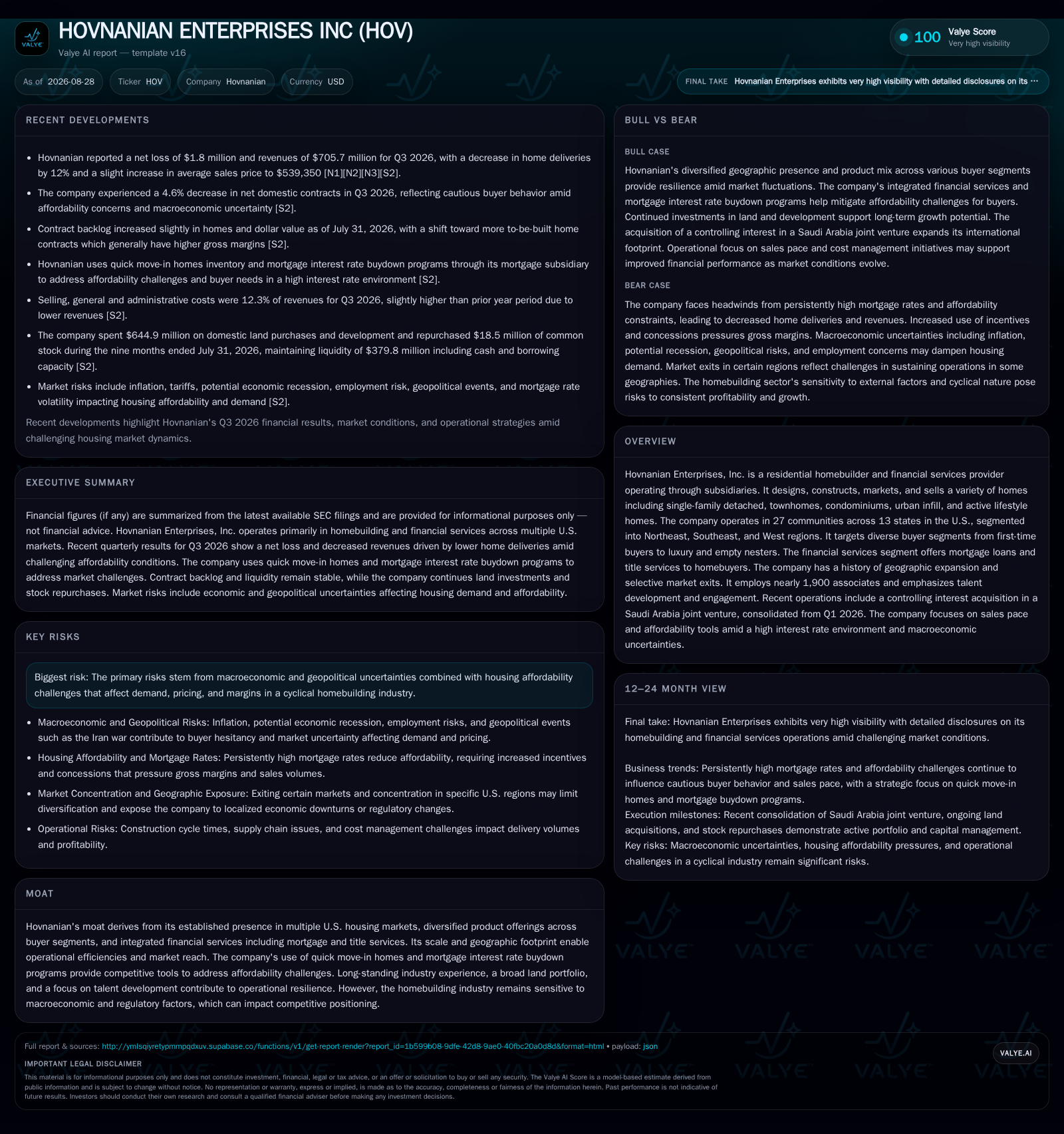
In Q3 2026, Hovnanian reported revenues of $705.7 million, marking an 11.7% decrease from the prior year, primarily due to a 12.0% reduction in homes delivered, despite a slight 0.4% increase in average sales price to $539,350 [S2][N1]. The net loss of $1.8 million and EPS of -$0.70 per share underscore the financial pressure from reduced volumes amid challenging market conditions [S2].
Contract backlog showed a slight increase in both units and dollar value as of July 31, 2026, with a notable shift toward more to-be-built homes, which generally offer higher gross margins but extend working capital cycles [S2]. The company’s use of quick move-in homes and mortgage interest rate buydown programs remains central to addressing affordability challenges in a high interest rate environment [S2]. Meanwhile, liquidity stood at $379.8 million, including $221.9 million in cash and borrowing capacity, sustaining capital investments such as $644.9 million spent on domestic land purchases and development during the nine months ended July 31, 2026 [S2].
Business Model and Unit Economics
Hovnanian’s business model combines homebuilding and financial services, generating revenue primarily through the sale of single-family homes, townhomes, condominiums, and related products across 27 U.S. markets. Revenue is driven by volume (homes delivered), pricing (average sales price), and product mix (home type and buyer segment). The firm targets diverse buyer profiles from entry-level to luxury and active lifestyle homes, allowing some pricing segmentation flexibility [S2].
Unit economics are influenced by land acquisition costs, construction expenses, incentives, and financing support. Fixed costs include land holdings and overhead, while variable costs relate to construction materials and labor. Operating leverage is constrained in the near term due to volume declines and increased incentives, notably mortgage rate buydowns that compress gross margins (homebuilding gross margin was 11.8% in Q3 2026, slightly above prior year quarter but down to 10.8% YTD) [S2]. The shift toward to-be-built homes in backlog may improve future margins but delays cash inflows and elevates capital intensity. Financial services operations offer ancillary revenue streams and facilitate sales but require management of credit risk and regulatory compliance.
Moat, Competition and Counterforces
Hovnanian’s moat rests on its diversified geographic footprint, spanning 13 U.S. states and multiple buyer segments, which mitigates localized downturns and enables market-specific product tailoring. The integrated financial services subsidiary offering mortgage loans and title services creates cross-selling opportunities and buyer affordability solutions, such as mortgage interest rate buydowns. This vertical integration can enhance customer stickiness and sales conversion rates amid competitive pressure [S2].
However, the residential construction industry is fragmented and highly sensitive to macroeconomic cycles, interest rates, and regulatory factors. Competitive threats arise from regional builders with stronger local brand recognition or niche players specializing in luxury or affordable segments. Increased incentives and concessions necessary to stimulate demand create margin pressures, while geographic exits in markets like Chicago and San Francisco reflect challenges maintaining competitive scale or profitability. Switching frictions are moderate, as buyers may pivot to rentals or alternative homebuilders if affordability or product appeal falters.
Bull Case
In a favorable scenario, mortgage rates stabilize or decline, improving housing affordability and enabling Hovnanian to convert its increased to-be-built backlog at higher gross margins. The company’s quick move-in home inventory and mortgage buydown programs effectively bridge buyer affordability gaps, accelerating sales pace and volume recovery. Continued land acquisitions position Hovnanian to capitalize on rising demand, while operational efficiencies and cost management enhance margin resilience. The Saudi Arabia joint venture grows profitably, diversifying revenue sources and providing international growth optionality [S2].
Confirming evidence would include sequential improvements in contract signings, higher gross margins without disproportionate incentive escalation, and positive cash flow from backlog conversion. Falsification would be sustained volume declines, margin erosion despite incentives, or worsening liquidity metrics indicating capital strain.
Base Case
Under the base case, mortgage rates remain elevated, constraining buyer affordability and moderating demand. Hovnanian’s sales volumes recover slowly, supported by incremental price increases and incentive programs, but gross margins stay compressed due to elevated concessions and inflationary input costs. The shift to to-be-built homes supports margin stability but delays cash flow, resulting in modest net losses or breakeven performance. The financial services segment continues to support home sales but faces competitive and regulatory pressures.
Land investments and stock repurchases continue moderately, balanced against cautious capital discipline. The Saudi Arabia JV contributes marginally without significant near-term profit impact. Macroeconomic uncertainties and geopolitical risks keep buyer confidence subdued, preventing a strong cyclical rebound. Confirmation would be stable but subdued revenue and margin trends with steady liquidity; falsification might be a sharp margin recovery or material volume acceleration.
Bear Case
In a downside scenario, persistently high mortgage rates and worsening economic conditions severely curtail housing demand, leading to further declines in home deliveries and revenues. To stimulate sales, Hovnanian must increase incentives and concessions, further compressing gross margins and potentially triggering losses. Geographic concentration risks are amplified as certain regional markets underperform or require costly exits, increasing fixed cost burdens and impairing scale economies.
Liquidity deteriorates due to elevated capital intensity from land holdings and longer cycle times on to-be-built homes, limiting the company’s ability to invest or service debt. The financial services segment faces increased credit losses or regulatory costs. Confirming evidence includes sustained declines in contract signings, margin compression beyond current levels, and cash flow deficits. Falsification would be improved affordability metrics, margin stabilization, or successful market diversification.
What Matters Next
Key metrics to watch include: (1) Net contract signings and backlog composition by to-be-built versus quick move-in homes, indicating demand and margin trajectory; (2) Average sales price trends relative to incentive levels and concessions, revealing pricing power and margin pressure; (3) Gross margin percentage and changes in incentive spending, including mortgage rate buydowns, signaling profitability dynamics; (4) Home deliveries volume reflecting operational execution and cycle timing; (5) Liquidity and borrowing capacity providing potential financial flexibility for land investments and downturn resilience; (6) Performance and contribution of the Saudi Arabia joint venture as an indicator of international growth potential; (7) Cost management effectiveness in selling, general and administrative expenses relative to revenues; and (8) Macroeconomic indicators such as mortgage rates, employment, and consumer confidence impacting housing demand.
Disclosure of metric granularity remains important—for example, more detailed segmentation of incentives or contract duration would aid clarity on revenue visibility and margin sustainability. Monitoring management commentary on market exits or expansions may also provide insight into strategic portfolio adjustments.
Disclaimer: This is research-only, informational analysis and not investment advice. It may include AI-generated interpretation and general industry context. Always verify important details using primary sources.

Comments