
HP Inc's Strategic Shift Powers AI-Enabled Growth and Hybrid Work Solutions
HP’s latest quarter highlights modest earnings growth amid intensified restructuring, underpinning its pivot toward AI-driven products and hybrid work technologies.
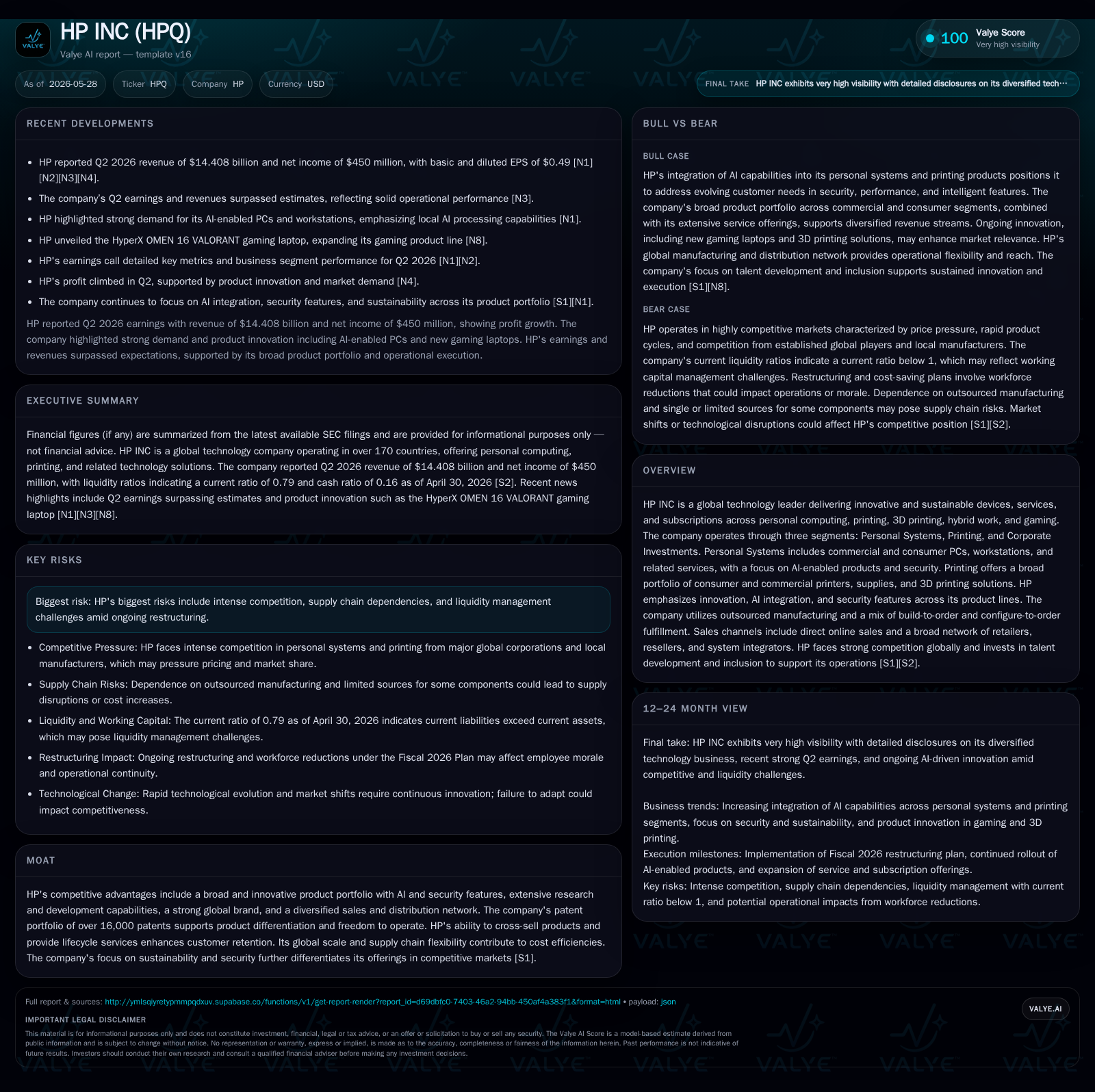
HP Inc’s Q2 2026 results reflect a steady net earnings increase to $995 million for the first half of fiscal year 2026, alongside a near doubling in restructuring charges indicating active cost realignment efforts [S2]. The company continues evolving its business model around three segments—Personal Systems, Printing, and Corporate Investments—with a sharpened focus on AI integration, security enhancements, and sustainable device innovation [S1],[S2]. HP’s broad distribution network and large patent portfolio remain key competitive moats as it navigates challenges from aggressive competition, supply chain constraints, and shifting customer preferences toward subscription models and big tank printers [S1]. Looking forward, HP’s rollout of AI-enabled devices, including targeted gaming laptops, combined with ongoing structural initiatives under its Fiscal 2026 Plan, underpin growth potential while highlighting execution risks linked to restructuring investments [S3],[N9]. Financially, HP maintains stable liquidity with approximately $3.7 billion in cash despite elevated restructuring expenses, but current liabilities exceed current assets supporting a cautious view on near-term operational flexibility [S2],[F1].
Q2 2026 Operating Update: Earnings and Strategic Highlights
HP Inc’s latest quarterly filing dated May 28, 2026 ([S2]) reveals operational momentum anchored in solid financial performance mixed with active cost realignment. Net earnings for the six months ended April 30, 2026 rose modestly to $995 million compared to $971 million a year earlier. However, restructuring charges surged substantially to $491 million from $192 million in the prior period reflecting HP’s intensified efforts to optimize cost structure under its Fiscal 2026 Plan. Despite this elevated expense backdrop, HP demonstrated cash stability with cash and cash equivalents holding steady at approximately $3.7 billion ([S2],[F1]). This suggests resilience in liquidity even amid ongoing transformation costs. Additional event disclosures ([S3]) reiterate management’s commitment to executing a comprehensive strategy focused on artificial intelligence enablement and productivity improvements.
Business Model Evolution: Devices, Services, and AI Integration
HP operates through three primary segments: Personal Systems (PS), Printing, and Corporate Investments ([S1],[S2]). Personal Systems encompasses commercial and consumer PCs—ranging from desktops and notebooks to premium workstations—with increasing emphasis on AI-powered features such as local AI processing acceleration. This segment also supplies endpoint security solutions and lifecycle services including deployment support and extended warranties. Printing delivers a diversified portfolio covering consumer/commercial printer hardware alongside consumables like ink cartridges and emerging industrial graphics supplies leveraging additive manufacturing (3D printing). Corporate Investments represents incubation projects aimed at digital enablement.
Revenue is generated from product sales complemented by growing subscription-based services that foster recurring revenue streams critical for lifetime customer value enhancement ([S1]). Fulfillment balances build-to-order efficiencies with configure-to-order customization catering to specific client requirements. HP’s multi-channel market approach spans direct e-commerce sales paired with a broad reseller network comprising retailers targeting consumers/SMBs plus system integrators wrapping value-added services for enterprises ([S1]). This layered go-to-market alignment allows tailoring by geography given diverse demand patterns.
Competitive Positioning within Personal Systems and Printing Segments
HP’s competitive moat is grounded in its broad yet innovative product lineup embossed with advanced AI capabilities as well as enhanced security features implemented through hardware-enforced endpoint protection leveraging deep-learning malware detection ([S1]). Its global footprint supported by a vast patent library of over 16,000 patents offers substantial intellectual property protection enabling differentiated technology offerings.
Cross-selling across devices, supplies, software, and services creates switching costs advantageous in sustaining long-term client relationships. The company’s sustainability agenda further elevates product appeal especially in developed markets where environmentally conscious buyers drive demand for energy-efficient designs ([S1]). However, the printing segment endures pricing pressures due to competition from generic alternatives while transitioning customers towards higher-margin big tank printers which carry distinct lifetime profitability profiles relative to traditional cartridge devices ([S1]). Supply chain flexibility stemming from outsourced manufacturing partnerships worldwide enhances cost competitiveness despite persistent risks around component exclusivity or availability.
Industry Dynamics: Market Trends, Customer Behavior, and Supply Chain Considerations
Macro trends weigh heavily on HP’s industry environment. Accelerated digitization reduces total print volumes but spurs demand for managed print services and ink subscription models that support consistent consumable sales ([S1]). Hybrid work adoption globally fuels PC refresh cycles emphasizing powerful systems capable of handling AI workloads locally rather than relying solely on cloud processors – an arena where HP aims to lead by embedding integrated Intel/AMD processors plus NVIDIA GPUs optimized for graphics-heavy applications ([S1]).
Supply chain challenges remain salient as semiconductor memory/storage costs fluctuate alongside logistics complexities. To mitigate these constraints HP smartly mixes high-volume basic builds with configured orders tailored to enterprise needs ensuring time-to-market speed without sacrificing customization options ([S10]). Geographic sales nuances impose differentiated tactics particularly across emerging markets where channel reach contrasts sharply versus mature regions predominantly serviced via direct commercial accounts ([S1]).
Growth Drivers: AI-Enabled PCs, Subscription Models, and Hybrid Work Adoption
AI capabilities define HP's primary growth engines going forward. The company emphasizes local AI processing embedded into new workstation-class PCs elevating user experience through intelligent automation enhancing speed, security checks against malware threats via adaptive algorithms, and cost efficiencies enabled through predictive maintenance ([S1]). These feature advancements foster stickier customer relationships within enterprise IT ecosystems sensitive to cybersecurity vulnerabilities.
Subscription offerings transforming traditional upfront hardware sales into annuity-like revenues underscore strategic shifts aiding margin expansion potential despite initial platform investment demands ([S1]). Concurrently sustainable device innovation aligns well with increasing corporate ESG mandates encouraging procurement of energy-conscious equipment.
The gaming PC segment also surfaces as a niche growth vertical highlighted by recent launches such as the HyperX OMEN 16 VALORANT laptop blending high-performance gaming GPU capabilities with brand recognition among eSports audiences expanding hybrid consumer engagement ([N9]).
Risks and Constraints: Competition, Supply Dependencies, and Margin Pressures
HP confronts vigorous competition globally spanning tier-one PC manufacturers alongside copier/printer incumbents aggressively competing to gain market share particularly in low-end printing supplies commoditized sectors ([S1]). Component sourcing risks persist notably where multiple suppliers are unavailable requiring reliance on limited vendors – a factor exacerbated by geopolitical tensions disrupting trade flows.
Margin pressures arise when shifting device mix favors big tank printers that secure better upfront margins but yield less high-margin consumable replenishment posing lifetime profitability tradeoffs ([S1]). Execution risk around the steepening restructuring charges ($491 million vs $192 million year-over-year) introduces uncertainty concerning workforce downsizing impacts on operational continuity alongside anticipated cost-saving realizations under the Fiscal 2026 Plan aiming for substantial productivity gains by fiscal 2028 ([S2],[S21]). Management must navigate fluctuating consumer demand patterns driven by hybrid consumption preferences complicating inventory forecasting.
Upcoming Catalysts: Guidance, Product Launches, and Execution Milestones
Key milestones include progressive rollouts of next-gen AI-enabled PCs targeting both enterprise endpoints requiring heightened security protocols as well as gaming enthusiasts seeking detachable performance advances – signaling diversification within Personal Systems ([N9],[S3]). Subscription platform scaling metrics will be critical barometers tracking conversion rates from legacy outright purchases toward recurring billing structures key to boosting revenue predictability.
Operational efficiency outcomes linked to ongoing restructuring actions under the company’s Fiscal 2026 Plan promise potential fiscal impact beyond immediate quarters as savings are layered atop investment outlays aimed at future-proofing competitiveness ([S3],[S21]). Upcoming quarterly guidance disclosure periods should shed light on pace adjustments needed given recent macroeconomic headwinds impacting disposable income pools affecting consumer device buying behavior.
Financial Profile Snapshot: Cash Flow Strength and Liquidity Status
From a financial standpoint using the latest quarter ended April 30, 2026 data ([S2],[F1]), HP maintains approximately $3.7 billion in cash equivalents balancing against current liabilities exceeding current assets ($30.2 billion vs $23.9 billion) yielding a current ratio near 0.79 signaling tight working capital positioning under ongoing capital-intensive restructuring initiatives. Operating cash flows remain robust bolstered by solid net earnings totaling $995 million in six months despite almost tripling restructuring expenses over prior year levels suggesting disciplined cash conversion ability amidst proactive cost reorganization efforts. Tax rate improvements also provide incremental bottom-line benefits with effective rates dropping below historical highs potentially contributing to net margin expansion.
Disclaimer: This analysis is based exclusively on publicly available SEC filings dated through May 28, 2026([S1]-[S3]), up-to-date news sources([N9]), and companyfacts financial extracts([F1]) without any proprietary insight or forecasts. It is intended solely as an informational overview reflecting recent operating developments and strategic positioning without offering investment advice or predictions.
Disclaimer: This is research-only, informational analysis and not investment advice. It may include AI-generated interpretation and general industry context. Always verify important details using primary sources.

Comments