
Hormel Foods Reports Q2 Update: Earnings Strength Amid Restructuring and Market Challenges
Hormel Foods delivers solid Q2 revenue growth supported by strong segment performance while advancing cost-saving restructuring initiatives that reshape its operating profile.
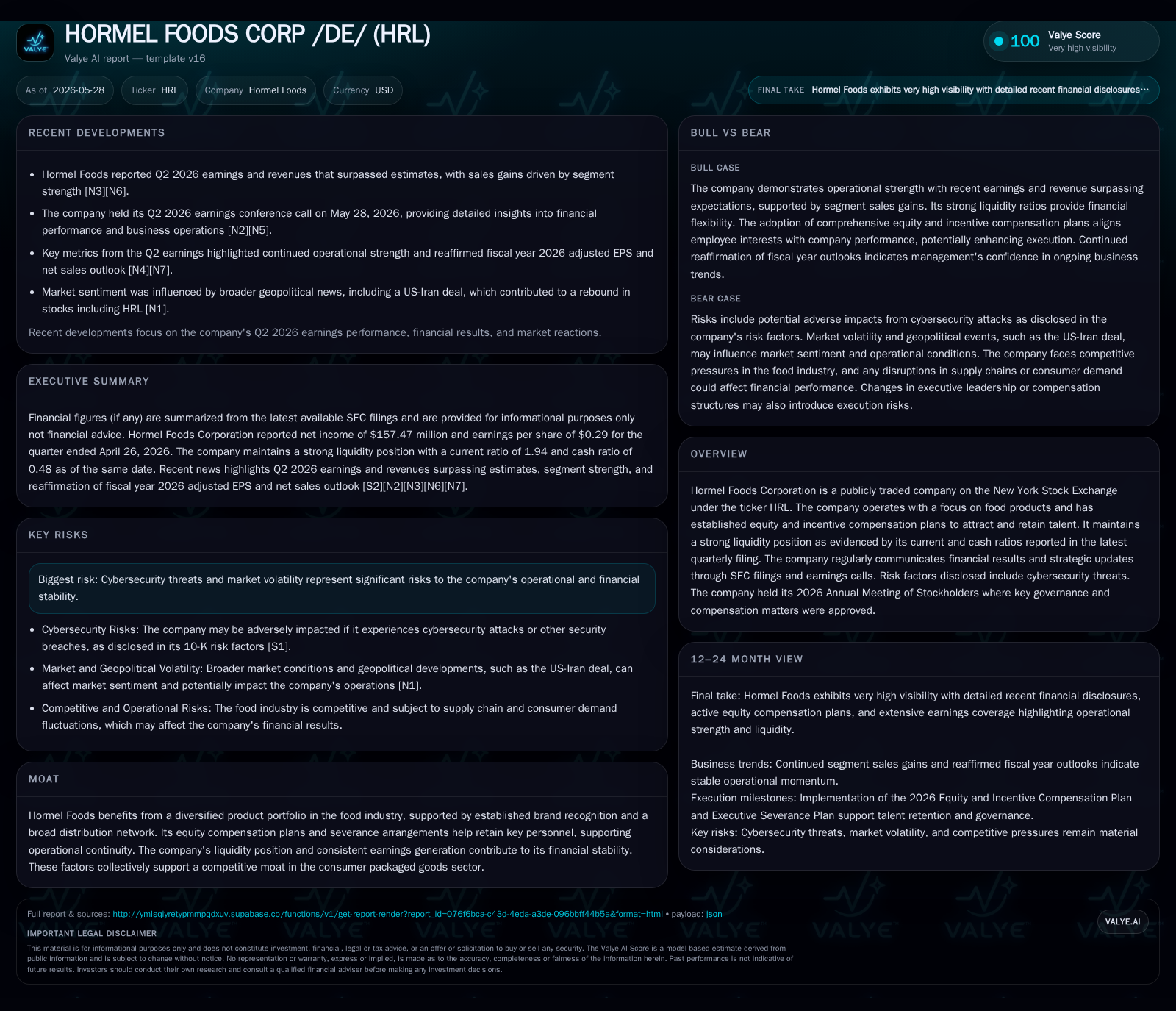
In the latest quarter ended April 26, 2026, Hormel Foods reported a notable sales gain driven primarily by core business segments despite ongoing market pressures and restructuring charges. The company is actively reducing administrative costs through a substantial workforce realignment while reinvesting in innovation and brand development. Hormel's broad product portfolio and entrenched distribution network underpin stable demand, but cybersecurity risks and commodity volatility remain cautionary factors. Management reaffirmed its full-year outlook, emphasizing efficiency gains as a key growth lever.
Q2 2026 Operational Performance Highlights
Hormel Foods’ most recent quarterly filing (10-Q) for the period ending April 26, 2026, depicted an encouraging top-line trend supported by notable segment performance improvements [S2][S4][N2]. The company reported sales advances across multiple core categories even as gross margins experienced pressure from elevated input costs. Margin dilution was partly offset by operational efficiencies from ongoing corporate restructuring measures initiated late in fiscal year 2025. These restructuring efforts entail workforce realignment targeting around 250 corporate and sales roles primarily by year-end 2025, aimed at reducing administrative overhead and boosting long-term operational agility
The earnings release accompanying the quarter also highlighted sustained consumer demand resilience within foundational product lines, illustrating the company’s ability to navigate inflationary headwinds while preserving brand preference. Cost discipline combined with strategic reinvestments contributed to the quarter’s operating income supporting a positive earnings beat relative to market expectations [S3][N9]
Business Model and Product Portfolio Dynamics
Hormel Foods operates through a diversified portfolio of branded consumer packaged food products distributed widely across grocery retail chains, foodservice providers, and international markets. Revenue streams derive predominantly from sales of prepared meats, protein-based products, grocery items, and complementary specialty foods. The company’s earnings depend on volume growth, pricing strategies responsive to input cost cycles, and maintaining product mix favoring higher-margin innovative offerings.
A critical strength resides in well-recognized brands that generate consumer loyalty and afford moderate pricing power despite a competitive landscape populated with private-label producers and other branded challengers [S1]. Hormel leverages extensive distribution channels spanning traditional supermarkets to emerging e-commerce marketplaces to ensure broad market penetration. Switching costs are moderate but mitigated through continuous product innovation and marketing investments designed to reinforce brand equity
The company routinely updates its portfolio with health-conscious options or premium-tier products aligned with evolving consumer preferences, which support margin expansion potential over time. Its food manufacturing operations are integrated with meat processing capabilities subject to capacity utilization constraints typical of the industry.
Industry Landscape and Competitive Benchmarking
Within the food production ecosystem, Hormel competes against both multinational consumer goods firms offering diverse product lines and nimble regional manufacturers specializing in niche categories. Regulatory oversight concerning food safety standards imposes operational compliance demands that can influence capacity deployment decisions especially in meat processing segments.
Commodity price volatility particularly affects raw material inputs such as pork and beef, creating cyclical earnings risks that require active cost management strategies including hedging where appropriate. Distribution infrastructure reliability remains paramount given heavy reliance on retail chains with complex shelf space competition.
Though exact market share data are proprietary, Hormel’s scale affords it advantages relative to smaller competitors in procurement efficiencies, marketing reach, and ability to absorb industry shocks [S1].
Growth Drivers: Innovation, Distribution, and Cost Efficiencies
Key initiatives propelling growth include launching new products tailored to health-conscious consumers and expanding into premium segments where willingness to pay supports higher margin realizations. Reinforcing broad geographical distribution networks sustains volume momentum as consumer buying habits evolve.
Notably, the corporate restructuring effort announced in November 2025 targets reducing approximately 250 positions primarily in corporate administration and sales functions [S4][N9]. These changes are anticipated to lower fixed cost bases freeing capital for reinvestment into research & development pipelines and marketing campaigns critical for sustaining competitive differentiation
The emphasis on streamlined operations coupled with selective portfolio enhancements paints a picture of deliberate resource allocation aimed at balancing short-term profitability pressures with long-term sustainable growth.
Risks and Constraints: Cybersecurity and Market Volatility
Hormel continues to cite cybersecurity threats as a significant risk factor given its dependence on information technology systems for manufacturing controls, supply chain logistics, and customer data management. Potential cyber incidents could disrupt operations or compromise sensitive information impacting reputation and financial results [S1][S2].
Market volatility presents constraints including fluctuating commodity prices shaping cost of goods sold dynamics as well as variability in consumer discretionary spending influencing volume trends. Supply chain interruptions stemming from regulatory changes or capacity bottlenecks add layers of unpredictability.
These macro risks necessitate vigilant risk management frameworks alongside flexible operational strategies.
Outlook and Key Upcoming Milestones
Management has reiterated its full-year guidance for adjusted earnings per share (EPS) growth alongside net sales increases for fiscal year 2026 despite some near-term income declines attributed principally to restructuring charges [N9][S3]. Progressive execution of cost-saving initiatives will be critical milestones monitored by stakeholders.
Other important forthcoming events include ongoing product rollout schedules designed to capitalize on emerging consumption patterns as well as continuous evaluation of capital deployment aligned with strategic priorities discussed during the company's recent Annual Meeting of Stockholders where governance matters including compensation frameworks were approved [S3].
Financial Position and Capital Resources Overview
As of the latest quarter end on April 26, 2026, Hormel Foods reported cash & equivalents balance near $827 million against total debt approximating $2.35 billion resulting in net debt around $1.52 billion [F1]. The current ratio was approximately 1.94 based on current assets and current liabilities, indicating liquidity coverage over short-term obligations
This balance sheet posture underpins capability to invest prudently in growth drivers while managing leverage pragmatically amidst the broader economic uncertainties facing the food sector [F1][S2].
This analysis synthesizes Hormel Foods Corporation’s most recent publicly available filings to outline its operational status, business model strengths, sector environment, risk factors, key growth levers, and financial standing without recommending investment actions or forecasts.
Disclaimer: This is research-only, informational analysis and not investment advice. It may include AI-generated interpretation and general industry context. Always verify important details using primary sources.

Comments