
Heron Therapeutics Advances Acute Care Growth While Managing Oncology Portfolio Challenges
Heron Therapeutics leverages proprietary drug delivery technology and new reimbursement policies to drive growth in acute care products amid patent litigation and competitive pressures in oncology.
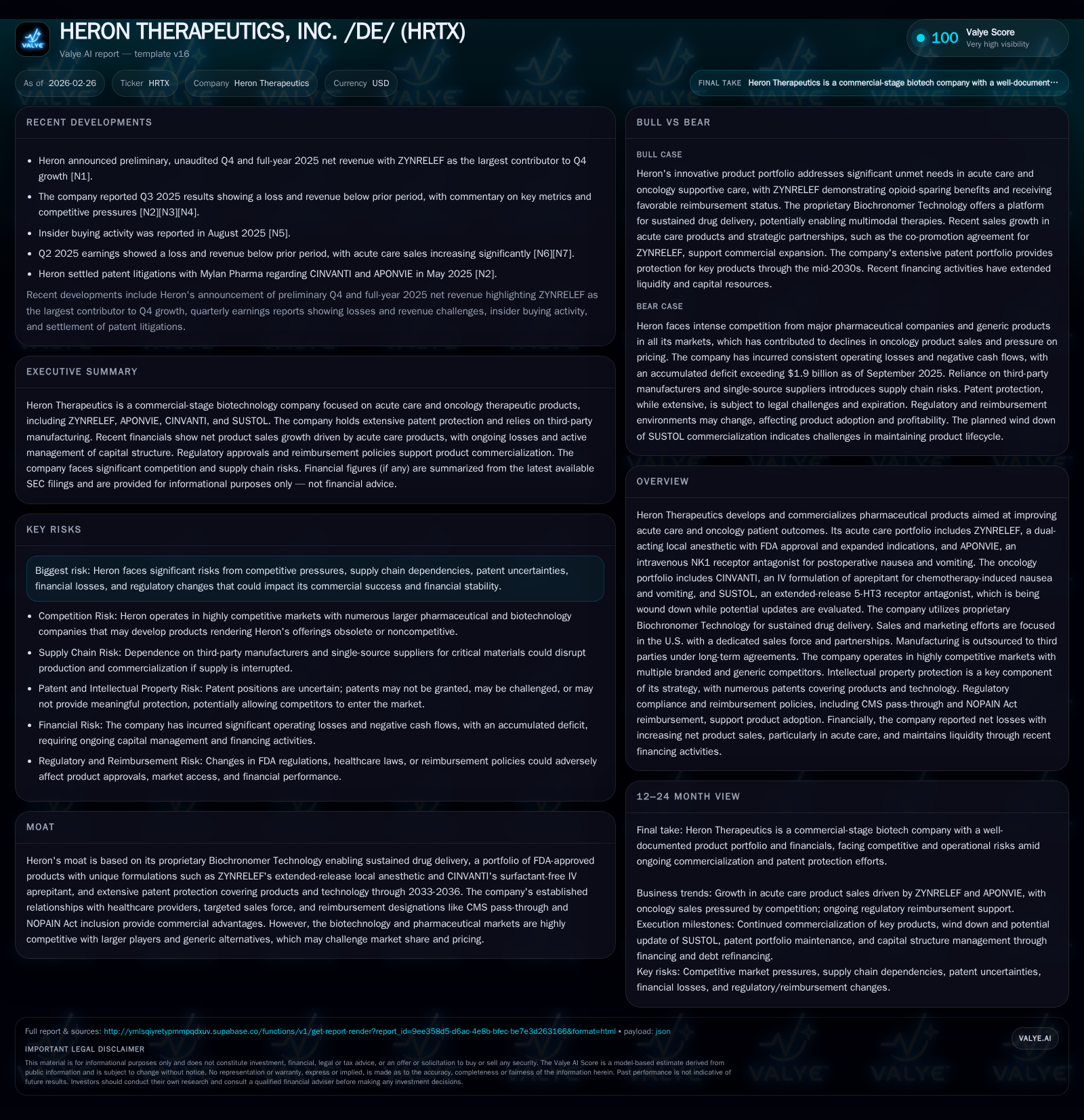
Heron Therapeutics has expanded sales of its acute care portfolio, notably the local anesthetic ZYNRELEF, benefiting from FDA approvals and favorable Medicare reimbursement changes. The oncology segment faces headwinds from competition and generics, reflected in modest sales declines and ongoing patent litigation. The company sustains operational losses but improved profitability metrics between 2024 and 2025, with stable liquidity supported by equity and debt financings. Continued product innovation, regulatory positioning, and resolution of patent challenges will be pivotal to Heron's future performance.
Company Overview
Heron Therapeutics is a commercial-stage biotechnology company focused on developing pharmaceutical innovations primarily targeting acute care and oncology patients to enhance treatment outcomes. Leveraging its proprietary Biochronomer Technology platform enabling sustained release formulations, Heron has created differentiated therapies addressing postoperative pain management and chemotherapy-induced nausea [S1][S18]. Key marketed products include ZYNRELEF—a dual-action extended-release local anesthetic combining bupivacaine and meloxicam—and a portfolio including APONVIE and CINVANTI for nausea management.
Historical Financial Performance: Drivers and Trends
Heron's financial history reflects the impact of product portfolio strategy pivoting around FDA approval milestones and reimbursement enhancements. A summary of annual performance from FY2022 to FY2025 follows:
Historical performance (annual)
| FY | Net ($mm) | CFO ($mm) | OpInc ($mm) | Capex ($) | Net YoY |
|---|---|---|---|---|---|
| 2025 | -20 | -28 | -3 | 317000 | -48.7% |
| 2024 | -14 | -23 | -12 | 1706000 | +87.7% |
| 2023 | -111 | -59 | -111 | 1545000 | +39.3% |
| 2022 | -182 | -147 | -175 | 1825000 |
Source: SEC companyfacts cache [F1].
Capital returns and efficiency (annual)
| FY | FCF ($mm) | ROE% |
|---|---|---|
| 2025 | -28 | -140.9 |
| 2024 | -24 | 40.4 |
| 2023 | -60 | 325.4 |
| 2022 | -149 | -1341.2 |
Source: SEC companyfacts cache [F1].
Revenue figures are not explicitly reported but quarterly filings provide net product sales insights [S7][S18]. Operating losses have materially decreased since FY2023 reflecting better expense controls alongside ramping sales.
Key drivers include:
- Commercial launch of ZYNRELEF starting mid-2021 with expanded FDA label indications through early-2024.
- Favorable CMS reimbursement evolution transitioning from outpatient pass-through status to inclusion in the NOPAIN Act effective April 1st enhancing Medicare separate payment status.
- Growth of APONVIE IV antiemetic sales bolstered acute care revenues.
Gross margin saw slight compression in Q3 2025 partly due to inventory reserves and supplier cost variations though full-year trends seem positive [S7][S26].
Product Portfolios Driving Growth
Acute Care:
ZYNRELEF is Heron's flagship acute care asset. It is FDA-classified as an extended-release local anesthetic demonstrating opioid-sparing benefits post-surgery versus standard bupivacaine solutions. Launched mid-2021 with indication expansions for soft tissue and orthopedic surgeries avoiding articular cartilage exposure [S1][S18].
In September 2024 the FDA approved a vial access needle redesign improving clinical usability [S1]. Integration into the NOPAIN Act reimbursement framework enables separate Medicare payment outside bundled surgical fees until end-2027 encouraging hospital adoption [S1].
Total acute care net product sales grew approximately 67% for Q3 and nearly 69% year-to-date through September compared to prior periods driven by market share gains and new customers across ZYNRELEF and APONVIE IV formulations [S7].
Oncology:
Oncology revenues focus on CINVANTI (IV aprepitant) for chemotherapy-induced nausea and SUSTOL (extended-release granisetron), which Heron is winding down while evaluating potential reintroduction pending regulatory review [S17].
CINVANTI net sales showed modest quarter-over-quarter growth (+1.7% Q3), but overall oncology net sales declined (-3.4% YTD) due to competition from branded rivals and generics impacting price realization despite higher unit volumes [S7].
Legal Landscape and Patent Protection
Heron's intellectual property is robust yet actively challenged by generics:
- Successful patent infringement litigation protected CINVANTI patents against Fresenius Kabi through at least 2035 after favorable court rulings invalidated obviousness claims [S1][S25].
- Settlements with Mylan and Qilu concluded suits regarding ANDA filings for APONVIE allowing generic launches only post-June 2032 protecting exclusivity aligned with patent terms [S25][S27].
- Defenses against Paragraph IV filings remain active but the diversified patent estate provides some protection.
Maintaining exclusivity preserves pricing power critical amid rapid commoditization tendencies post-patent expiry.
Future Growth Prospects
Growth catalysts include:
- Expansion of ZYNRELEF adoption supported by enhanced reimbursement policies such as permanent J-code recognition from October 2025 reducing hospital financial barriers [S1].
- Potential relaunch or updated SUSTOL versions following regulatory feedback after wind-down phase [S17].
- Increasing APONVIE penetration leveraging exclusive patents until early-mid-2030s.
- Product line extensions using Biochronomer technology offering sustained delivery advantages.
Risks persist related to payor coverage changes amid healthcare cost containment initiatives; accelerated generic competition; supply chain dependencies on third-party manufacturers; evolving FDA promotional compliance requirements [S4][S6][S9].
Returns & Capital Allocation Profile
Despite narrowing operating losses (operating income improved ~78% YoY between FY24-FY25), Heron continues negative returns due to substantial R&D investments paired with commercial scaling expenses:
- FY25 net loss was approximately $20.2 million vs $13.6 million prior year reflecting operational dynamics including legal costs partially offset by other improvements [F1].
- Operating cash flow remained negative at about -$27.6 million in FY25 albeit improved relative to historical outflows indicating ongoing working capital use during scale-up.
- Free cash flow approximates negative $27.9 million after minimal capex ($0.3 million) consistent with outsourcing strategies.
- Cash position strong at $28.6 million supported by strategic equity raises including convertible notes refinancing completed mid/late-2025 correcting prior negative equity balances now positive at $14.3 million [F1][S11][S13].
No dividends or buybacks are indicated consistent with biotech capital reinvestment norms.
Operational Infrastructure & Commercial Strategy
Heron's commercial model deploys specialized acute care and oncology sales forces engaging surgeons, oncologists nurses and pharmacists supported via co-promotion agreements such as with Crosslink Network expanding orthopedic market reach for ZYNRELEF [S16][S18].
Manufacturing is fully outsourced under long-term contracts exemplified by agreements like with Patheon Austria GmbH ensuring supply stability but exposing supply chain risk typical of small biopharma entities [S16][S26].
Industry Context Analysis
The postoperative pain management market where ZYNRELEF competes is crowded: incumbents like Pfizer's Marcaine hydrochloride solution plus generics create competitive pressure requiring differentiation via efficacy (opioid sparing), ease-of-use enhancements (needle redesign), and supportive reimbursement coding encouraging hospital adoption amid opioid epidemic focus. Oncology supportive care agents face durable generic pressure post-patent expiry necessitating continuous portfolio refresh absent next-gen pipeline candidates here yet notable industry margin pressures.
Risks Summary
Key risks include:
- Ongoing generic erosion despite near-term settlement wins potentially accelerating post-patent expiry or failed legal defenses.
- Complex regulatory environment including anti-kickback laws; fraud/abuse statutes; data privacy laws imposing compliance costs plus litigation risks.
- Reimbursement policy shifts may limit pricing flexibility or delay product adoption.
- Third-party manufacturing dependence risks production continuity disruptions.
- Substantial accumulated deficits imply ongoing capital markets reliance absent rapid profitability gains risking dilution concerns.[S4][S5][S6][S14]
Conclusion
Heron Therapeutics stands at an inflection balancing promising advances within its acute care franchise driven chiefly by ZYNRELEF’s clinical profile coupled with advantageous Medicare reimbursement against challenges marked by oncology revenue stagnation amid generic incursions and legal contestations. Operational results indicate measured improvement toward reducing historic losses accompanied by stable liquidity bolstered through recent financing underpinning ongoing development/commercial activities. Future trajectory hinges on continued ZYNRELEF uptake alongside strategic patent defense success plus potential asset revitalization pending regulatory clarity.
This analysis is based exclusively on publicly available information as of February 26th, 2026.
Disclaimer: This is research-only, informational analysis and not investment advice. It may include AI-generated interpretation and general industry context. Always verify important details using primary sources.

Comments