
HSBC’s Growth Fueled by Global Trade Scale and Hong Kong Expansion Post-Hang Seng Privatisation
HSBC demonstrated robust revenue growth in 2025 anchored by strategic regional focus and digital investments, while targeting higher returns through streamlined operations and capital discipline.
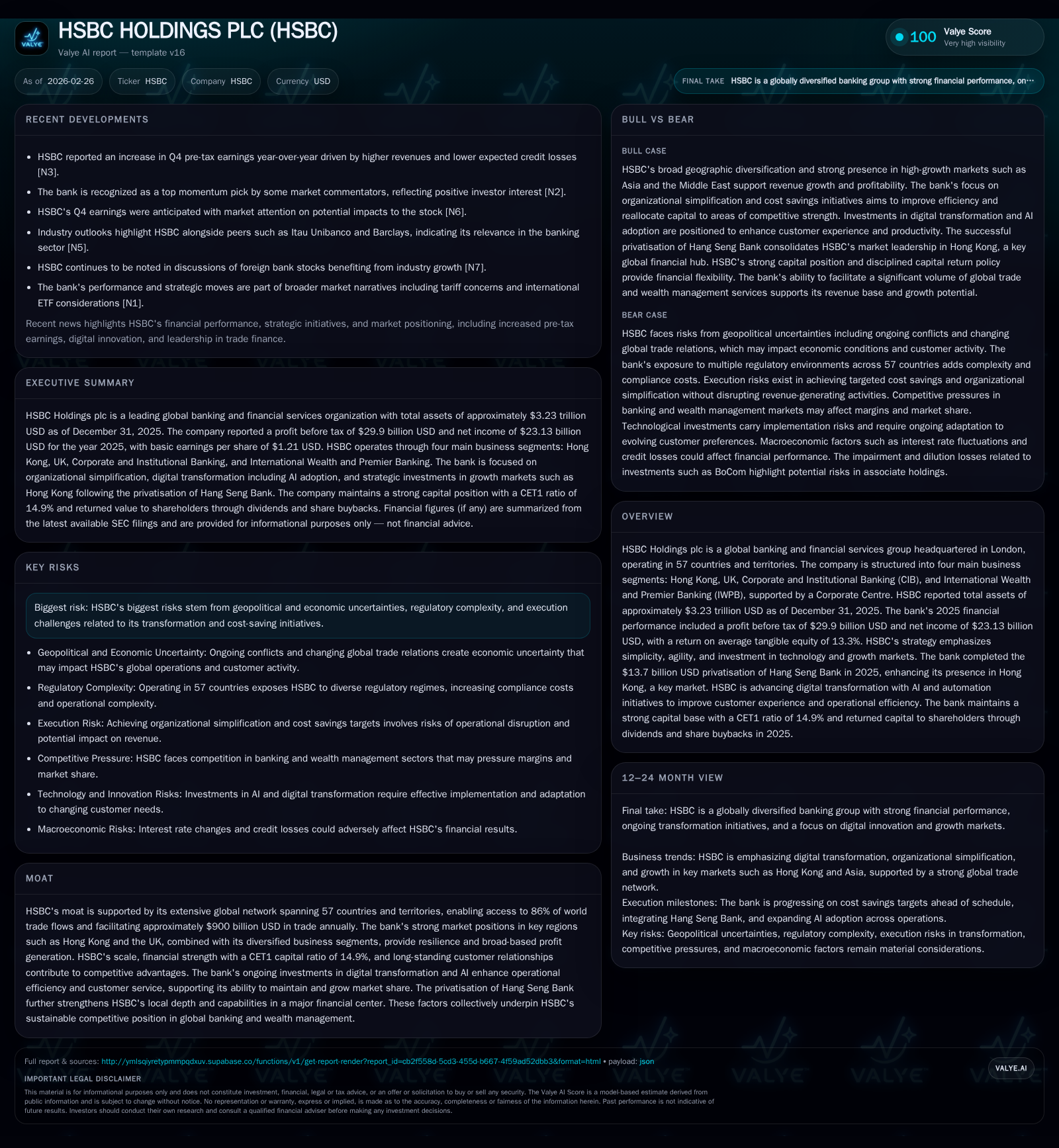
HSBC Holdings plc reported significant revenue growth of 17.3% in 2025, driven by expanding trade finance, deposit growth in Hong Kong, and the full privatisation of Hang Seng Bank. Despite a net income decline of 7.5% due to notable items including restructuring costs and impairments, HSBC achieved a strong return on tangible equity of 13.3%. The bank’s future growth relies on leveraging its global network, technology adoption, and its status as a trade super-connector between mainland China and global markets. Capital allocation remains disciplined with ongoing share buybacks, a stable dividend payout ratio target, and cost control efforts aligned with investment priorities.
Overview
HSBC Holdings plc operates as one of the largest banking organizations globally with total assets surpassing $3.23 trillion USD at the end of fiscal year (FY) 2025 [F1]. The firm’s four principal business segments—Hong Kong, UK, Corporate and Institutional Banking (CIB), and International Wealth and Premier Banking (IWPB)—are underpinned by a Corporate Centre that supports group-wide functions [S2][S3].
Despite a reported profit before tax decrease to $29.9 billion USD in 2025 compared to prior years primarily due to notable items such as impairments and legal provisions, HSBC demonstrates operational strength highlighted by a robust return on average tangible equity (RoTE) of 13.3%, or an impressive 17.2% when excluding these items [S3][F1]. This reflects a strategy pivot towards simplicity, agility, and investing heavily in technology alongside growth markets.
Historical Performance Drivers
From FY2023 through FY2025, HSBC saw revenue increase significantly from approximately $2.26 trillion USD to $3.23 trillion USD representing strong top-line growth centered around expanding its core business lines and regional footprint [F1]. Net income declined modestly in the latest fiscal period from nearly $25 billion USD in FY2024 to about $23 billion USD due largely to exceptional charges including a combined impairment loss related to Bank of Communications ($2.1bn) plus restructuring costs (~$1bn) linked to organisational simplification [S3][F1].
Historical performance (annual)
| FY | Rev ($bn) | Net ($bn) | Rev YoY | Net YoY |
|---|---|---|---|---|
| 2025 | 3.2 | 23.1 | +17.3% | -7.5% |
| 2024 | 2.8 | 25.0 | +21.8% | +1.8% |
| 2023 | 2.3 | 24.6 | +47.3% | |
| 2022 | 16.7 |
Source: SEC companyfacts cache [F1].
Capital returns and efficiency (annual)
| FY | Div ($bn) | ROE% |
|---|---|---|
| 2025 | 13.5 | 11.2 |
| 2024 | 17.1 | 13.0 |
| 2023 | 12.2 | 12.8 |
| 2022 | 7.0 | 8.5 |
Source: SEC companyfacts cache [F1].
The bank’s steady increase in customer loans and deposit bases notably contributed to top-line growth — net loans grew by nearly $58 billion while deposits rose almost $132 billion USD year over year with key contributions from the UK mortgage sector and Hong Kong retail banking respectively [S12][F1].
Business Segments & Geographic Breakdown
Segment-wise constant currency profit before tax further elucidates HSBC’s diversified strength:
- Hong Kong: $9.6bn (32%), with deposits growing +7% to over $540bn maintaining top market share at ~25%
- UK: $6.7bn (22%), supporting balanced loan growth (+6%) mainly in mortgages and commercial lending
- CIB: $11.4bn (38%), fee income up +7%; advancing treasury services including next-gen tokenised deposit products across key financial hubs
- IWPB: $4.4bn (15%), wealth management revenues up +5%, wealth balances booked at $2.1tn reflecting regional leadership particularly in Asia / Middle East [S6][S7][F1]
Digital Transformation & Operational Efficiency
HSBC invests aggressively in artificial intelligence (AI) with over 100 generative AI use cases active internally; this supports enhanced productivity among its engineering teams (~31,000 employees using AI-enabled coding assistants) [S27]. Fintech innovation also thrives with tokenised deposits enabling real-time cross-border payments spanning Hong Kong, Singapore, UK and Luxembourg ahead of further rollouts [S4][S27].
Cost efficiencies realize progress via organisational simplification delivering savings targeted at $1.8 billion medium term—up from an initial commitment of $1.5 billion—facilitated partly by synergies unlocked through the Hang Seng Bank privatisation completed at $13.7 billion [S4][S15].
Capital Allocation & Returns
HSBC maintains disciplined capital allocation focused on shareholder returns balanced with capital adequacy:
- Dividend payout ratio target set at approximately 50% for fiscal years through at least 2028.
- FY2025 dividends totaled about $13.48 billion despite a reduced net profit compared to prior years.
- Share repurchases amounted to roughly $6 billion during FY2025 with further buy-backs deferred until common equity tier one (CET1) ratios normalize post-Hang Seng transaction impact.
HSBC reported CET1 capital ratio steady at a robust level near 14.9%, reaffirming the bank's resilience amid risk-weighted asset increases chiefly driven by foreign currency translation effects [S10][S16][S18]. Approximate return on equity calculations based on available data for FY2025 are around low double digits near ~11%, consistent with the bank’s mid-to-high teens RoTE targets excluding exceptional items [F1][S11].
Future Growth Prospects & Targets
Looking forward, HSBC raised its ambition targeting an annual RoTE of at least 17% from fiscal years 2026 through to 2028 while aiming for increasing top-line revenue growth reaching up to +5% by FY2028 on a constant currency basis excluding material non-recurring charges [S10]. Key growth enablers include:
- Continued expansion in Asia-Pacific wealth management through increased Wealth Centres opened across Hong Kong, mainland China, Singapore and UAE.
- Leveraging its deep presence as a trade finance gateway centralizing about $900 billion worth of trade annually equivalent economically to G20 nation output.
- Streaming digital wallet innovations along with real-time tokenized payments enhancing customer stickiness.
- Ongoing portfolio optimization manifested through strategic exits releasing reinvestment capital.
Strategic Milestones
The complete takeover of Hang Seng Bank consolidates HSBC's community roots while enhancing scale efficiencies estimated at $0.3 billion annualized cost savings reallocated directly toward growth initiatives within Hong Kong's dynamic financial ecosystem viewed as the world’s leading cross-border wealth center projection towards the end of this decade [S4][S15].
Technology initiatives embedding accelerated adoption of artificial intelligence coupled with customer-first leadership culture frameworks position HSBC as agile amidst digital disruption waves transforming traditional banking interfaces globally [S27].
Conclusion
HSBC’s fiscal year ending December 31, 2025 exhibits nuanced growth dynamics steeped in legacy markets like Hong Kong dovetailed with innovation-driven service reimaging across wealth management and transaction banking sectors worldwide [F1]. The bank's strategy focused tightly on simplicity alongside financial discipline echoes in raised performance targets reinforcing confidence for medium-term investor expectations absent unforeseen macro upheavals [S10].
Continued monitoring will be essential regarding credit developments especially within CRE loan portfolios as well as geopolitical developments influencing trade corridors pivotal for HSBC’s franchise sustainability.
This analysis is based on publicly available data as of February 26, 2026 including company filings and news reports without providing investment advice or recommendations.
Disclaimer: This is research-only, informational analysis and not investment advice. It may include AI-generated interpretation and general industry context. Always verify important details using primary sources.

Comments