
Hubbell Inc Expands Industrial Electrical Portfolio with NSI Acquisition While Managing Inflation and Supply Chain Pressures
Hubbell’s latest quarter reflects strategic acquisition integration, margin resilience amid cost inflation, and operational scale in electrical and utility solutions.
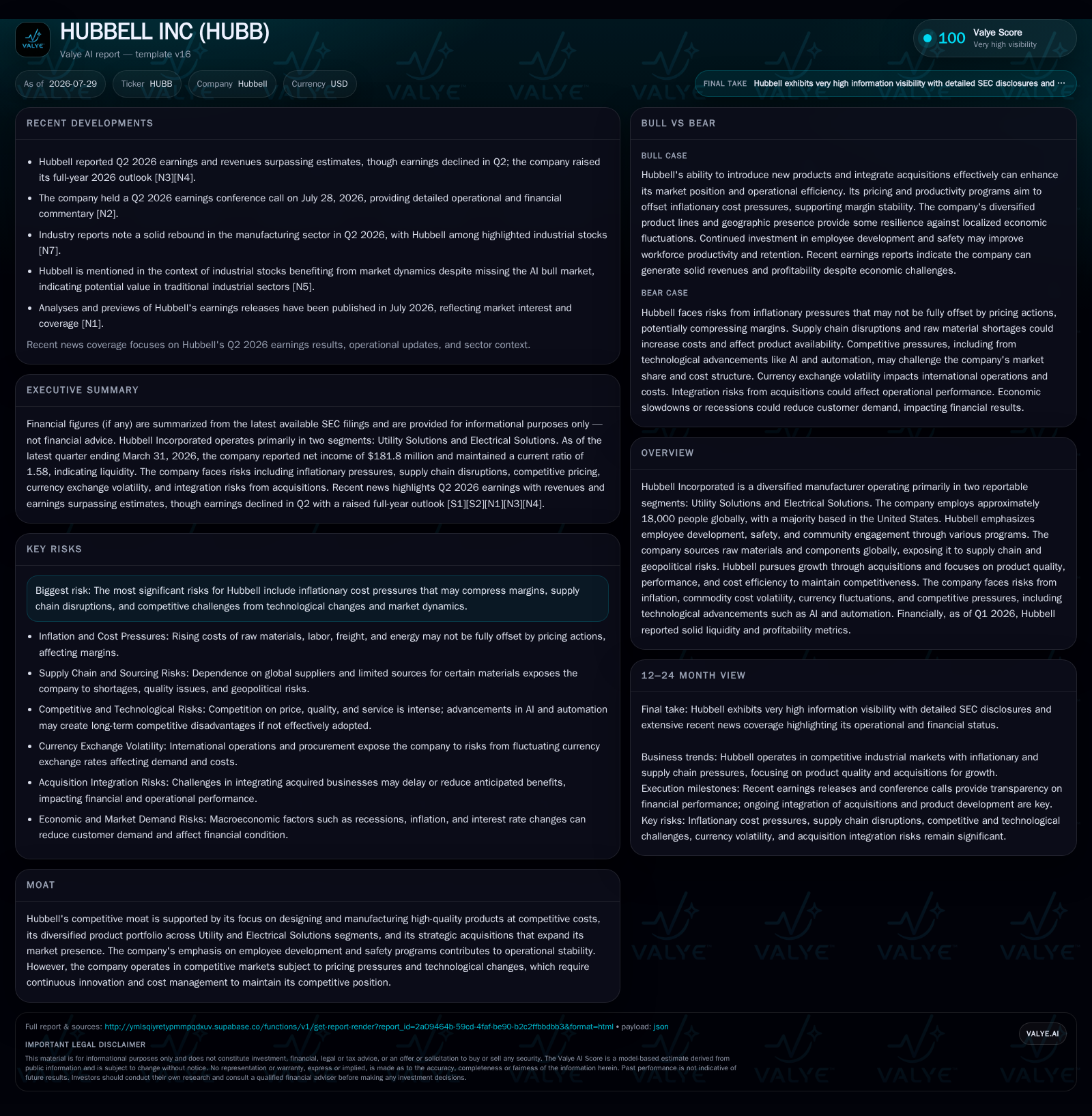
In Q2 2026, Hubbell Incorporated completed a transformative $3 billion acquisition of NSI Industries, significantly broadening its electrical fittings and wire management product footprint. Despite ongoing inflationary pressure on raw materials and supply chain challenges, the company sustained positive revenue growth driven by operational productivity and pricing actions. Hubbell’s dual-segment focus on Utility Solutions and Electrical Solutions, complemented by rigorous labor development programs and safety initiatives, underpins stability amid competitive market pricing pressures and technological shifts. Going forward, the key watchpoints include successful integration of NSI, margin recovery trajectories post-acquisition-related expenses, and capital deployment efficacy amid elevated debt levels.
Recent Operating Update
Hubbell Incorporated's second quarter ending June 30, 2026, featured significant operational developments highlighted by the completion of its $3 billion cash acquisition of NSI Industries. This strategic acquisition, financed through a combination of $900 million in unsecured term loans, $1.9 billion in senior notes issuance, and commercial paper facilities, substantially broadens Hubbell’s industrial electrical fittings and wire management product portfolio, enhancing its presence in infrastructure and commercial electrical markets [S16][S17]. The company reported Q2 revenues and earnings that exceeded analyst expectations, driven by robust price realization initiatives and operational productivity improvements despite ongoing inflationary pressures on raw materials such as copper and aluminum [S3][N1][N3].
While the acquisition-related transaction and integration expenses exerted near-term pressure on operating margins, management anticipates margin accretion over time through cross-selling opportunities and channel conversions leveraging NSI’s complementary product lines [S4]. The company continues to navigate risks related to inflationary cost pressures, supply chain disruptions, currency fluctuations, and competitive dynamics, including technological shifts such as automation and AI integration impacting product development and manufacturing cycles [S2][S18].
Business Model Overview
Hubbell operates primarily through two reportable segments: Utility Solutions and Electrical Solutions. The Utility Solutions segment focuses on products essential for electric grid modernization, including advanced connectors, metering automation components, and smart grid devices. The Electrical Solutions segment serves industrial and commercial construction markets with a broad range of wiring devices, lighting components, and electrical fittings [S1]. Sales channels include direct sales to utilities and industrial contractors, as well as distribution through electrical wholesalers and channel partners serving commercial end users.
Revenue generation depends on a combination of unit volume growth driven by infrastructure investments and strategic price realization to offset raw material cost inflation. Margins are sensitive to commodity price volatility and tariff impacts, necessitating agile raw materials sourcing and supply chain management. The company pursues cost efficiency through lean manufacturing initiatives and operational productivity enhancements. Strategic acquisitions like NSI expand Hubbell’s product portfolio into adjacent markets, enabling bundled solutions that increase customer retention and reduce price sensitivity.
Labor relations remain stable, with approximately 61% of the 18,000 global employees based in the U.S., including about 2,425 unionized workers. The company invests heavily in employee development through programs such as "Hubbell University," leadership training, and campus recruitment, supporting workforce retention and operational consistency amid manufacturing complexity [S1]. Safety culture is emphasized via enterprise-wide incident tracking and comprehensive health and well-being benefits.
Industry Structure and Competitive Position
The electrical equipment manufacturing industry is capital intensive, producing wiring devices, connectors, power distribution equipment, and utility solutions for utilities, construction firms, and industrial OEMs. Hubbell competes with peers such as Eaton Corporation, Emerson Electric, and Schneider Electric, all of which emphasize acquisitive growth and innovation in automation technologies.
Within this competitive landscape, Hubbell leverages its diversified product offerings across two synergistic segments to serve multiple end markets. Its scale provides relative bargaining power with suppliers, mitigating some raw material input risks compared to smaller competitors. However, pricing pressures persist in commoditized product categories, requiring continuous innovation and operational efficiency to maintain premium positioning.
The NSI acquisition exemplifies Hubbell’s strategy to expand market share in niche electrical fittings, complementing its system-level product sales and enhancing cross-selling capabilities.
Growth Drivers
Several secular trends underpin Hubbell’s growth prospects. Infrastructure modernization initiatives aimed at upgrading aging utility grids drive demand for advanced monitoring and connectivity products within the Utility Solutions segment. The expansion of renewable energy installations, including solar and wind, increases the need for specialized connectors and power management components.
Urbanization and industrial digital transformation fuel demand for sophisticated electrical solutions emphasizing energy efficiency and automation. Smart grid technology adoption aligns with Hubbell’s advanced metering infrastructure offerings, helping utilities reduce outage durations and improve operational reliability.
Strategic acquisitions remain a core growth lever, enabling rapid expansion into new geographic markets and product adjacencies without extended internal R&D cycles. The company is also exploring AI integration within manufacturing processes to enhance quality control and operational productivity, though the direct financial impact remains under evaluation.
Risks and Watchpoints
Key risks include sustained inflationary pressures on raw materials such as copper and aluminum, which challenge the company’s ability to fully pass through costs despite pricing actions. Supply chain disruptions and component shortages continue to pose risks to shipment volumes and lead times.
The integration of NSI presents execution risks, including aligning IT systems, harmonizing corporate cultures, and realizing anticipated operational synergies. Currency exchange rate volatility may affect global sourcing costs given Hubbell’s international procurement footprint.
Competitive pressures necessitate ongoing investment in innovation to prevent margin erosion from commoditization. Regulatory changes related to tariffs, environmental compliance, and product standards could unpredictably impact cost structures.
Labor retention remains critical amid skilled manufacturing workforce scarcity, although recent employee engagement surveys indicate strong workforce commitment [S1]. Cybersecurity risks related to automation and AI systems also warrant monitoring.
What To Watch Next
Upcoming quarterly results will be closely analyzed for margin recovery as acquisition-related expenses normalize and cost savings materialize. Volume trends in Utility Solutions’ grid modernization products will provide insight into infrastructure spending momentum.
Price realization effectiveness amid evolving raw material inflation and order backlog status will be key indicators of demand visibility. Capital allocation updates should clarify the pace of debt reduction following significant bridge loan facilities used to finance the NSI acquisition.
Any disclosures regarding accelerated adoption of AI or automation technologies in manufacturing or product innovation would signal potential competitiveness enhancements. Macroeconomic indicators influencing construction and utility infrastructure activity will also guide expectations for near-term organic growth across core segments.
Financial Profile Discussion
As of March 31, 2026, Hubbell reported $501.6 million in cash and equivalents against total debt of approximately $1.44 billion as of September 30, 2025, resulting in a net debt position near $943 million [F1]. The company’s liquidity is supported by current assets of approximately $2.8 billion and current liabilities of about $1.78 billion, yielding a current ratio of 1.58, indicative of adequate short-term solvency [F1].
Interest expense is expected to increase due to the higher debt load from acquisition financing, though this is anticipated to be offset over time by incremental earnings contributions from NSI [S14][S25]. Operating cash flow generation remains robust, supporting working capital requirements and capital expenditures focused on plant optimizations and technology upgrades
Overall, Hubbell maintains a financially disciplined profile balancing transformative acquisition investments with prudent liquidity management, positioning it to integrate new business lines effectively while meeting near-term obligations.
Financial position in context
As of 2026-03-31, companyfacts shows $502 million in cash and equivalents [F1]. Current assets of $2.8 billion and current liabilities of $1.78 billion imply a current ratio near 1.58x for 2026-03-31 [F1].
This analysis synthesizes publicly available SEC filings through July 29, 2026, along with recent company disclosures without offering investment research views or opinions on valuation or trading decisions.
Disclaimer: This is research-only, informational analysis and not investment advice. It may include AI-generated interpretation and general industry context. Always verify important details using primary sources.

Comments