
Cassava Sciences Advances Simufilam Development Amid Ongoing Regulatory and Manufacturing Challenges
Latest quarterly update underscores Cassava Sciences’ focus on simufilam for TSC-related epilepsy, highlighting clinical progress alongside regulatory and legal risks.
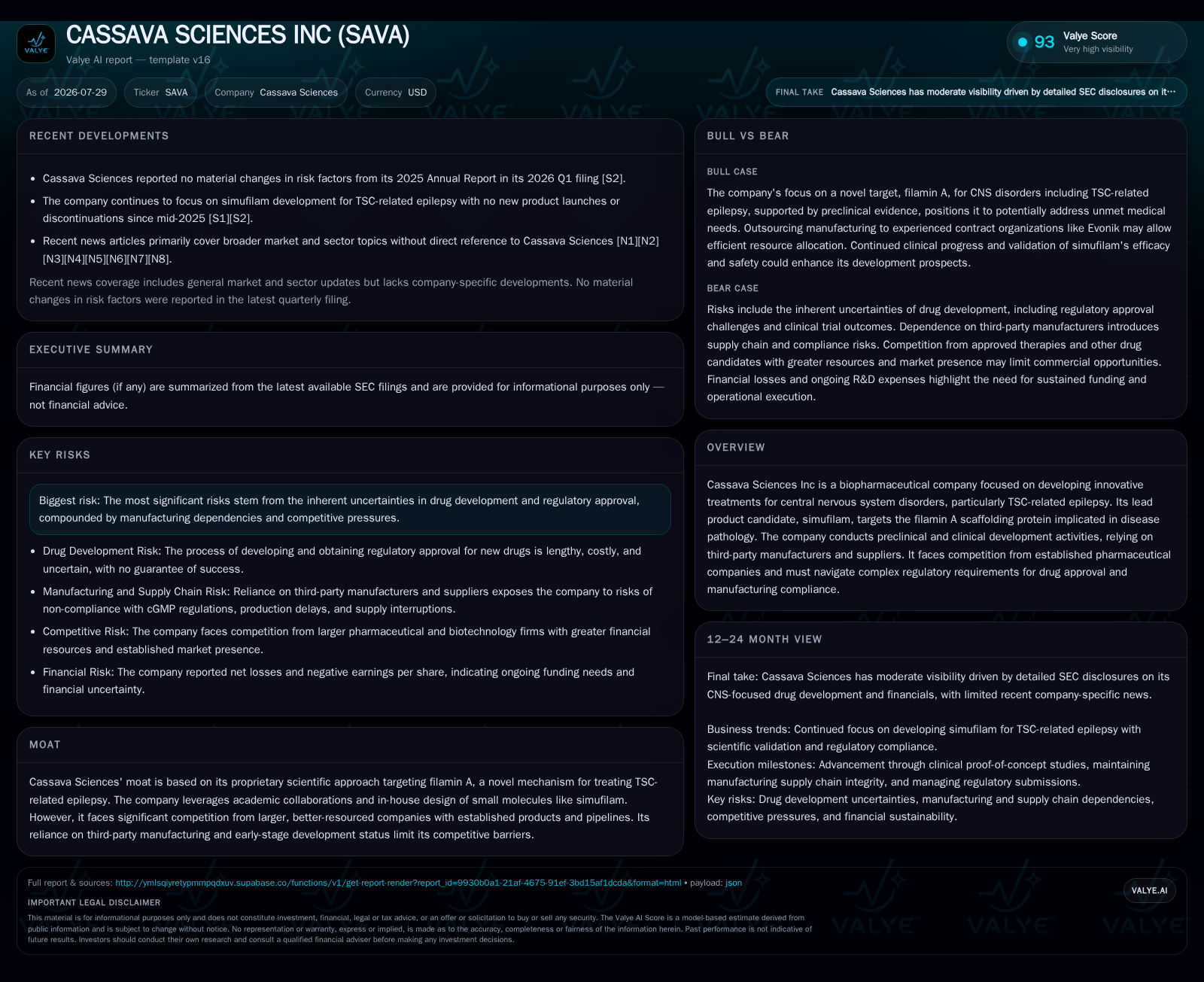
Cassava Sciences continues to develop simufilam, its lead small molecule therapeutic targeting filamin A in tuberous sclerosis complex (TSC)-related epilepsy. The company's recent quarterly filing reveals stable risk factors with an emphasis on regulatory compliance and manufacturing dependencies. Despite litigation settlements weighing on the company, Cassava maintains a cash position supporting ongoing R&D. Key growth drivers include clinical trial advancements and exploration of new indications, while risks persist from legal exposures, single-source supply reliance, and competitive pressures in CNS drug development.
Latest Operating Update
Cassava Sciences’ 10-Q filing dated July 29, 2026, reaffirms that there have been no material changes to the risk factors described in its annual 10-K report from March 12, 2026 [S2]. The company issued a contemporaneous press release emphasizing continued pursuit of simufilam as the lead therapeutic candidate for tuberous sclerosis complex (TSC)-related epilepsy [S3]. Noteworthy is the company’s focus on advancing clinical development while navigating persistent regulatory complexity and supplier dependence. This steady-state risk profile suggests that Cassava remains entrenched in early-to-mid stage biotech commercialization risks, particularly those common to CNS-targeted small molecule therapeutics.
Business Model Overview
Cassava Sciences operates primarily as a drug developer focused on central nervous system (CNS) disorders, with particular concentration on TSC-related epilepsy through its proprietary small molecule simufilam [S1]. Simufilam modulates the scaffolding protein filamin A—a novel mechanism distinct from mTOR inhibition—which underpins Cassava's scientific differentiation. The company designs drug candidates in-house with academic collaboration for molecular characterization. Monetization events depend chiefly on successful advancement through phased clinical trials leading to regulatory approvals. Revenue generation prospects hinge largely on milestone payments or eventual product sales post-approval given absence of current commercial products.
The company lacks internal manufacturing or commercialization infrastructure; instead it relies heavily on third-party contract development and manufacturing organizations (CDMOs), notably Evonik Industries AG for clinical-grade simufilam supply [S1]. This reliance adds cost variability and supply chain vulnerability—common risks for small biotechs before scale-up or partnering deals. Other suppliers provide excipients, finished dosage forms, packaging, and labeling components essential for maintaining clinical trial supply continuity.
Cassava previously operated an exploratory Alzheimer's blood test biomarker program (SavaDx) but ceased development mid-2025 to concentrate resources on CNS therapeutic candidates [S1]. This strategic narrowing aligns with resource optimization often necessitated by constrained cash flow profiles typical of experimental-stage biotech firms.
Industry Landscape and Competitive Position
Within the biotechnology sector focused on CNS disorders, Cassava sits alongside peer companies such as Biogen Inc., Neurocrine Biosciences, Sage Therapeutics, and Axsome Therapeutics—firms similarly pursuing small molecule approaches or biologics targeting neurological diseases. These competitors benefit from larger R&D budgets, more mature pipelines, and established commercial capabilities. Cassava’s moat rests heavily on filamin A modulation as a novel target for TSC-related epilepsy—a niche with unmet medical needs but also limited prior validation compared to mainstream mTOR inhibitors.
The CNS therapeutic environment is demanding due to complex disease biology, high failure rates at late-stage trials, intense regulatory scrutiny, and pricing pressures exacerbated by healthcare reform legislation such as the Inflation Reduction Act (IRA) [S23]. These dynamics impose high barriers to entry but equally compress potential pricing power post-approval.
Growth Drivers
Key growth levers for Cassava hinge on advancing simufilam through critical clinical milestones demonstrating safety and efficacy. Positive patient enrollment rates and favorable pharmacodynamic biomarker data could validate the novel filamin A mechanism in human populations. Expansion beyond TSC epilepsy into broader CNS or neurodegenerative indications represents a strategic lever contingent on successful preclinical findings.
The firm's integration of artificial intelligence (AI) capabilities aims to boost R&D productivity by enhancing molecular design and statistical analysis efficiencies [S1], potentially accelerating pipeline advancement relative to peers who rely more conventionally on iterative laboratory experimentation.
Strategic partnerships or licensing arrangements offer additional upside by providing non-dilutive capital infusion via milestone payments and access to commercialization infrastructures absent from Cassava’s current capabilities.
Risks and Constraints
Despite these positives, Cassava faces significant headwinds. The company’s dependence on single-source suppliers like Evonik creates bottleneck risk—disruptions could delay clinical trials or inflate production costs materially [S5]. Continued regulatory uncertainty prevails, with evolving FDA policies impacting approval timelines or label restrictions [S11].
Legal liabilities weigh heavily: the firm incurred a $40 million civil penalty settling an SEC probe related to Phase 2b disclosures and agreed recently to pay $31.25 million in securities litigation settlements [S4], [S5]. Such outcomes draw management focus away from operations, raise compliance costs, and impair reputation—factors that can hinder capital raising ability critical for sustaining high cash burn during trials.
Additionally, changing healthcare laws impose downward pressure on drug pricing through government negotiations under Medicare Part B/D programs encouraged by the IRA [S23]. Payor reimbursement variability compounds market access risks post-approval.
Finally, typical biotech volatility persists around clinical trial results due to unpredictable safety/efficacy outcomes which can abruptly pivot investor sentiment.
What to Watch Next
Investor attention should focus closely on announcements concerning:
- Completion of current-phase clinical trials for simufilam with data releases validating efficacy signals relevant to seizure reduction,
- Regulatory submissions or feedback events signaling FDA acceptance or concerns,
- Updates regarding manufacturing scale-up plans or alternate supplier engagement mitigating single-source risk,
- New intellectual property filings or clarity around patent portfolio strength,
- Corporate partnerships/licensing deals providing funding infusions or commercialization pathways,
- Litigation developments impacting financial exposure or reputational standing.
These milestones will substantially influence operational viability metrics such as patient enrollment speed, regulatory milestone achievements, supply chain robustness, and R&D expenditure trends.
Financial Profile Discussion
No material changes have surfaced recently that would suggest improved profitability near term; instead sustained cash burn aligns with expected investment-heavy biotech trajectory requiring either deal-making or equity raises ahead of product commercialization phases.
Liquidity health depends substantially on successful capital raising strategies paired with control over manufacturing costs amidst ongoing clinical trial commitments. The balance sheet presently does not show debt leverage concerns; however continued expenditures without licensing revenue places emphasis squarely on execution of pipeline progression milestones.
Conclusion
Cassava Sciences remains an early-stage biotech with focused scientific differentiation targeting filamin A modulation through simufilam for TSC-related epilepsy treatment. The latest quarterly update reflects steady advancement amid unchanged risk environment dominated by regulatory complexities, supply dependencies, legal challenges, and industry competition. Management prioritizes efficient resource allocation post-SavaDx discontinuation while leveraging AI tools for R&D enhancement.
Success hinges critically upon timely positive clinical trial outcomes facilitating regulatory approvals balanced against manufacturing resilience and legal mitigation efforts. Financially cushioned yet loss-making status accentuates dependency on external capital or partnership deals to sustain operability until product commercialization viability is proven.
This nuanced profile typifies many CNS-oriented small molecule biotechs facing long developmental timelines but possessing potential upside if their novel mechanisms achieve meaningful clinical validation within tightly regulated markets.
Disclaimer: This analysis is provided solely for informational purposes reflecting publicly available documents as of July 29, 2026. It does not constitute investment advice or research view regarding any security discussed herein.
Disclaimer: This is research-only, informational analysis and not investment advice. It may include AI-generated interpretation and general industry context. Always verify important details using primary sources.

Comments