
Hawthorn Bancshares Inc: Navigating Regional Banking Amid Varied Loan Portfolios and Regulatory Dynamics
Hawthorn Bancshares operates a diversified regional banking platform with a focus on credit risk management, capital allocation, and steady shareholder returns.
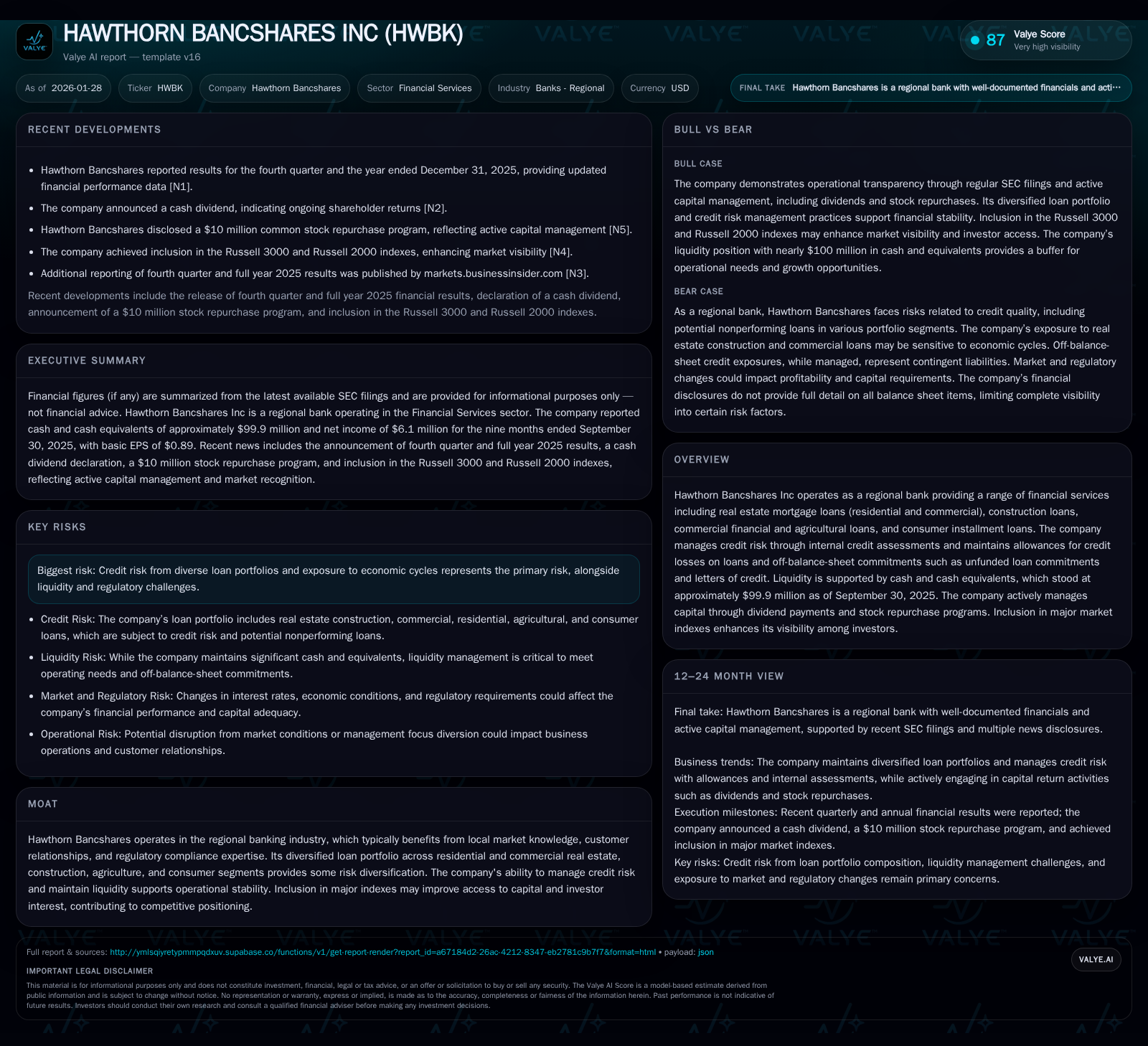
Hawthorn Bancshares Inc is a regional bank offering diverse loan products across residential and commercial real estate, construction, agricultural, and consumer segments. Recent developments include strong liquidity, a $10 million share repurchase program, and inclusion in major market indexes, reinforcing visibility and capital access. The company’s business model relies heavily on credit risk controls and capital management, with economic sensitivity tied to local market conditions and regulatory requirements. Key uncertainties include credit quality trends and the impact of broader economic cycles on loan performance.
What Changed Recently
In late January 2026, Hawthorn Bancshares reported fourth quarter and full-year results for 2025, highlighting sustained liquidity with approximately $99.9 million in cash and equivalents as of September 30, 2025, and net income of $6.1 million for the first nine months of that year [N1][S9]. The company announced a $10 million common stock repurchase program replacing its prior authorization, reflecting management’s confidence in the balance sheet and earnings stability [N5]. Alongside this, Hawthorn declared a quarterly cash dividend, continuing a shareholder return program consistent with prior periods [N2]. Importantly, Hawthorn achieved inclusion in the Russell 2000 and Russell 3000 indexes, a milestone that could broaden institutional investor interest and potentially facilitate capital market access [N4]. These developments underscore a strategic emphasis on capital management and market positioning.
Business Model as a System
Hawthorn Bancshares operates as a regional bank with a business model centered on providing a diversified suite of lending products: primarily real estate mortgage loans (both residential and commercial), real estate construction loans, commercial financial and agricultural loans, and consumer installment loans [S1][S7]. Its customers are typically local individuals, businesses, and agricultural operators, leveraging the bank's regional footprint and specialized knowledge.
The bank actively manages credit risk through detailed internal credit assessments that categorize loans by performance and risk status, including standard classifications such as pass, special mention, substandard, and nonaccrual [S1][S2]. It maintains an allowance for credit losses covering both on-balance-sheet loan exposures and off-balance-sheet commitments like unfunded loan commitments and letters of credit [S10]. This approach helps the bank prepare for potential losses and maintain regulatory compliance.
Liquidity management is supported by a substantial cash reserve and access to Federal Home Loan Bank advances, alongside a stable deposit base exceeding $1.5 billion [S9][S13]. Capital management practices include regular dividend payments to shareholders and opportunistic share repurchases, aiming to optimize shareholder value while meeting regulatory capital adequacy requirements influenced by Basel III standards [N2][N5][S14][S15]. The company’s legal and regulatory framework imposes constraints on capital distribution and requires ongoing prudence.
Operationally, the company balances growth initiatives with rigorous risk controls, leveraging its local market knowledge and customer relationships to differentiate from larger national banks [Valye overview]. The interplay between credit risk, liquidity, capital adequacy, and competitive positioning forms the backbone of its business model.
Industry Map & Competitive Battlefield
Hawthorn Bancshares operates in the regional banking segment of the financial services industry, characterized by competition primarily from other community and regional banks, credit unions, and larger national banks with regional branches. Regional banks typically compete on the strength of local knowledge, personalized customer service, and tailored lending solutions, especially in commercial real estate, agriculture, and small business sectors.
Key competitive factors include:
Loan product diversity and specialization: Hawthorn’s diversified loan portfolio across real estate mortgages, construction, commercial, agricultural, and consumer segments provides flexibility but also exposes the bank to sector-specific risks.
Credit risk management: Regional banks compete on credit quality and risk mitigation, as loan losses directly impact profitability and regulatory capital.
Capital and liquidity strength: Adequate capital cushions and liquidity profiles enable banks to grow lending while sustaining regulatory compliance.
Technology and digital banking capabilities: While not explicitly detailed for Hawthorn, industry trends pressure regional banks to adopt digital platforms for customer acquisition and operational efficiency.
Regulatory compliance and cost: The regional banking landscape is heavily influenced by regulatory requirements varying across states and federal levels, impacting cost structures and strategic decisions.
Against this backdrop, Hawthorn’s moat is rooted in its diversified loan book, robust risk management, and local market expertise [Valye overview]. However, competitive pressures remain from banks with larger scale or more advanced technology platforms. Additionally, potential macroeconomic fluctuations affecting real estate and agricultural markets can alter competitive dynamics.
Where the Economics Become Real
Hawthorn’s unit economics hinge on interest income from its loan portfolio net of credit losses and funding costs. The bank’s loan mix impacts yield and risk profile:
Real estate mortgages (residential and commercial): Typically generate stable interest income but are sensitive to property market cycles and interest rate changes.
Construction loans: Higher yielding but more volatile, dependent on project completion and economic conditions.
Commercial financial and agricultural loans: Provide diversification but can be affected by commodity prices, local economic health, and borrower creditworthiness.
Consumer installment loans: Generally smaller and higher risk per unit, but contribute to portfolio diversification.
Credit risk is a critical bottleneck. Nonperforming loans appear mainly in commercial and construction categories, requiring vigilant monitoring and provisioning [S2]. Loan loss allowances, including for off-balance-sheet exposures, represent a direct drag on earnings but are essential for capital preservation [S10].
Liquidity economics play a role through the cost and stability of deposits, with Hawthorn holding over $1.5 billion in deposits, a low-cost funding source relative to wholesale borrowings [S9][S13]. Federal Home Loan Bank advances supplement liquidity but at higher marginal cost. The bank’s ability to maintain liquidity enables it to fund loan growth and operational needs.
Capital economics include managing CET1 and other regulatory capital buffers to support risk-weighted assets while allocating cash flows between dividends and share repurchases [S14][S15]. The announced $10 million buyback program suggests management believes capital is sufficient to support shareholder returns alongside growth.
Profitability metrics such as net interest margin, efficiency ratio, and return on equity are not detailed in the available disclosures but would be critical for deeper economics understanding.
Diligence Questions / Disconfirming Signals
Credit Quality Trends: How have nonperforming loan ratios evolved across loan segments, especially commercial and construction? Are there early signs of stress from local economic conditions or real estate markets that could impair asset quality?
Loan Portfolio Concentrations: What are the geographic and sectoral concentrations within the loan book? Is the bank overly exposed to any single industry or borrower group?
Competitive Positioning in Digital Banking: What investments has Hawthorn made in digital channels and technology infrastructure? How does it compare to peers in customer acquisition and operational efficiency?
Capital Adequacy Under Stress: How resilient is the capital position under adverse economic or regulatory scenarios? What are the triggers and constraints for dividends and buybacks?
Deposit Stability: Given the size of the deposit base, what is the composition and stickiness of deposits? Are there risks of outflows in a rising rate or economic downturn environment?
Regulatory Environment: How does Hawthorn navigate evolving federal and state regulatory requirements? Are there any pending regulatory issues or compliance costs that could materially impact results?
Growth Strategy Risks: Are there plans for acquisitions or significant loan portfolio expansions? What are the operational and integration risks?
Earnings Sensitivity: How sensitive are net interest margins and earnings to interest rate fluctuations and credit losses?
Management Incentives: How are executive and employee incentives aligned with risk management and long-term shareholder value?
These questions highlight areas where further information would clarify the sustainability and trajectory of Hawthorn Bancshares’ business model and financial health.
This analysis is based on publicly available information as of January 28, 2026, including company disclosures and recent news reports. It does not constitute investment advice or recommendations. Financial figures are drawn from the latest SEC disclosures where available and are provided for informational context only.
Disclaimer: This is research-only, informational analysis and not investment advice. It may include AI-generated interpretation and general industry context. Always verify important details using primary sources.

Comments