
Hawthorn Bancshares Inc: Navigating Regional Banking with Operational Streamlining and Local Market Focus
Hawthorn Bancshares leverages deep regional roots and diversified financial services while managing credit and competitive pressures in Missouri and adjacent markets.
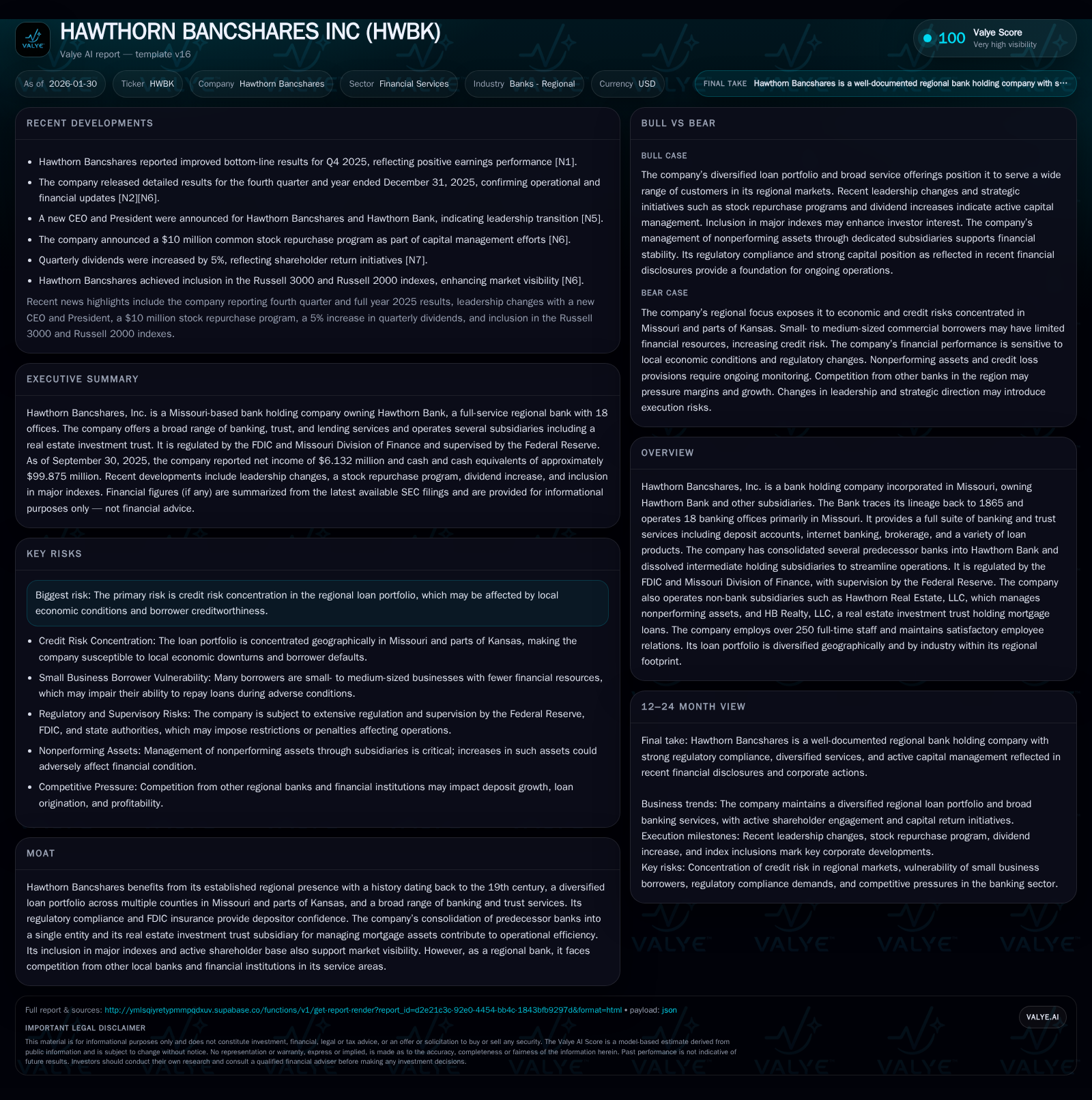
Hawthorn Bancshares, Inc. is a Missouri-based regional bank holding company operating 18 offices primarily within Missouri, offering a broad range of banking, trust, and brokerage services. Recent organizational simplifications and leadership transitions coincide with steady financial results and dividend growth reported in early 2026. The company competes in a fragmented but competitive regional market, contending with larger banks and alternative financial providers. Key economic drivers include credit quality, deposit growth, interest rate management, and operational efficiencies from consolidation efforts. Risks remain focused on credit concentration and local economic sensitivity.
What Changed Recently
Hawthorn Bancshares reported its financial results for Q4 and the full year ended December 31, 2025, showing improvement in net income and operational performance. The company announced a 5% increase in its quarterly cash dividend, reflecting confidence in cash flow stability and capital position [N1][N6][N11]. Alongside financial updates, Hawthorn appointed a new CEO and president, potentially marking a new phase in strategic execution and market positioning [N8]. The company also achieved inclusion in the Russell 3000 and Russell 2000 indexes, which can enhance visibility and institutional interest [N14].
Operationally, the previous consolidation efforts culminated with the dissolution of Union, the intermediate holding company owning Hawthorn Bank, streamlining corporate structure to improve efficiency and regulatory clarity [S3].
Business Model as a System
Hawthorn Bancshares functions as a Missouri-registered bank holding company with a primary subsidiary, Hawthorn Bank, operating 18 branches predominantly across Missouri counties such as Cole, Boone, Henry, Cass, and Benton. The bank offers a full suite of banking products, including commercial and industrial loans, real estate loans (both residential and commercial), personal installment loans, deposit accounts insured by the FDIC, internet banking, debit cards, certificates of deposit, trust and brokerage services, and safety deposit boxes [S1].
The company also operates non-bank subsidiaries to manage specific assets and risks. Hawthorn Real Estate, LLC, established in 2008, holds and manages nonperforming assets to facilitate orderly disposition and strengthen the bank’s financial position. HB Realty, LLC is a real estate investment trust holding mortgage loans, structured to include employee participation through preferred shares, aligning incentives and providing dividend income [S1][S4].
Regulatory oversight is multi-layered: the FDIC and Missouri Division of Finance supervise deposit and banking operations, while the Federal Reserve oversees the holding company under the Bank Holding Company Act and related financial holding company rules [S1][S5]. Compliance with Basel III capital adequacy guidelines is maintained, and the bank holds a "well-capitalized" classification, critical for operational flexibility including dividends and executive compensation [S14][S15].
The company’s business model is cyclical and dependent on its ability to attract deposits, prudently originate loans, manage asset quality, and generate net interest margin while balancing regulatory constraints. Cross-selling trust and brokerage services supplements fee income, diversifying revenue streams [S1].
Industry Map & Competitive Battlefield
Hawthorn operates within the regional banking sector, competing primarily in Missouri’s mid-sized markets including Jefferson City, Columbia, Springfield, and the Kansas City metropolitan area. Competition includes other community and regional banks, credit unions, savings banks, and increasingly, nonbank financial institutions offering overlapping services. This competition pressures deposit growth, loan pricing, and customer retention [S17][S18].
Larger national and multinational banks also encroach on regional markets, leveraging scale advantages in technology, product breadth, and brand recognition. Mergers and consolidations in the banking industry further intensify competition by creating larger entities with expanded resources [S18].
The regulatory environment including the Bank Secrecy Act, USA PATRIOT Act, and Basel III capital rules imposes operational and compliance costs, but also serves as a barrier to new entrants, reinforcing the position of established players like Hawthorn with longstanding regional roots [S16].
Hawthorn’s competitive positioning is strengthened by its historical presence dating back to 1865, local market knowledge, diversified loan portfolio spread across multiple Missouri counties plus some Kansas exposure, and the ability to deliver personalized trust and investment services. However, the bank must continuously invest in technology and customer experience to maintain relevance against digitally savvy competitors.
Where the Economics Become Real
The economic engine of Hawthorn Bancshares revolves around net interest margin, loan performance, deposit stability, and operational efficiency. The bank’s income depends heavily on the spread between interest earned on assets (loans and securities) and interest paid on deposits and borrowings [S7]. In 2023, the company repositioned its balance sheet by selling $83.7 million of investment securities at a realized loss, indicating active asset-liability management in response to interest rate environments [S7].
Deposit acquisition and retention are critical as these funds provide the low-cost capital to fund loans. Competitive pressures can force higher deposit rates, squeezing margins. Similarly, the average life of deposits influences asset-liability matching and interest rate risk exposure [S7].
Loan portfolio quality is managed through an internal risk-rating system categorizing loans as Pass, Watch, or other risk grades. Pass loans are well collateralized and have strong borrower repayment capacity, while Watch loans signal potential credit weaknesses. This categorization guides provisioning and risk management [S12]. Concentration risk is inherent given the bank’s regional focus, making local economic cycles and borrower creditworthiness key sensitivities.
Capital adequacy is maintained at levels exceeding minimum Basel III requirements, enabling dividend payments and risk-taking capacity [S14][S15]. The 5% dividend increase announced in January 2026 suggests confidence in ongoing capital generation and liquidity [N6][N11].
Operational leverage benefits from consolidation of predecessor banks and reduction of intermediate holding companies, which streamline governance and reduce administrative overhead [S3]. The company employs over 250 full-time employees supporting operations, with stable employee relations [S6].
Diligence Questions / Disconfirming Signals
The impact of the recent leadership change on strategic priorities and risk appetite remains to be seen. How will the new CEO and president address competitive pressures and technological investments? [N8]
Given the company’s regional loan concentration, what is the current status of Watch and nonperforming loans, especially in sectors vulnerable to local economic downturns? Detailed credit quality metrics are not disclosed in the recent news.
The sale of investment securities at a loss in 2023 raises questions about the bank’s interest rate risk management effectiveness and the potential for further unrealized losses if rates rise or remain volatile [S7].
Competitive dynamics in the primary service areas include larger banks and nonbank lenders with more advanced digital platforms. How is Hawthorn investing in technology and customer experience to maintain market share?
The majority retail investor ownership (52%) versus institutional ownership (30%) could influence corporate governance, capital raising flexibility, and strategic initiatives [N10]. How aligned are retail shareholders with long-term value creation?
The dissolution of the captive insurance subsidiary in 2023 suggests a change in risk management approach [S6]. What alternative risk mitigation strategies have been adopted?
Regulatory compliance and evolving capital requirements remain significant. How prepared is Hawthorn for potential tightening in banking regulations or stress in the regional economy?
This analysis synthesizes public news and company disclosures as of early 2026. It is intended for informational purposes and does not constitute investment advice or recommendations.
Disclaimer: This is research-only, informational analysis and not investment advice. It may include AI-generated interpretation and general industry context. Always verify important details using primary sources.

Comments