
Howmet Aerospace Navigates Cyclicality and Supply Challenges with Robust Q4 Earnings
Howmet Aerospace's strong fiscal 2025 results highlight operational resilience amid aerospace market cyclicality and raw material pressures.
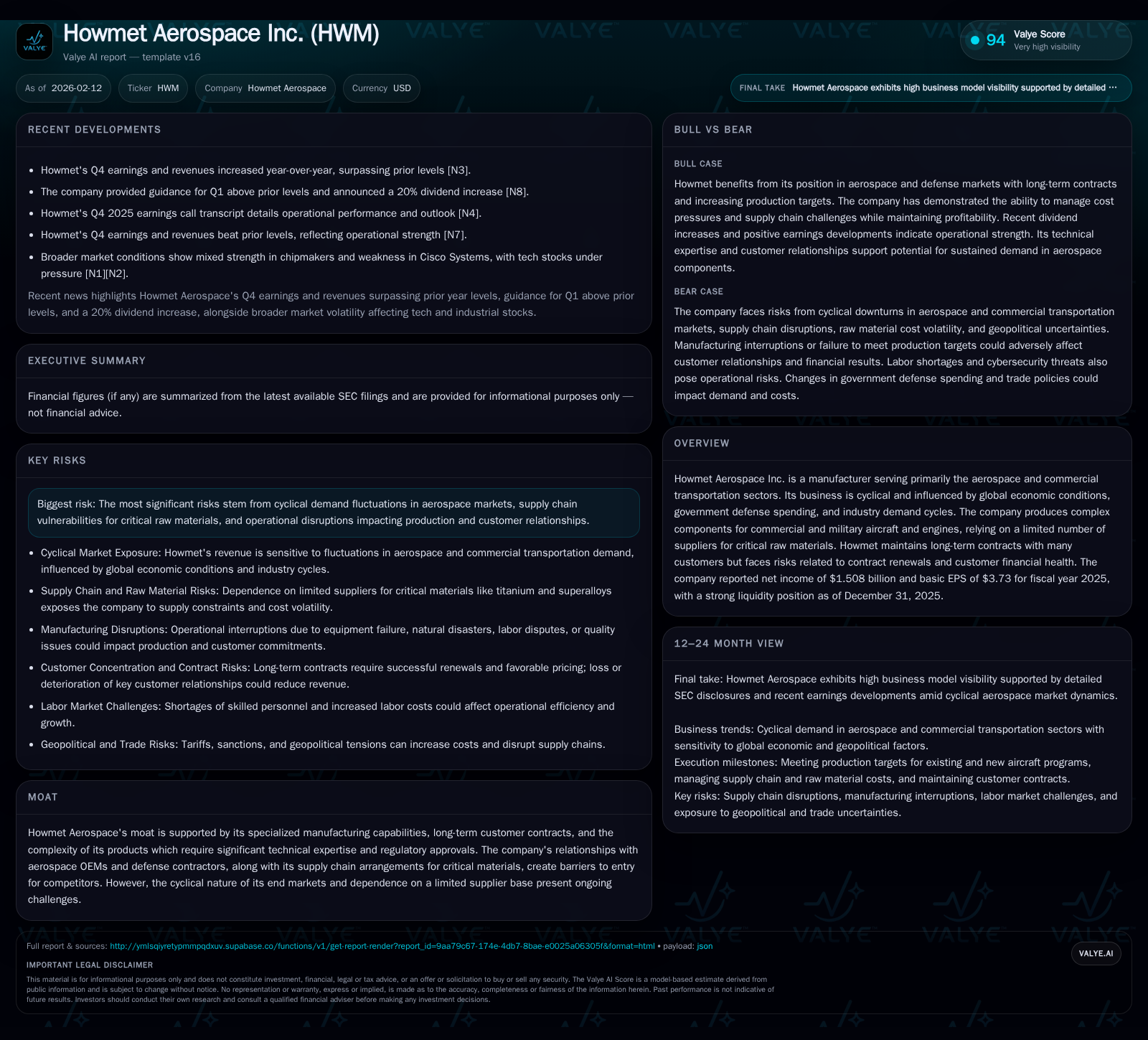
In fiscal 2025, Howmet Aerospace delivered a notable net income of $1.508 billion and an EPS of $3.73, surpassing consensus estimates despite the cyclical aerospace environment. The company’s Q4 revenue growth and a solid liquidity position underpin its ability to withstand supply chain constraints, particularly relating to critical raw materials such as titanium and nickel. Long-term customer contracts and technical manufacturing expertise reinforce Howmet’s competitive moat, though exposure to global economic shifts and geopolitical tensions remain significant risk factors.
Q4 2025 Earnings Beat: Surpassing Expectations in a Cyclical Industry
Howmet Aerospace closed fiscal year 2025 with solid financial performance that exceeded market expectations, highlighted by a net income tally of $1.508 billion and basic EPS of $3.73 [F1]. Q4 revenues demonstrated year-over-year growth driven by resilient demand across commercial aerospace components and commercial transportation products [N1][N4]. This earnings beat provided a confident springboard into the new year despite the well-understood cyclical dynamics shaping Howmet’s markets.
Investors responded positively to these results, reflecting confidence in Howmet’s execution capabilities amidst external headwinds [N2]. The company's performance is even more notable given the aerospace sector’s sensitivity to macroeconomic shifts — underscoring operational efficiencies and effective cost management as key contributors.
Navigating Cyclicality: Aerospace Demand and Commercial Transportation Trends
Howmet’s revenue streams are intimately tied to the broader aerospace industry cycles—chiefly influenced by commercial airline OEM procurement schedules, defense spending patterns, and transportation manufacturing volumes [S1]. The company emphasized that fluctuations in global economic conditions directly affect end-customer orders for aircraft and engine components.
The commercial aerospace segment historically depends on airline profitability trends, passenger traffic recovery rates, and financing availability for aircraft orders. Defense aerospace revenues are subject to governmental budget allocations, shifting strategic priorities, and geopolitical stressors altering procurement timelines [S1]. Meanwhile, Howmet’s commercial transportation product demand correlates with vehicle production volumes which themselves respond to regulatory environments, fuel pricing, and fleet replacement cycles.
This inherent cyclicality means Howmet must continuously tailor operations to evolving industry demand while managing inventory levels and workforce flexibility.
Supply Chain Under the Microscope: Critical Materials and Cost Pressures
A significant operational challenge highlighted in recent filings involves securing critical raw materials like titanium, nickel, cobalt, aluminum, and advanced superalloys essential for high-performance aerospace components [S1]. These inputs are subject to volatile pricing linked to geopolitical tensions—including ongoing impacts from the Russia-Ukraine conflict—trade restrictions, tariffs, and export controls.
Titanium price volatility stands out due to its extensive use in aircraft engine parts; supply concentration among a limited number of suppliers enhances vulnerability [S1]. Additionally, delays or failures by customers to return titanium scrap increase Howmet’s raw material purchasing at higher spot prices.
Inflationary pressures on labor and energy also intensify overall production costs. While contractual mechanisms permit passing through some raw material cost increases to customers, timing lags exist that require careful margin management.
Moat Deep Dive: The Strength of Technical Expertise and Customer Relationships
Howmet benefits from entrenched competitive advantages grounded in its specialized engineering know-how for complex metal components requiring high precision manufacturing techniques [valye_report_excerpt].
Long-term contracts with original equipment manufacturers (OEMs) in both commercial aerospace and defense coupled with multi-year supply agreements provide revenue visibility uncommon in many other industrial segments. These relationships reflect high barriers to entry for new competitors given regulatory certifications required for aerospace-grade products.
Moreover, the deep integration into customer supply chains — including cooperative product development efforts — enhances customer retention though it simultaneously creates dependencies that mandate continuous quality assurance investment.
Risk Radar: Managing Market Volatility and Contractual Dependencies
Despite strengths, Howmet faces multiple risk vectors. Chief among these is demand cyclicality which can compress periods of order slowdowns affecting factory utilization rates [S1]. Variable government defense budgets add another layer of uncertainty given their susceptibility to congressional appropriations processes.
Contract renewals represent potential inflection points impacting revenue if major OEMs or military agencies elect alternate suppliers or reprioritize procurement timelines [valye_report_excerpt]. The concentrated supplier base for critical materials further exacerbates operational risk especially amid geopolitical trade disruptions or capacity constraints.
These uncertainties necessitate robust risk mitigation strategies encompassing supplier diversification where possible alongside flexible manufacturing processes capable of scaling with order volumes.
Liquidity & Balance Sheet Health: Fueling Future Growth Opportunities
Financially, Howmet enters 2026 with solid balance sheet metrics underpinning its strategic options. Cash and cash equivalents stood near $742 million at year-end 2025 while current assets exceeded current liabilities by more than double—yielding a current ratio of approximately 2.13 [F1].
This liquidity cushion positions Howmet well for capital expenditures focused on innovation or capacity expansion despite inherent cyclicality pressures. It also provides flexibility if temporary working capital demands spike due to supply chain disruptions or inventory buildup needs.
Strategic Outlook: Guidance, Dividend Boosts, and Market Positioning
During the Q4 earnings call, management issued forward guidance projecting Q1 2026 results above analyst consensus estimates—a signal of sustained operational momentum into the new fiscal year [N14][N2].
Coupled with this confidence was an announced dividend increase of approximately 20%, reflecting strong cash flow generation capability alongside a shareholder-friendly capital return philosophy [N14].
Such moves underscore management’s conviction about balancing growth opportunities while rewarding shareholders within an industry context marked by cyclical variability.
Macro Influences: Global Economic Factors and Geopolitical Impacts
Howmet's operating environment continually evolves under the influence of broad macroeconomic currents including inflationary trends affecting wage costs and input prices as well as energy pricing volatility impacting manufacturing expenses [S1].
Geopolitical developments—most notably the Russia-Ukraine conflict—continue shaping raw material markets crucial for aerospace manufacturing. Titanium pricing instability has been tethered closely to these tensions owing to regional supply origins [S1].
Additionally, international trade policies remain fluid with new tariff regimes introduced in late 2025 requiring vigilant monitoring. Inflation-induced cost pass-through timing mismatches represent another complexity layering near-term margin pressures on top of structural risks.
Investor Sentiment and Market Reactions: Option Activity and Stock Momentum
The post-earnings reaction in markets displayed active investor engagement as evidenced by notable option flows focusing on HWM shares [N12]. This heightened activity suggests institutional participants are recalibrating positions based on both strong quarterly fundamentals and broader market headwinds impacting equity sectors outside industrials.
Equity markets experienced weakness concurrent with tech sector declines fueled by AI-related valuation concerns [N9][N10], marking a contrasting backdrop against which Howmet’s cyclical yet sturdy fundamentals stand out.
The mixed market environment underscores investors’ appetite for companies demonstrating durable earnings power amid volatile conditions—traits exemplified recently by Howmet’s financial disclosures.
This analysis synthesizes publicly available data from regulatory filings and market disclosures without offering investment advice or price targets. Readers should conduct their own due diligence when considering any exposure related decisions concerning Howmet Aerospace or its peers.
Disclaimer: This is research-only, informational analysis and not investment advice. It may include AI-generated interpretation and general industry context. Always verify important details using primary sources.

Comments