
Hyliion’s Commercialization Delay Challenges Growth Despite Technological Edge
Hyliion Holdings Corp. continues development of its KARNO Power Module with government contracts supporting R&D, yet sustained losses and delayed revenue commercialization cast uncertainty on near-term growth.
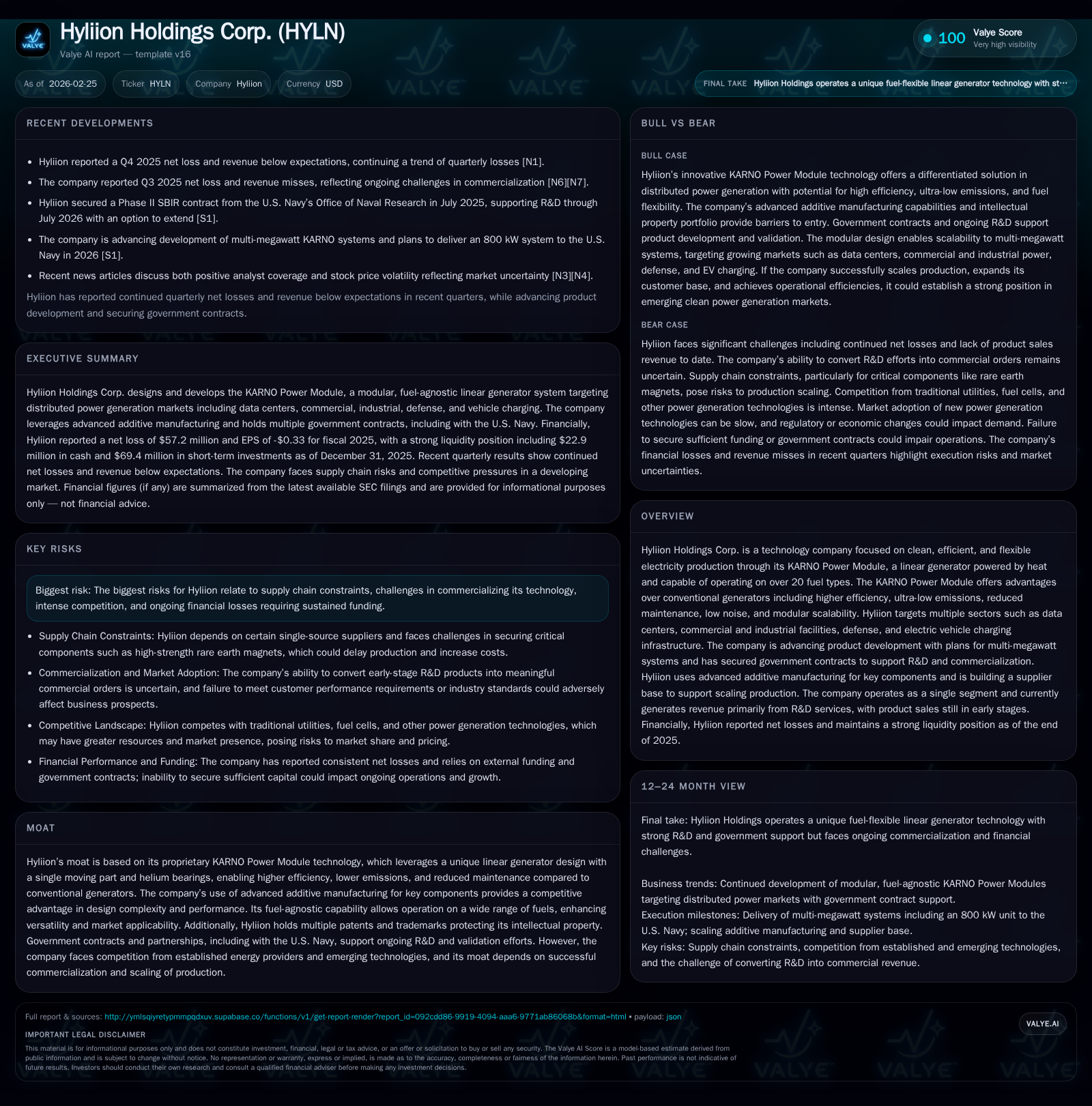
Hyliion Holdings Corp., a developer of a unique linear generator technology called the KARNO Power Module, remains in its early stages with no commercial sales as of fiscal 2025. The company’s revenues are derived primarily from U.S. government R&D contracts, notably with the Navy's Office of Naval Research (ONR). Despite technological advantages such as fuel agnosticism, modularity, and advanced additive manufacturing, Hyliion reported continued operating losses and negative cash flow in 2025. The anticipated launch and commercialization of KARNO generators is targeted for late 2026, with growth prospects hinging on successful scaling and market acceptance. Capital expenditures increased significantly in 2025 to support production capacity expansion, but the company faces risks including supply chain constraints, intense competition, and reliance on government funding.
Company Overview
Hyliion Holdings Corp. designs and develops clean power generation technology centered on its proprietary KARNO Power Module—an innovative linear generator using heat power capable of running on over twenty types of fuels including natural gas, propane, renewable hydrogen, and ammonia. The company emphasizes modularity, ultra-low emissions via flameless oxidation, low maintenance requirements (thanks to a single moving part design supported by helium bearings), and scalability suitable for stationary power and transport applications [S1][S19].
Headquartered in Cedar Park, Texas with R&D operations in Cincinnati, Ohio, Hyliion targets multiple verticals such as data centers demanding uninterrupted clean power, military naval vessels undergoing electrification initiatives under the Department of Navy contracts, commercial & industrial customers seeking reduced carbon footprint onsite generation, and electric vehicle recharging infrastructure where flexible power sources are advantageous [S1][S19].
Historical Performance
As an early-stage technology developer still in the prototype/testing phase of its flagship KARNO generator product line, Hyliion's revenues have been limited predominantly to research & development contracts—principally from U.S. government agencies. Since September 2024, Hyliion has secured cost-plus-fixed-fee contracts totaling up to approximately $20 million from the Office of Naval Research (ONR) focused on technical validation for naval shipboard integration and stationary power needs [S1][S25]. These governmental contract revenues accounted fully for reported revenue during fiscal 2024 through 2025.
Commercial sales have not commenced yet as the company continues product testing, targeting first deployments by late 2026 which could initially be subsidized or provided for free to anchor customers to demonstrate capabilities [S1][S19].
Financial Snapshot (Fiscal Years Ended December 31)
Historical performance (annual)
| FY | Net ($mm) | CFO ($mm) | OpInc ($mm) | Capex ($mm) | Net YoY |
|---|---|---|---|---|---|
| 2025 | -57 | -47 | -66 | 24 | -9.9% |
| 2024 | -52 | -57 | -64 | 17 | +57.9% |
| 2023 | -124 | -117 | -137 | 7 | +19.5% |
| 2022 | -153 | -117 | -159 | 3 |
Note: Omitted columns lack sufficient annual XBRL coverage in the provided tags (need ≥2 annual points): Rev, Div. Source: SEC companyfacts cache [F1].
Capital returns and efficiency (annual)
| FY | Buybacks ($mm) | FCF ($mm) | ROE% |
|---|---|---|---|
| 2025 | 0 | -70 | -29.8 |
| 2024 | 14 | -73 | -21.3 |
| 2023 | 0 | -124 | -40.3 |
| 2022 | -120 | -36.2 |
Source: SEC companyfacts cache [F1].
Note: Revenue unavailable in provided data [F1].
Analysis: Operating losses substantially narrowed post-2023 peak losses reflecting progress toward product maturity although still sizable relative to equity base. Operating cash flows remain negative reflecting ongoing development costs. Capital expenditures have ramped sharply as Hyliion invests in additive manufacturing equipment critical to producing complex KARNO Core components. Equity contraction mainly reflects accumulated deficits exceeding fresh equity raises; absence of buybacks post-2024 preserves cash for operations.[F1]
Business Model & Product Development
The KARNO Power Module combines a linear engine coupled with a power generation core that eliminates typical rotary mechanical wear points producing electricity efficiently from heat sources. This technology's fuel agnosticism enables switching seamlessly across various fuels depending on availability or environmental preference—a key differentiation versus conventional gensets. Its scalable modular design fits applications ranging from sub-megawatt data center backup power to multi-megawatt naval vessel platforms [S1][S19].
Hyliion adopts advanced additive manufacturing (3D printing) for critical core components, fostering designs not feasible with traditional machining while improving component performance attributes. This approach also targets reduction in cost per unit enabling competitive pricing when scaled. Increased installed additive printer capacity during 2025 aims to address projected surges in demand following expected commercial launch [S12][S13][S21].
Government-funded R&D programs represent the company's sole revenue stream today, supporting ongoing refinement activities like increasing output power levels toward targeted multi-megawatt systems, enhancing durability measures for sustained operational use, and building integrated software architectures enabling control over multiple KARNO cores working synchronously [S19][S25].
Future Growth Prospects & Catalysts
Critical near-term catalysts include:
- Completion of comprehensive design improvements throughout calendar year 2026 leading into commercialization readiness[S19].
- Transition from government-funded R&D contracts to product revenue as initial customer deployments commence late-2026 or shortly thereafter [S1][N1].
- Expansion of additive manufacturing capabilities both through new printer installations and optimization upgrades to existing printer parameters which reduce print time while maintaining quality [S19].
- Broadening sales channels potentially via partnerships or outsourcing distribution/service functions currently managed internally [S19].
- Ability to expand into adjacent market segments such as industrial waste heat utilization or e-mobility applications including marine vessels if fundamental technical progress holds [S1].
However growth faces constraints:
- Dependence on continuous government funding until commercial sales can generate positive gross margins remains critical [S1][S6].
- Risks around achieving projected performance criteria at scale may delay or limit market acceptance.
- Supply chain bottlenecks especially around single-source suppliers could hamper timely scaled production [S8][S10].
- Competitive pressures exist from incumbent energy providers adopting renewable integration strategies alongside other emerging distributed generation solutions [S29].
Forecasts & Milestones To Watch
No explicit financial guidance was provided beyond anticipated timelines outlined in contractual milestones. Market observers should monitor:
- Progress updates from ongoing testing campaigns including early deployment unit results [N1][S3].
- Timing of initial commercial orders versus backlog indications derived from signed agreements or letters-of-intent mentioned by management [S19].
- Installation ramp-up rates for new additive printers and resultant output capacity increases.
- Cost trajectory improvements impacting gross margins necessary to progress towards profitability.
- Evolution in government contract renewals or new awards given heavy reliance on ONR funding streams.
Returns & Capital Allocation
Hyliion’s financial profile remains characteristic of an ambitious early-stage tech company focused heavily on innovation over profitability:
- The company's approximate Return on Equity based on latest net loss relative to shareholder equity is about -29.8%, reflecting significant cumulative operating deficits eroding capital base [F1].
- Operating cash flows continue negative consistent with prior years indicating ongoing investment burn without offsetting inflows yet.
- Capital expenditures grew markedly reflecting strategic buildout of proprietary additive manufacturing infrastructure key to production scaling ambitions.
- No dividends have been paid nor are expected given cash flow negativity.
- Share repurchases ceased after meaningful buyback activity in full-year 2024 totaling ~$14 million; retention of cash resources presumably prioritized ahead of commercialization—no buybacks reported in FY25 [F1].
Liquidity remains adequate as cash plus equivalents totaled roughly $23 million at year-end fiscal 2025 supporting operational runway together with high current ratio about tenfold current liabilities underscoring low immediate solvency risk though sustained future capital raises may be necessary absent rapid revenue growth [F1][S7][S10].
Industry Context & Technical Nuances (Analysis)
Distributed generation markets increasingly emphasize integration flexibility, emissions reductions aligned with tightening regulations, and lifecycle cost efficiency particularly for complex heat-to-electricity conversions required in diverse fuel environments. Hyliion's single moving part architecture aided by helium bearings reduces mechanical wear—a significant pain point limiting reliability and maintenance cycles in conventional generators. Additive manufacturing further supports lightweighting combined with geometric optimization unattainable by subtractive methods which could lead to lower total cost ownership over system life per deployed unit. Nonetheless, balancing scale economics that large incumbents enjoy alongside evolving grid-edge regulatory frameworks poses ongoing hurdles common across emerging energy tech startups trying to establish footholds amid shifting policy incentives.[F1][S29]
Risk Factors Summary
Key material risks documented include:
- Potential delays or failures in finalizing design sufficient for market launch jeopardizing near-term revenue realization.
- Overreliance on U.S governmental contract revenues currently forming exclusive income source risking abrupt impact if discontinued or scaled back abruptly.[S1]
- Supply-chain vulnerabilities involving single-source component suppliers increasing pricing volatility or delivery delays adversely affecting margins and fulfillment timelines.[S8]
- Sustained losses requiring recurrent capital infusions exposing dilution risks without assured financing alternatives.[F1]
- Regulatory fluctuations affecting defense procurement standards or public energy policy requiring costly compliance adaptations.[S11][S20]
- Intellectual property protection challenges especially internationally could erode competitive positioning or invite costly litigation.[S6]
Conclusion
Hyliion Holdings stands at a pivotal juncture transitioning from an R&D-centric operation fueled by government contracts toward planned commercialization of its innovative KARNO Power Module technology addressing critical clean energy generation needs across several sectors including defense and industry. While promising technological features like additive-manufactured parts and fuel versatility differentiate it from legacy solutions, stretched financial metrics marked by persistent losses and heavy capex investments reflect typical early-stage execution risks alongside supply chain fragilities. The coming year will be crucial as Hyliion aims to demonstrate scalable production effectiveness while converting signed interests into paying customers amidst high capital intensity inherent in clean energy hardware ventures. Stakeholders should closely observe proof points related to product reliability milestones, and signs that the company can monetize technology breakthroughs sustainably at scale beyond its government contract foundation.
Disclaimer: This report is prepared solely for informational purposes based on publicly available SEC filings and published news articles as of February 25, 2026 without offering investment advice or recommendations.
Disclaimer: This is research-only, informational analysis and not investment advice. It may include AI-generated interpretation and general industry context. Always verify important details using primary sources.

Comments