
MarineMax Elevates Market Reach with Global Marina Network and Superyacht Services
Latest quarterly updates reveal MarineMax’s expanding footprint and service breadth amid looming economic headwinds.
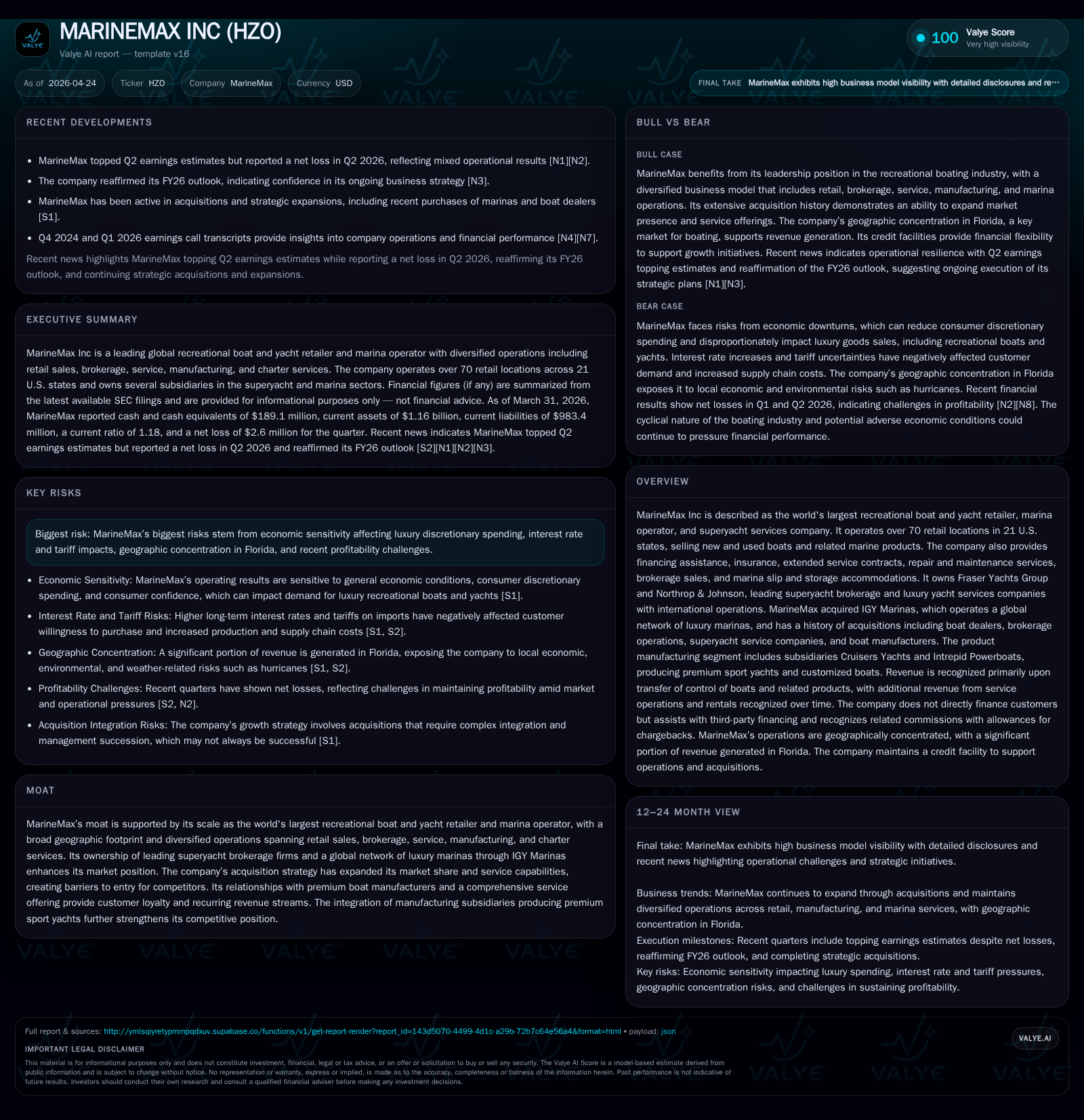
MarineMax reported an expanded global presence with over 120 locations, including a growing portfolio of luxury marina operations through strategic acquisitions. Despite a Q2 earnings beat, the company faced a net loss, pressured by cyclical demand softness in the discretionary boating market. Its integrated business model spans retail sales, brokerage, manufacturing, marina management, and luxury charter services, positioning it uniquely within the marine leisure industry. The company's growth hinges on leveraging its marina network and superyacht services, while mitigating risks from economic volatility concentrated in key regions like Florida.
Q2 2026 Operating Update Highlights Growth and Risks
MarineMax’s most recent quarterly filing for Q2 ended March 31, 2026 highlights a significant expansion in its global marine footprint while also revealing the pressures from an uncertain macroeconomic environment. The company now operates more than 120 locations worldwide which include over 70 retail dealership sites in the U.S., many complemented by marina facilities. The strategic acquisition of IGY Marinas has added ownership or operation of approximately 65 marina and storage locations globally across key yachting destinations in the Americas, Caribbean, Europe, and Asia. This international marina network expansion underscores MarineMax’s transformation into an end-to-end marine lifestyle provider beyond traditional boat retailing [S2].
However, management expresses caution given rising concerns about a potential economic recession and persistent inflation stemming from disruptions to international trade. As is characteristic of the recreational boating sector—a largely discretionary luxury market—economic volatility notably influences consumer demand patterns. The recent quarter reflected these headwinds as MarineMax reported a slip into net loss territory despite beating earnings estimates. This tension between growth via market expansion and softness in legacy segments frames the company’s near-term operational narrative [S2][N1][N4].
Diverse Revenue Streams and Integrated Service Offering
MarineMax’s business model is multifaceted: it combines new and used boat sales with ancillary revenue from financing assistance, insurance products (extended service contracts), brokerage sales through high-end firms Fraser Yachts Group and Northrop & Johnson, plus repair/maintenance services. The company’s manufacturing arm includes subsidiaries producing premium sport yachts such as Cruisers Yachts and Intrepid Powerboats which enhance vertical integration. Furthermore, the IGY Marina acquisition brings luxury marina management into the fold—covering berth rentals, storage accommodations, and yacht hospitality—creating a comprehensive ecosystem for boating enthusiasts [S1][F1].
This integrated paradigm ensures multiple touchpoints for customer interaction prompting retention through recurring revenue streams beyond initial boat sales. For example, customers benefiting from financing solutions can also access insurance options; boat owners can avail themselves of maintenance services; brokers link buyers/sellers; and marina guests partake in premium experiences abroad ensuring prolonged engagement within the MarineMax platform. Such cross-segment synergies are difficult to replicate without scale and complement the company’s historical acquisition approach aimed at consolidating fragmented marine retail, service, brokerage, manufacturing, and marina assets [S1].
Industry Dynamics: Competitive Scale, Pricing Leverage, and Marine Economy Cyclicality
MarineMax occupies a commanding competitive position as the world’s largest recreational boat/yacht retailer combined with expansive marina operations and elite superyacht brokerage presence. Its U.S.-centric dealership base exceeds 70 locations spread across 21 states—a scale unmatched domestically—with international reach concentrated through marquee assets like IGY Marinas globally alongside Fraser Yachts’ brokerage hubs.
Nonetheless, pricing power remains constrained given the luxury discretionary nature of boating purchases which are highly sensitive to consumer confidence indices and interest rate fluctuations affecting financing costs. Supply chain challenges seen industry-wide have arguably subdued manufacturing throughput capacity gains at its production subsidiaries. Moreover, geographic concentration risk persists; with Florida consistently contributing over half of dealership revenues (~54% in FY25), localized economic disruptions or severe weather events (e.g., hurricanes) pose tangible downside risk to operating performance [S1][S2][F1].
The industry itself lacks secular growth drivers; cyclical swings dominate underlying demand with downturns often precipitating widespread inventory reduction efforts or store closures—as MarineMax has historically enacted during prior economic contractions. Superyacht brokerage operations buffer this volatility somewhat due to their higher margin profile focused on ultra-wealthy clientele less impacted by typical consumer cycles—providing a stabilizing underpinning within MarineMax’s portfolio [S1].
Growth Opportunities in Global Marina Network and Luxury Segments
The IGY Marinas acquisition constitutes one of MarineMax’s most significant growth initiatives to date—a network spanning key yachting hotspots is instrumental for capturing year-round vessel docking revenues plus associated hospitality services targeting affluent yacht owners globally {"N5"}. Expanding occupancy rates at these luxury marinas represents incremental margin improvement given fixed cost bases related to property management.
Additionally, MarineMax continues developing its technology-enabled retail platform following the Boatzon acquisition aimed at digitizing boat sales processes—a response to evolving customer purchasing behaviors favoring online research combined with showroom engagement. In tandem with organic store openings or dealership franchising potential across U.S. geographies not fully penetrated yet (outside Florida’s concentration), these moves promote steady top-line expansion.
Superyacht services through Fraser Yachts Group and Northrop & Johnson remain focal points for growth given escalating demand for bespoke charter experiences alongside brokerage transactions—segments benefiting from affluent demographics showing resilience against broad economic uncertainty. Furthermore, manufacturing subsidiaries’ rights ownership expansions (e.g., Aviara brand acquisition) provide product mix enhancement opportunities serving premium dayboat niches within recreational boating markets [S1][N5].
Challenges from Economic Volatility and Regional Concentration
MarineMax faces material risks from macroeconomic uncertainties explicitly cited in its latest filings: disrupted global trade inflations could dampen disposable income levels thereby curbing new boat purchase frequency alongside reduced leasing or charter activities. Consumer sentiment downturns correspondingly depress spend on non-essential luxury goods such as yachts.
The pronounced geographical dependency on Florida dealerships manifests acute vulnerability; this region alone accounts for over half total dealership revenue—an exposure compounded by intrinsic climate risks including hurricanes that can disrupt operations or asset valuations abruptly [S1][S2]. In prior downturns MarineMax has responded by curtailing capital deployment—deferring acquisitions temporarily or managing inventory conservatively—and selectively closing underperforming locations to preserve cash flow stability.
Without clear secular industry growth catalysts beyond regional tourism rebound cycles or demographic shifts favoring boat ownership among younger cohorts (still uncertain), operational performance remains significantly tied to economic cycle timing rather than structural tailwinds alone.
Key Upcoming Catalysts and Execution Metrics to Monitor
Investors should monitor several near-term indicators reflecting execution momentum:
- Maintenance or revision status of FY26 guidance as reaffirmed recently offers insight into management confidence after Q2 performance {"N5"}.
- Speed of integration completion for recent acquisitions like those expanding marina portfolios or service groups.
- Retail network dynamics including any announced openings versus closures impact on comparable-store sales trends.
- Inventory turnover rates reflecting supply chain normalization or demand shifts.
- Marina operational metrics such as berth occupancy/utilization ratios which directly affect recurring revenue quality.
- New product launches or refreshed models from subsidiary manufacturers providing potential boosts to order books.
- Refinancing efforts surrounding credit facility maturities planned for August 2027 amid current leverage levels [S2][F1].
Monitoring these milestones provides clarity on how well MarineMax leverages its diversified base while counteracting cyclical headwinds.
Financial Profile: Balance Sheet Strength Amid Profitability Pressures
As of quarter-end March 31, 2026 MarineMax maintains robust liquidity evidenced by $189 million in cash & equivalents supporting working capital needs against $983 million current liabilities yielding a current ratio of approximately 1.18 —a moderate buffer reflecting significant short-term obligations primarily connected to inventory financing via floor plan arrangements [F1][S2].
Long-term debt net of current maturities sits near $339 million per latest filings indicating steady leverage attributable chiefly to facilities financing large asset acquisitions like IGY Marinas (delayed draw term loan components) [S2]. Interest expense showed a downward trend quarter-over-quarter though still notable at around $14.7 million driven by existing debt service costs [S2].
Operationally fiscal year 2025 saw revenue decline roughly 5% versus prior year driven partly by closed locations offsetting comparable store sales declines totaling approximately 2%. Net loss approximated $31.6 million while operating income also contracted significantly reflecting margin pressures amid soft demand conditions—in line with management's commentary on cyclical weakness despite growth investments [F1][S1]. Capital expenditures remained consistent near $60 million annually primarily allocated toward maintenance capex supporting retail sites and marinas infrastructure upkeep [F1]. Free cash flow generation was modest but positive around $12 million showcasing operating cash flow resilience despite earnings setbacks.
Historical performance (annual)
| FY | Net ($mm) | CFO ($mm) | OpInc ($mm) | Capex ($mm) | Net YoY |
|---|---|---|---|---|---|
| 2025 | -32 | 73 | 34 | 61 | -183.1% |
| 2024 | 38 | -26 | 128 | 60 | -65.2% |
| 2023 | 109 | -222 | 201 | 65 | -44.8% |
| 2022 | 198 | 77 | 265 | 58 |
Source: SEC companyfacts cache [F1].
Capital returns and efficiency (annual)
| FY | Buybacks ($mm) | FCF ($mm) | ROE% |
|---|---|---|---|
| 2025 | 27 | 12 | -3.4 |
| 2024 | 2 | -86 | 3.9 |
| 2023 | 21 | -288 | 11.9 |
| 2022 | 21 | 18 | 25.3 |
Source: SEC companyfacts cache [F1].
| Segment / Location Footprint Breakdown | Approximate Counts |
|---|---|
| US Retail Dealership Locations | Over 70 |
| Global Marinas & Storage Locations (IGY) | ~65 |
| Superyacht Brokerage Firms | Fraser Yachts & Northrop & Johnson |
| Manufacturing Subsidiaries | Cruisers Yachts & Intrepid Powerboats |
In summary, MarineMax’s scale-led integrated model entrenches it among top marine leisure providers worldwide with strategic acquisitions reinforcing long-term value creation potential despite facing cyclicality inherent in luxury discretionary markets coupled with regional concentration risks requiring careful navigation.
Disclaimer: This is research-only, informational analysis and not investment advice. It may include AI-generated interpretation and general industry context. Always verify important details using primary sources.

Comments