
International Battery Metals Advances Lithium Extraction Technology Amid Market Pressures
IBATF’s modular direct lithium extraction technology shows potential but faces commercial and financial challenges.
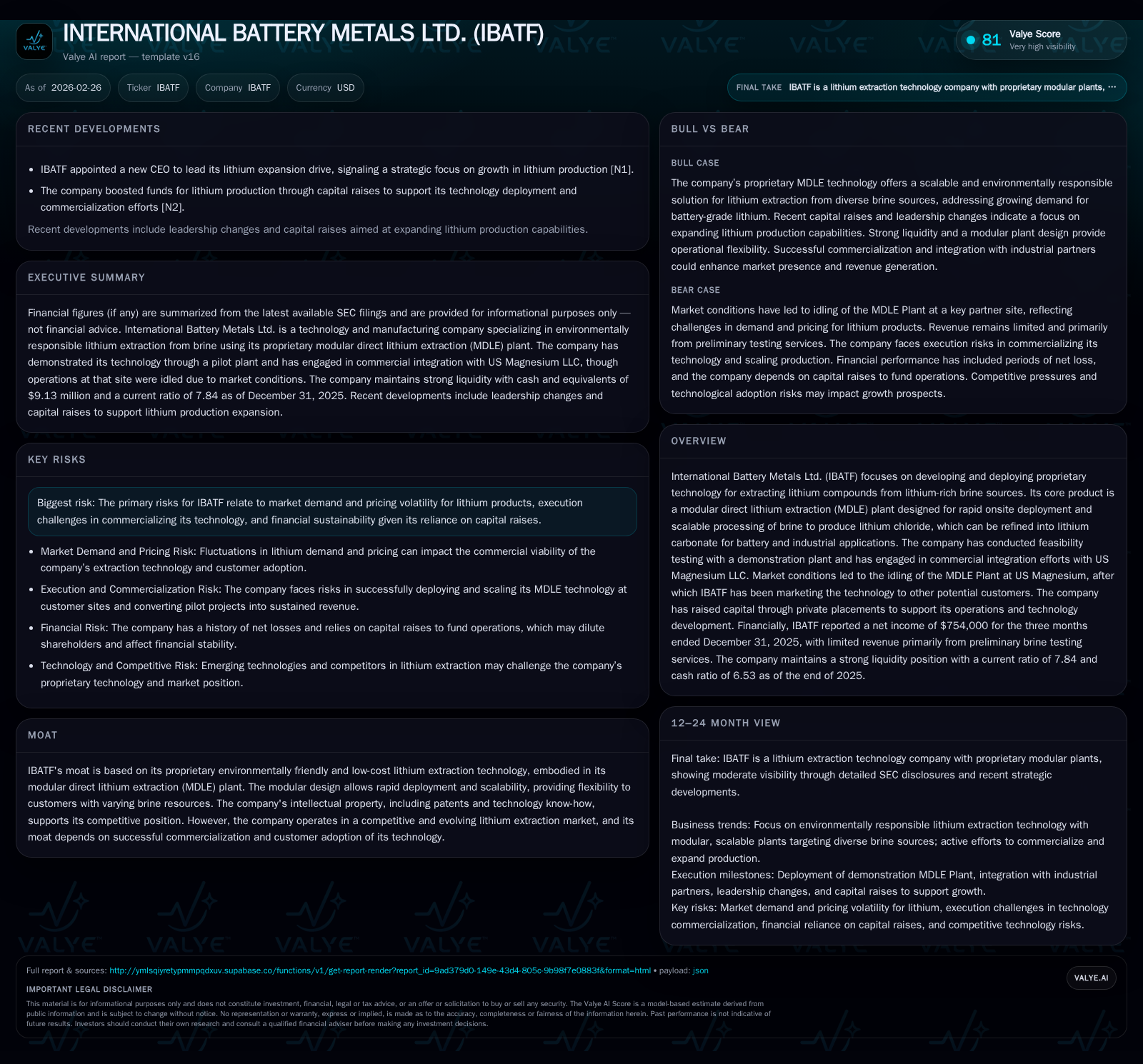
International Battery Metals Ltd. (IBATF) has developed a proprietary modular direct lithium extraction (MDLE) plant targeting environmentally friendly and scalable lithium chloride production from brine resources. The company experienced growth driven by technology demonstrations and integration efforts with US Magnesium LLC but has faced operational setbacks including the idling of its MDLE plant due to subdued lithium market demand and pricing pressures. IBATF is focused on scaling its technology and securing new customers while managing ongoing cash flow deficits through private placements. Key risks include market volatility and execution hurdles in commercial adoption.
Innovative Technologies Driving Past Growth at IBATF
International Battery Metals Ltd. (IBATF) specializes in modular direct lithium extraction technology designed to produce high-purity lithium chloride from lithium-rich brine sources. The company's signature offering is its Modular Direct Lithium Extraction (MDLE) Plant, constructed initially as a demonstration unit in Lake Charles, Louisiana. This facility enabled IBATF to conduct feasibility tests validating the selective lithium extraction process exploiting proprietary absorption columns filled with specialized media capturing lithium and chloride ions from brine.
Historical performance (annual)
| FY |
|---|
| 2026 |
Source: SEC companyfacts cache [F1].
The intellectual property underpinning the MDLE Plant comprises patents and know-how emphasizing environmentally friendly methods that minimize water usage and chemical waste compared to traditional evaporation ponds or hard rock mining alternatives. This moat built around sustainable, low-cost operational advantages has fueled technological progress and attracted potential partners in the evolving battery metals ecosystem [F1][S7].
Crucially, the company undertook a strategic lease agreement with US Magnesium LLC in May 2024 to trial integration of the MDLE Plant with an existing magnesium production site in Utah—using waste brines to generate lithium chloride eluent that was further refined into battery-grade lithium carbonate onsite. This collaboration marked IBATF’s first commercial step beyond research, culminating in preliminary revenue transactions linked to brine testing [S7].
Financially, these innovation efforts manifested in operating losses attributable to capital investments in R&D and demonstration scale-up activities across recent fiscal years. Operating income declined notably year-over-year as reflected by increased expenses related to engineering adaptations for varying brine conditions and absorption column throughput optimization cost [F1]. Despite negative operating income trends, these investments have been foundational in advancing commercial-grade modular extraction capability.
Operational Setbacks and Market Influence on Recent Performance
Operational performance has recently encountered significant headwinds tied to external market dynamics. By September 2024, dwindling demand for lithium products coupled with price weakness prompted idling of the MDLE Plant at the US Magnesium facility [S7]. This event curtailed active processing volumes and stalled further revenue generation from this channel.
Revenue recognized by IBATF during calendar year 2025 comprised limited preliminary contracts primarily focused on brine testing services rather than recurring lithium sales or fully scaled plant operations [S8]. Total net income for the trailing twelve months ending December 31, 2025 stood at $754,000—an improvement reflecting discrete R&D credits or reimbursable cost recoveries rather than sustained commercial cash flows [F1][S25].
The gap between ongoing operating expenses—largely selling, general & administrative charges and depreciation—and nascent sales revenues illustrates the execution risk inherent during this commercialization phase. The financial strain coincides with rising accrued liabilities due to accelerated development efforts aiming to retrofit or customize the MDLE system for alternate brine streams characterized by lower lithium concentrations prevalent in U.S.-based reservoirs like Texas and Arkansas [S7][S22].
Scaling the Modular Direct Lithium Extraction Plant: Future Growth Opportunities
Looking ahead, IBATF targets enhancements to its MDLE platform capable of processing broader brine profiles at increased flowrates. Current configurations optimally handle flows up to approximately 300 gallons per minute (gpm) suitable for higher concentration South American sources (~1,800 ppm lithium). However, U.S. natural brines exhibit lower lithium ppm values between roughly 200–800 ppm requiring adaptability [S7][S16].
Management plans an optimized configuration featuring incremental equipment such as heat exchangers, pumps, reverse osmosis units, chillers, and condensate coolers aimed at roughly doubling processing throughput toward an estimated 480 gpm target. At these scales, annualized production could reach near 2,000 metric tons of lithium chloride equivalents—a meaningful step change enhancing customer value propositions [S22].
Capital expenditure estimates vary widely depending on deployment scope—from approximately $1 million for minimal "make-ready" site modifications maintaining current capacity up to $10 million for fully customized retrofits maximizing output [S22]. Given existing cash reserves as of December 2025 ($9.1 million), financing constraints necessitate imminent capital raises explicitly earmarked for plant upgrades [F1][S15][S21].
Customer diversification beyond US Magnesium is underway though no new binding contracts are publicly disclosed; marketing efforts focus on industrial producers possessing suitable brine byproducts or resource holders within emerging U.S. plays [S7]. The scalability advantage inherent in modular plant design is a critical selling point amidst fluctuating energy supply chains increasingly prioritizing agile onsite processing solutions.
Financial Structure and Capital Allocation Strategies Underpinning Sustainability
IBATF’s balance sheet exhibits robust liquidity, reflected by a current ratio approximating 7.8x supported by $10.97 million in current assets against $1.4 million current liabilities as of December 31, 2025 [F1][S5]. The company retains total assets near $41 million dominated by plant/equipment net book values alongside intangible assets primarily representing intellectual property worth over $3 million net after amortization [S5][S14].
Despite substantial cash availability and recent private placement proceeds exceeding $7.7 million during the nine months ended December 2025—their cumulative operating cash flow remains significantly negative (approximately -$8.3 million free cash flow) as persistent losses offset investing activities [F1][S17][S20]. Net equity stands around $33.3 million with an accumulated deficit near -$34 million attributable to historic R&D outlays.
Return on equity remains modest at approximately 2.3%, typical for companies navigating early-stage technology commercialization without mature operating cash inflows [F1]. No dividends or share repurchase programs exist; capital allocation prioritizes re-investment into development capex alongside exploration of strategic partnerships or licensing opportunities [S19].
Given dependence on equity raises evidenced via frequent private placements involving sophisticated investors like Encompass Capital Advisors LLC—the sustainability of funding hinges critically on investor confidence aligned with prospective milestone achievement [S10][S21]. High warrant liabilities recorded underscore complex equity-linked financing structures affecting reported earnings volatility.
Navigating Market Demand and Pricing Volatility in Lithium Extraction
Lithium markets experienced pronounced cyclicality over recent years attributable to shifting EV battery demands, geopolitical factors influencing supply chains, and evolving chemical processing technologies impacting cost curves industry-wide. For IBATF specifically, the value proposition of its MDLE technology is intertwined with raw material pricing: low lithium prices reduce economic incentives for industrial users to deploy new extraction infrastructure preferring cheaper spot purchases or established suppliers.
The company acknowledges primary risks emerging from depressed demand/pricing environments limiting immediate uptake; also risks associated with execution complexity remain salient given pilot-scale nature of operations transitioning towards full commercial installations . Processing nuances such as producing sufficiently concentrated "lithium chloride eluent" compatible with downstream carbonation units add layers of integration risk requiring meticulous engineering validation.
Sector expertise suggests near-term success depends heavily on ability to tailor modular systems rapidly across diverse geographies with variable brine chemistries without excessive capex escalation—a balance challenging given customizations needed for lower ppm U.S. reservoirs compared to original designs intended for higher concentration South American salars.
Key Milestones and What to Watch Next at International Battery Metals
Absent specific revenue guidance or confirmed contracts beyond noted pilot engagements; investor attention should pivot towards tangible next-gen MDLE deployment timelines announced internally but yet quantifiable externally. Upcoming quarters may reveal:
- Progression on optimized plant builds capable of expanded throughput nearing 2,000 metric tons/year LiCl equivalent output.
- New customer contract signings beyond US Magnesium validating commercial traction.
- Capital raising outcomes requisite to finance high-end customization expenditures projected between $1 – $10 million.
- Advances in intellectual property filings or regulatory approvals enhancing competitive moat.
- Cash flow trends preceding transition from developmental losses toward sustainable positive operating margins.
In summary, IBATF stands at an inflection point merging innovative environmental tech promise with pragmatic commercial realities amid volatile commodity markets. Close monitoring of operational execution paired with disciplined financial stewardship will be essential as it endeavors to pivot from pilot-scale validations into scalable industrial deployments within the dynamic global battery metals supply chain landscape.
Disclaimer: This analysis is based solely on information provided by regulatory filings and factual excerpts without speculative numbers or investment recommendations.
Disclaimer: This is research-only, informational analysis and not investment advice. It may include AI-generated interpretation and general industry context. Always verify important details using primary sources.

Comments