IES Holdings Inc: Navigating Electrical & Technology Infrastructure Markets with Diversified Operations
IES Holdings operates a multi-segment electrical and technology systems business focused on mission-critical infrastructure, leveraging acquisitions and operational scale.
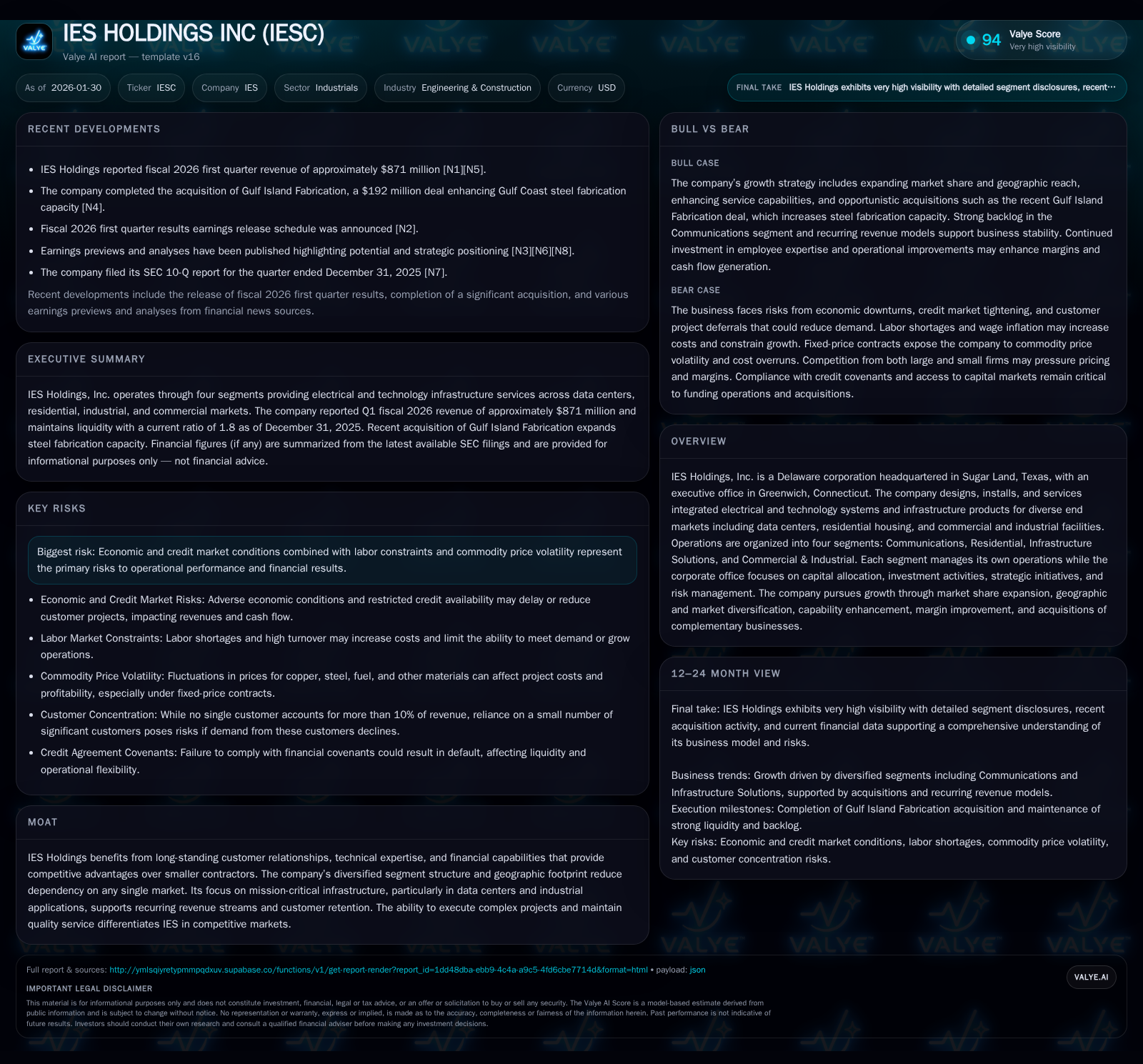
IES Holdings Inc (IESC) designs, installs, and services integrated electrical and technology systems across four distinct segments, targeting data centers, residential, infrastructure, and commercial/industrial markets. The company pursues growth through geographic expansion, market diversification, and strategic acquisitions, recently completing a significant acquisition to boost fabrication capacity. Its competitive advantages stem from deep customer relationships, technical expertise, and financial resources that enable it to execute complex projects. However, the business faces risks including economic cyclicality, labor shortages, commodity price volatility, and regulatory compliance costs.
What Changed Recently
In January 2026, IES Holdings announced the completion of its acquisition of Gulf Island Fabrication for approximately $192 million, marking a strategic expansion in the company’s steel fabrication capabilities, particularly benefiting its Infrastructure Solutions segment which serves heavy industrial and power generation markets [N6][N7]. This acquisition potentially enhances IES’s ability to offer custom-engineered electro-mechanical products and apparatus repair services, expanding its geographic footprint in the Gulf Coast region and increasing exposure to energy and industrial infrastructure projects.
Alongside this strategic move, IES reported fiscal 2026 first quarter revenues of $871 million, slightly below market estimates of $876 million, indicating stable but cautious top-line performance amid economic uncertainties [N1][N5]. The company reiterated its focus on margin improvement and free cash flow generation, reflecting an ongoing emphasis on operational efficiency [N2][N4].
Business Model as a System
IES operates as a multi-segment engineering and construction firm specializing in integrated electrical and technology infrastructure services. Its operations are divided into four reportable segments, each with discrete customer bases and operational strategies but aligned under common corporate objectives [S1]:
Communications: Nationwide provider of technology infrastructure services primarily for data centers, including design, build, and maintenance. This segment benefits from long-term contracts with co-location and managed hosting customers, contributing to recurring revenue streams and customer stickiness [S3].
Residential: Regional electrical installation services for single-family and multi-family housing, including expansion into HVAC and plumbing in select markets, with a strong concentration in Texas and Florida [S8]. This segment is more cyclical and weather-dependent but benefits from long-standing customer relationships and local market knowledge.
Infrastructure Solutions: Provider of electro-mechanical solutions, apparatus repair, and custom-engineered products like generator enclosures, serving industrial markets such as power generation, petrochemical, and manufacturing. This segment is capital project-driven and sensitive to industrial capital expenditure trends [S4][S6].
Commercial & Industrial: Electrical and mechanical design, construction, and maintenance services for commercial buildings, industrial facilities, and critical infrastructure projects, including data centers, renewable energy, and healthcare facilities. This segment has a mix of new construction and recurring maintenance work across multiple regions [S7].
From a corporate perspective, IES focuses on capital allocation, strategic initiatives, risk management, and talent development, while segments operate with operational autonomy to pursue market-specific opportunities and maintain local customer relationships [S1].
The business model relies on a combination of project-based revenues from design and build contracts and recurring revenues from maintenance and service agreements—particularly in the Communications and Commercial & Industrial segments—providing some revenue stability amid project cyclicality [S3][S7].
Acquisitions serve as a key growth lever, with a disciplined approach targeting businesses with strong management, sustainable competitive advantages, and complementary capabilities. This allows IES to expand into new geographies and markets while broadening its service offerings [S2].
Industry Map & Competitive Battlefield
IES operates in the highly fragmented electrical contracting and integrated infrastructure services industry, characterized by:
- Numerous small, privately owned local contractors with limited capital access.
- Larger national or regional players with broader capabilities and geographic reach.
- Specialized electro-mechanical fabricators and repair shops in certain industrial niches.
Competition varies by segment:
In Communications, competition includes national firms specializing in data center infrastructure with the ability to provide scale, technical expertise, and rapid response capabilities. IES’s long-term relationships and repeat business with large data center operators serve as a competitive moat [S3].
The Residential segment faces intense competition from local contractors with low barriers to entry. IES counters this through financial strength, employee training programs, and established customer relationships, particularly with national and regional homebuilders [S8].
Infrastructure Solutions competes with both domestic and international manufacturers and distributors of custom-engineered products, as well as specialized repair shops. IES leverages its geographic proximity to customers, technical customization capabilities, and financial resources as competitive differentiators [S4][S6].
The Commercial & Industrial segment faces competition from both small local firms and large multi-national companies. IES pursues projects where its access to capital, technical expertise, and safety record provide an edge. Local relationships and demonstrated performance also influence bidding success [S7].
Industry dynamics are influenced by:
- Cyclicality in capital spending, especially in data centers, industrial facilities, and residential construction.
- Labor market tightness and skilled workforce availability impacting project delivery and costs.
- Commodity price volatility, particularly in steel and electrical components, affecting project economics.
- Regulatory environment including licensing, safety, environmental compliance, and government contracting rules [S12][S13].
Where the Economics Become Real
Unit economics for IES Holdings are complex and vary significantly by segment and project type:
Project Size & Complexity: Larger, technically complex projects, such as data center builds or industrial electrical systems, yield higher margins due to specialized expertise and higher barriers to entry. However, they also carry greater risk of cost overruns and schedule delays.
Labor & Materials: Direct labor is a substantial cost component and is subject to wage inflation and availability constraints. Materials costs, notably steel and electrical components, are volatile. IES mitigates some commodity risk by early purchasing and contract escalation clauses but remains exposed on fixed-price, long-term projects without such protections [S13].
Recurring Revenue Streams: Maintenance and service contracts provide more predictable cash flow and higher margin stability, especially in Communications and Commercial & Industrial segments where mission-critical infrastructure demands reliability.
Geographic & Market Diversification: Operating across 28 states with 174 locations reduces dependency on any single market or economy, smoothing revenue volatility and providing local market insights for bidding and customer retention [S1][S7].
Acquisition Integration: Acquisitions contribute incremental revenue and capabilities but require capital deployment and integration effort, with potential short-term margin pressure. Gulf Island Fabrication acquisition represents a significant capital investment aimed at long-term capacity and market expansion [N6][N7].
Working Capital & Liquidity: IES maintains a current ratio of approximately 1.8 and held $88.8 million in cash and equivalents as of end-2025, supporting operational needs and acquisition funding [XBRL]. However, credit market conditions and customer payment delays remain risks [S9].
Pricing & Contract Terms: Competitive bidding pressures often require balancing price competitiveness with margin protection. Escalation clauses and pass-through provisions for commodities and labor costs are variably included, influencing margin predictability.
Diligence Questions / Disconfirming Signals
Post-Acquisition Integration: How effectively will the Gulf Island Fabrication acquisition integrate operationally and culturally? Are there risks of dilution to margins or capital allocation missteps?
Labor Market Constraints: Given ongoing labor shortages in skilled trades, how is IES managing recruitment, retention, and wage inflation? Could labor scarcity materially impact project timelines or costs?
Commodity Price Exposure: To what extent do contracts across segments include escalation or pass-through clauses? How vulnerable is IES to commodity price spikes on fixed-price projects?
Economic Cyclicality: How sensitive are each segment’s revenues and margins to economic downturns, especially residential construction cycles and industrial capital spending?
Regulatory/Compliance Risks: What is the company’s exposure to environmental liabilities, safety incidents, or litigation that could disrupt operations or impose costs?
Customer Concentration: Are there significant revenue concentrations among a few key customers, especially in Communications and Infrastructure Solutions? How stable is the customer base?
Recurring Revenue Growth: What is the pipeline and growth strategy for increasing recurring service contracts to improve revenue stability?
Capital Structure and Covenant Compliance: Given acquisition-driven capital deployment, what is the status of debt covenants, liquidity buffers, and refinancing plans?
Technological Obsolescence: Are any segments or products at risk from rapid technological changes that could reduce demand or require reinvestment?
This analysis is based on publicly available information and recent company disclosures through January 2026. It is intended for informational purposes and should not be construed as investment advice. Operational and financial outcomes depend on multiple factors including market conditions, management execution, and external risks that may evolve over time.
Disclaimer: This is research-only, informational analysis and not investment advice. It may include AI-generated interpretation and general industry context. Always verify important details using primary sources.

Comments