
iHeartMedia's Gradual Recovery and Strategic Leveraging of Podcast Leadership
iHeartMedia improved operating results in 2025 driven by cost controls and digital audio growth, yet heavy debt and net losses remain key challenges.
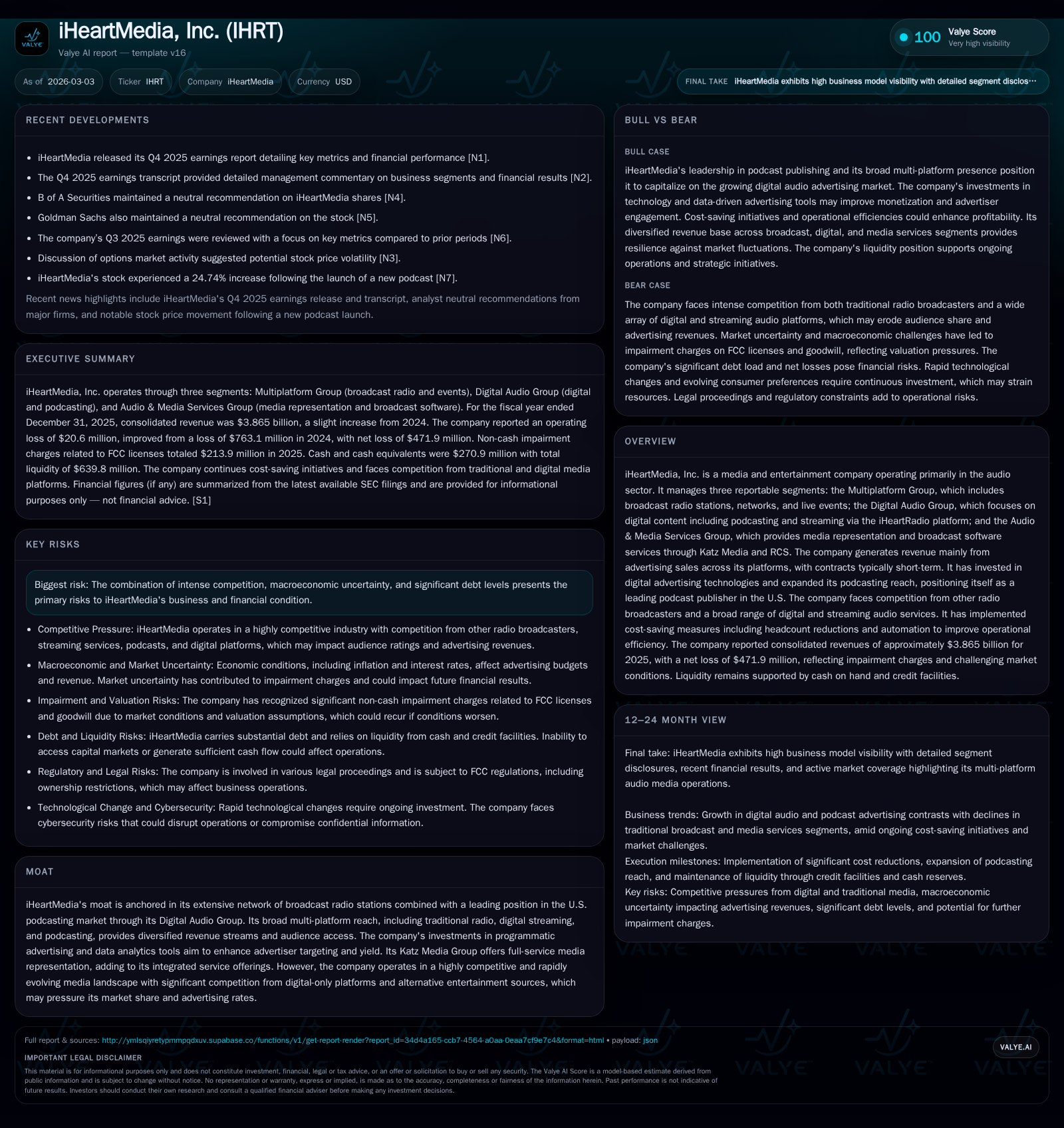
In 2025, iHeartMedia experienced a marginal revenue increase alongside a significant reduction in operating losses driven by operational efficiencies despite persistent net losses. The Digital Audio Group’s expansion, especially in podcasting and programmatic advertising, underpins growth prospects amid intense competition. The company maintains a substantial debt load with compliance intact but faces refinancing risks as multiple debt tranches mature through 2027. Free cash flow showed modest positive generation, supported by lower capital expenditures. Forward-looking indicators include monitoring the trajectory of digital ad revenues and near-term debt maturities.
From Steady Revenues to Improving Operating Results: A Look Back at FY2025
iHeartMedia delivered a modest top-line increase of 0.3% to $3.86 billion for fiscal year 2025, showing revenue stabilization following declines in preceding years [F1]. This flat-to-slightly-positive revenue environment reflects persistent advertising rate pressures within traditional broadcast radio platforms amid a shifting media consumption landscape dominated by on-demand digital audio services [S1]. Despite top-line stagnation, the company achieved a remarkable operational turnaround with its operating loss shrinking from an enormous -$763 million in FY2024 to just -$20.64 million in FY2025—a remarkable improvement exceeding 97% year-over-year [F1].
This operational progress owes chiefly to stringent cost-saving programs targeting legacy broadcast overheads and tighter control over capital spending; capex declined 16.3% year-over-year to $81.7 million, aligning with strategic reprioritization towards digital infrastructure enhancements rather than heavy physical asset investments [F1]. Operating cash flow benefited accordingly, rising nearly 30% YoY to $92.6 million aided by timing effects such as deferred revenue accruals and interest payment scheduling adjustments embedded in recent debt restructuring actions completed in late 2024 [F1, S8].
However, net losses remained significant at -$472.9 million albeit improved by over 53% compared to the previous year’s deficit (-$1 billion), signaling ongoing challenges including interest expense burdens related to large-scale indebtedness built through restructuring phases post-bankruptcy [F1]. The operating income improvement juxtaposed against sustained bottom-line losses presents a clear tension between profitable business unit operations and financial expense drag.
Historical performance (annual)
| FY | Rev ($bn) | Net ($mm) | CFO ($mm) | OpInc ($mm) | Rev YoY | Net YoY |
|---|---|---|---|---|---|---|
| 2025 | 3.9 | -473 | 93 | -21 | +0.3% | +53.2% |
| 2024 | 3.9 | -1010 | 71 | -763 | +2.8% | +8.4% |
| 2023 | 3.8 | -1103 | 213 | -797 | -4.1% | -316.6% |
| 2022 | 3.9 | -265 | 420 | 57 |
Source: SEC companyfacts cache [F1].
Capital returns and efficiency (annual)
| FY | FCF ($mm) |
|---|---|
| 2025 | 11 |
| 2024 | -26 |
| 2023 | 110 |
| 2022 | 259 |
Source: SEC companyfacts cache [F1]. | *Estimated change versus prior period
Digital Audio and Podcasting: The New Engine of Growth
iHeartMedia’s Digital Audio Group spearheads its future growth potential amid traditional broadcast headwinds [N2, S1]. This segment focuses heavily on expansion of podcast publishing—now established as one of the largest podcast content publishers in the United States—and streaming services via its flagship platform iHeartRadio.
The company has invested considerably in programmatic advertising technologies that automate ad placements using data analytics for improved targeting precision across multiple audio platforms [N2]. This multi-platform reach—from over-the-air broadcasting to streaming apps—is critical for maximizing advertiser engagement in a fragmented media market increasingly dominated by digital-first players.
Yet, despite these advancements, iHeartMedia faces stiff competition not only from other radio broadcasters but also from pure-play digital streaming giants that benefit from larger user bases and technology-driven personalization capabilities absent traditional licensing constraints [S1]. Continuing innovation in ad-tech will be pivotal for sustaining pricing power and market share.
Competitive Dynamics and Regulatory Considerations in Broadcast and Streaming
The company operates under intensive regulatory scrutiny governed chiefly by the Federal Communications Commission (FCC) as delineated under the Communications Act of 1934 and subsequent amendments impacting broadcast license issuance, renewal, ownership ceilings, and content regulations [S1].
Broadcast licenses require periodic renewal every eight years contingent on public interest standards and good regulatory standing without serious violations; iHeartMedia has historically obtained full-term renewals, though no future renewal is guaranteed given evolving policies or compliance changes [S1].
Regulations also address ownership interests interpreted through parameters like attributable holdings which include voting stock thresholds and contractual arrangements such as Local Marketing Agreements (LMA) or Joint Sales Agreements (JSA) that may grant effective programming control or advertising sales responsibility over stations not fully owned by the company [S1]. These frameworks restrict operational flexibility but also delineate competitive landscapes.
Moreover, FCC rules oblige transparency around transfer or assignment of licenses with mandatory public comment periods for substantial changes in control stressing community impact assessments—elements that can delay or limit strategic acquisitions or divestitures within radio portfolios.
Debt Load, Covenant Compliance, and Liquidity Outlook
iHeartMedia carries a sizeable debt burden totaling roughly $5 billion nominally outstanding as of end-2025 with net debt around $4.54 billion after subtracting $270 million held in cash equivalents [F1, S4–S6]. Notably this includes various senior secured notes spanning maturities between near-term (2026/27) and more extended (up to 2031) horizons together with an asset-based revolving credit facility bearing some $50 million outstanding against an available total commitment of $450 million maturing by mid-2027 [S4–S9].
The company completed significant debt exchange offers during late 2024 that reduced restrictive covenants substantially while realigning interest rates tied primarily to SOFR-based margins between approximately 2-6% depending on instrument specifics [S12–S17]. Voluntary amortization payments continue on term loans due through May 2029 at quarterly installments roughly equal to a quarter percent of original principal (~$5+ million per quarter), supporting gradual deleveraging efforts though sizable principal remains due soon particularly on certain notes maturing in calendar years 2026 and 2027 including ~$45 million senior unsecured notes alongside amortizing term loans coming due within twelve months [S4–S9].
Importantly, liquidity sources appear sufficient for ongoing operations over the next twelve months with management citing total available liquidity inclusive of revolver access standing near $640 million as of December-end despite macroeconomic uncertainty weighing on advertising demands overall [S8]. Covenant compliance is currently maintained without triggering fixed charge coverage ratio requirements related to borrowing base availability; however potential trigger events could impose tighter restrictions on capital movements if borrowing capacity diminishes substantially below set thresholds for multi-day periods [S6,S8,S18].
Risks associated with heavy indebtedness include reduced strategic flexibility due to covenant constraints limiting dividend distributions and stock repurchases; enforced maintenance of collateral liens across assets comprising both fixed assets and accounts receivable; exposure to rising interest costs on variable rate borrowings; heightened refinancing risk amid patchy credit markets; plus potential breaches that could accelerate repayments risking default scenarios affecting enterprise valuation negatively [S20,S24,S26,S27].
Capital Allocation Patterns: Cash Flow, Capex Trends, and Return Metrics
iHeartMedia’s operating cash flow rose significantly (+29.6%) last fiscal year stimulated partly by accounting timing shifts linked to deferred revenue recognition schedules triggered within sales cycles but also resulting from tighter working capital management including collections discipline on accounts receivable balances consistent with sector practice under cyclical advertising revenue frameworks [F1,S25]. After investing $81.7 million into capital expenditures focused largely on IT infrastructure upgrades across segments—Multiplatform Group leading with real estate optimization spend followed by Digital Audio Group software platform enhancements—the company generated free cash flow around $11 million indicating positive albeit thin conversion from operational earnings adjusted for reinvestment needs [F1,S25].
While exact annualized return on equity (ROE) calculations are complicated given persistent negative net income base values historically offsetting equity deficits before reorganization filings earlier this decade ([F1] indicates approx ROE near +4.5%), reported trends suggest gradual restoration towards profitability compounded by efficient capital allocation strategies minimizing incremental capex outlays relative to stable top-line activity levels.
Forward Signals: Key Developments to Monitor in iHeartMedia’s Transformation
Investor attention should focus closely on upcoming balance sheet milestones notably multiple sizable maturities clustered within calendar years 2026–27 — Term Loans due May 2026 (~$6 million), Senior Notes due ranging from ~$45M (6.375%) through senior secured notes staggered subsequently — which pose refinancing or repayment pressures that management will need to address through liquidity maneuvering or capital markets activity possibly influenced by macroeconomic sentiment around media ad spend recovery rates [N1,S3,S7,S9].
Operationally, shifts in digital advertising revenue growth trajectories monitored via quarterly disclosures will be vital gauges reflecting success of ongoing programmatic ad technology deployments alongside podcast audience expansion metrics driven by enhanced content offerings through iHeartRadio ecosystem integration noted during recent earnings commentary [N2,S1].
Potential non-core asset sales or portfolio rationalizations hinted at as part of broader strategic realignment efforts could also materially alter capital structure dynamics if executed effectively consistent with corporate declarations emphasizing opportunistic flexibility under evolving market conditions [N2,S4,S25]. Such moves would serve dual roles supporting deleveraging initiatives while sharpening focus on higher-growth digital audio segments thus advancing transition roadmaps away from traditional linear broadcasting dependency.
This analysis draws exclusively upon publicly filed SEC documents alongside recent earnings transcripts without speculative extrapolation or forecasting beyond documented guidance points provided therein by company management as of March 2026.
Disclaimer: This is research-only, informational analysis and not investment advice. It may include AI-generated interpretation and general industry context. Always verify important details using primary sources.

Comments