
Terrestrial Energy Advances IMSR Commercialization with DOE Partnerships and Solid Liquidity
Latest quarterly disclosures underscore Terrestrial Energy’s momentum in licensing and pilot deployment of its advanced nuclear reactor technology backed by strong financial resources.
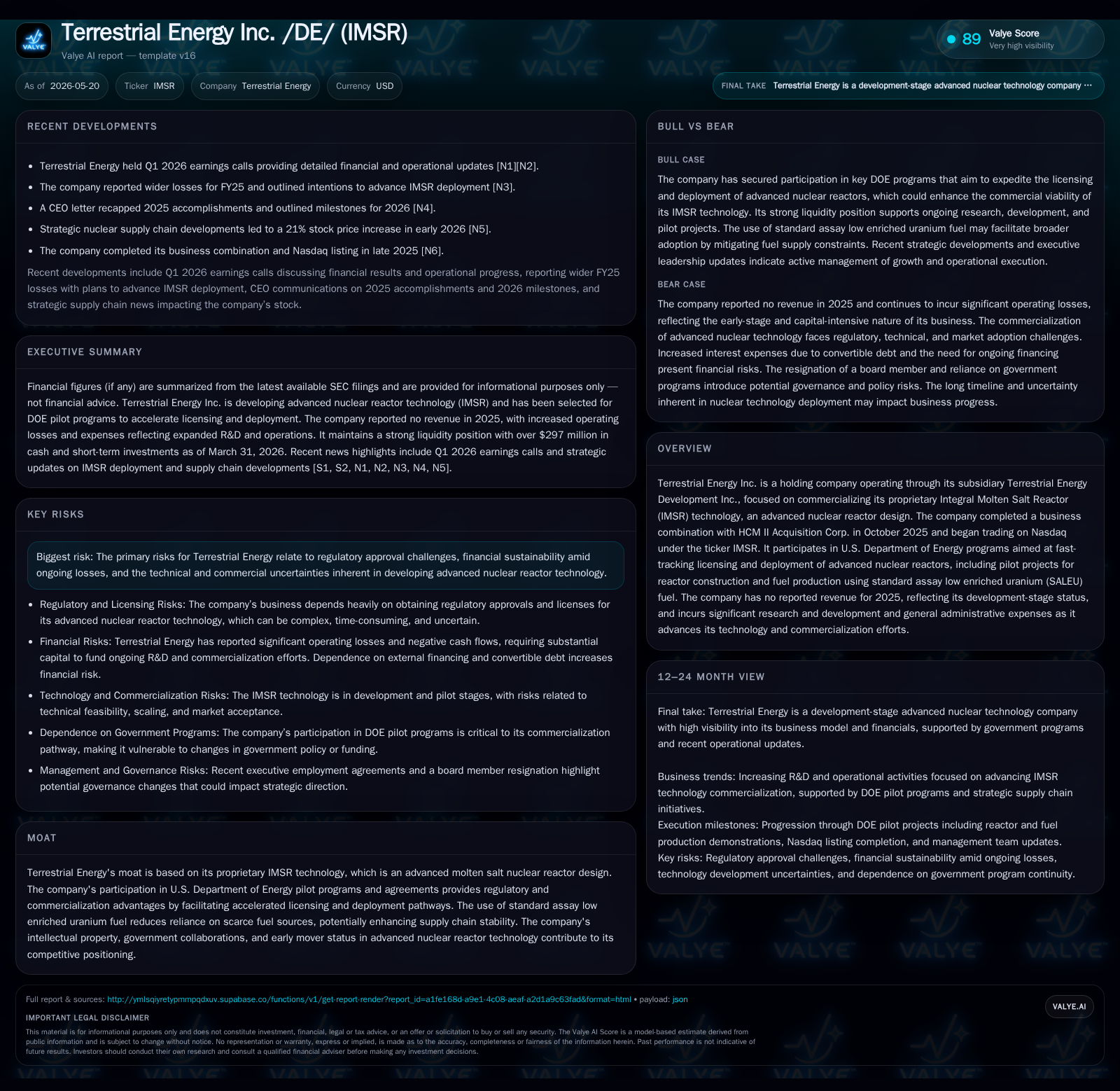
Terrestrial Energy’s May 2026 quarter filings reveal crucial progress in its Integral Molten Salt Reactor (IMSR) commercialization, driven by Department of Energy (DOE) pilot program participations and Other Transaction Authority agreements that accelerate licensing and deployment pathways. Operating through its subsidiary, the company leverages proprietary molten salt nuclear technology combined with standard assay low enriched uranium fuel to navigate a highly regulated, capital-intensive market. Though still pre-revenue, Terrestrial Energy maintains a robust liquidity position enabling sustained R&D investment amid industry challenges. Its competitive moat rests on DOE collaborations, unique fuel strategy, and early mover advantages in advanced nuclear modular reactors. Ongoing regulatory approvals and demonstration milestones will be pivotal in shaping the company’s route to commercial-scale operations.
Recent Quarterly Developments: Catalyzing IMSR Commercialization
Terrestrial Energy’s May 14, 2026 10-Q filing ([S2]) lays bare operational strides that position the company closer to commercial viability for its Integral Molten Salt Reactor (IMSR) technology. Notably, Terrestrial Energy underscores active participation in the U.S. Department of Energy’s (DOE) Advanced Nuclear Reactor Pilot Program and Advanced Nuclear Fuel Line Pilot Project—initiatives designed to compress typical nuclear licensing timelines by offering targeted fast-track pathways for small modular reactors incorporating advanced designs.
In January 2026, the company executed two pivotal Other Transaction Authority (OTA) agreements under the DOE pipeline: one to construct and run a pilot IMSR fueled by standard assay low enriched uranium (SALEU), a non-scarce fuel source critical for supply chain stability; another to expedite licensing milestones through DOE-supported projects targeting demonstration-scale reactors ([S2], [S3]). These developments highlight Terrestrial Energy's deepening governmental collaboration that grants it privileged access to resources, expertise, and accelerated regulatory interfaces.
Reflecting its development-stage nature, the company continues to report no revenue as it channels capital into research & development (R&D), project engineering, and administrative overheads. The operating expense trend reflects significant upfront investments as the IMSR transitions from a conceptual stage toward demonstration deployment—essential for future commercial contracts and market entry ([S2]).
Business Model and IMSR Technology Offering
Terrestrial Energy operates primarily through its wholly-owned subsidiary Terrestrial Energy Development Inc., which holds the intellectual property rights for the IMSR technology. The business model revolves around commercializing this proprietary molten salt reactor design aimed at utilities and energy providers seeking next-generation nuclear power solutions ([S1]).
Customers would ultimately pay for licenses to construct IMSR-based power plants or purchase reactor-generated electricity under long-term contracts once scaled deployment occurs. Revenue drivers will derive from contractually secured plant builds, operational service agreements, and potential downstream fuel cycle services associated with IMSR reactors.
Strategically differentiated by its molten salt coolant technology coupled with SALEU fuel usage—which lowers fuel scarcity risk—the IMSR offers prospects of enhanced safety profiles due to passive cooling features, operational efficiencies from modular construction techniques, and alignment with shifting regulatory frameworks embracing advanced reactors ([S1], [N1], [N2]). These combined attributes differentiate Terrestrial Energy within an emerging modular advanced nuclear niche marked by high technical barriers.
Competitive Positioning Within Advanced Nuclear Reactor Development
Terrestrial Energy situates itself as an early mover within a select cohort of developers pursuing advanced modular nuclear technologies supported by pioneer regulatory fast-track programs spearheaded by the DOE ([S1]). The company's moat is reinforced through multiple layers:
- Intellectual property protection on proprietary molten salt reactor designs.
- Exclusive participation and progress under federal pilot programs facilitating accelerated licensing schedules compared with traditional reactors.
- Adoption of SALEU fuel avoids bottlenecks common among competitors reliant on specialized or scarce fuels.
The landscape remains challenging due to considerable capital intensity, demanding multi-year technically complex regulatory cycles overseen by bodies such as the Nuclear Regulatory Commission (NRC). Few competitors have successfully navigated these stages or secured equivalent governmental endorsements. This niche positioning gives Terrestrial Energy both authority and first-mover advantages but also exposes it to high stakes inherent in pioneering novel technology deployments.
Strategic Growth Drivers: Regulatory Fast-Tracking and Fuel Innovation
Regulatory engagement is sine qua non for growth in the advanced nuclear field. The DOE’s Advanced Nuclear Reactor Pilot Program allows participants like Terrestrial Energy to bypass lengthier licensing processes traditionally lasting over a decade. By compressing timelines for design certification and operation permits via dedicated guidance and government-backed pilot support ([S1], [S2]), Terrestrial Energy enhances its path-to-market velocity significantly.
Concurrently, using SALEU fuel addresses strategic supply stability concerns that plague many advanced reactor initiatives dependent on rare isotopes or bespoke fuels. This capability reduces both construction lead times linked to fuel procurement uncertainties and operating cost variability downstream—a compelling value proposition fostering broader industry adoption ([S1], [S2]).
These factors collectively expand the total addressable market beyond niche pilots towards scaled commercial opportunities as decarbonization mandates intensify for reliable clean energy sources.
Risks and Constraints: Regulatory Challenges and Developmental Uncertainties
Despite notable progress, fundamental risks persist:
- Multilayered nuclear regulatory processes remain complex with potential delays impacting project timelines substantially ([S5]). Licensing hurdles are amplified given novel molten salt technology requiring thorough safety data validation.
- Technical execution risk is material—the transition from design concepts to physical demonstration plants involves upscaling engineering systems while adhering strictly to safety margins unique to molten salt chemistry.
- As a pre-revenue enterprise with meaningful R&D outlays reflected in losses exceeding $25 million as per latest annual data ([F1]), sustaining financial runway amidst uncertain near-term cash flows demands continued investor confidence or strategic funding sources.
- Policy shifts at federal or state levels could ultimately alter subsidy landscapes or approval priorities affecting deployment economics.
No significant legal proceedings have been reported ([S1]), mitigating counterparty risk concerns but operational risk dominates given developmental phase status.
Upcoming Catalysts to Monitor
Key milestones that could materially influence Terrestrial Energy’s trajectory include:
- Completion status updates on the pilot IMSR reactor project under OTA agreements along with construction timelines.
- Sequential licensure approvals under NRC or analogous bodies facilitated by DOE program accelerations.
- Fuel supply chain validation exercises demonstrating scalable SALEU availability ensuring uninterrupted reactor operation.
- Strategic partnership or off-take agreements signaling customer conversion from demonstration acceptance toward commercial utility-scale adoption ([S3], [N1], [N2]).
- Quarterly updates providing insights into whether operating expenses remain aligned with commercialization progression expectations vs burn rate headwinds.
Monitoring these factors will clarify pacing toward sustainable revenue streams beyond government contracts.
Financial Overview: Strong Liquidity Backdrop Supporting R&D
Terrestrial Energy holds approximately $77 million in cash and equivalents as of March 31, 2026 ([F1]), offering a solid liquidity cushion relative to minimal debt balances (~$153k reported June 2024) resulting in negligible net leverage ([F1]). The large current asset base against modest current liabilities yields an elevated current ratio near 54x—an indicator of excellent short-term solvency confirming capacity for expanded R&D spend without imminent liquidity strain ([F1]).
This financial position is crucial given ongoing capital intensity during scale-up phases typical of frontier nuclear technology providers lacking meaningful revenue recognition at present. Nevertheless, managing cash burn rates prudently will be essential until clearer paths toward commercial revenues materialize via plant deployments or licensing income streams.
Disclaimer: This analysis synthesizes publicly available SEC filings alongside recent earnings call disclosures to provide an informed industry perspective on Terrestrial Energy Inc.’s operational status without constituting investment advice or research views.
Disclaimer: This is research-only, informational analysis and not investment advice. It may include AI-generated interpretation and general industry context. Always verify important details using primary sources.

Comments