
IMMUNIC, INC. Advances Clinical Pipeline Amid High Operating Losses and Capital Raises
Clinical-stage biotech Immunic focuses on oral therapies for autoimmune diseases with a deep pipeline but faces significant capital and regulatory risks amid ongoing losses.
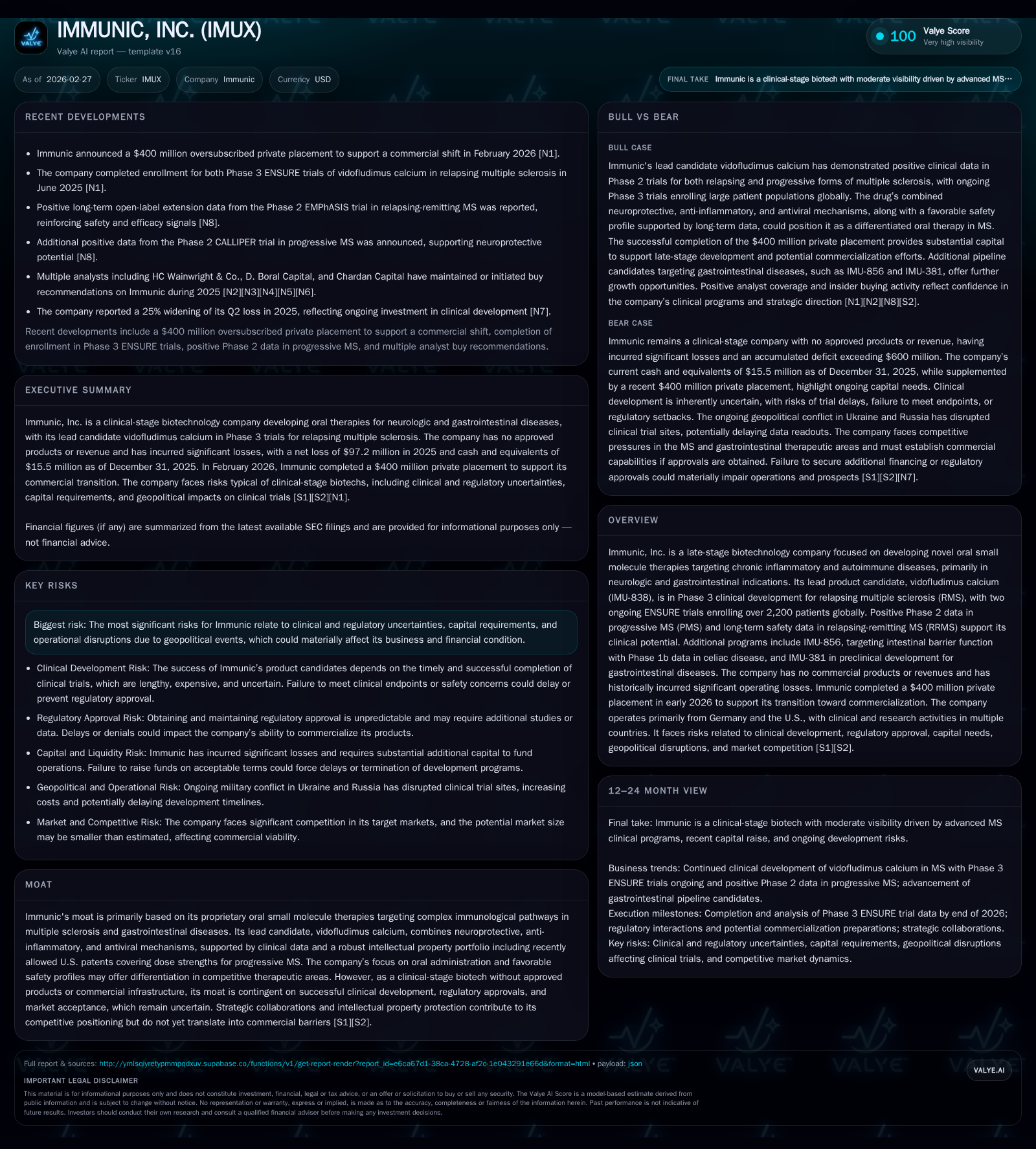
IMMUNIC, INC. (IMUX) is a late-stage biotechnology company developing oral small molecule therapies targeting autoimmune disorders, primarily multiple sclerosis and gastrointestinal diseases. Its lead candidate, vidofludimus calcium (IMU-838), is in Phase 3 trials for relapsing multiple sclerosis, supported by positive Phase 2 data. The company has no commercial revenues and sustained substantial losses in recent years, with a net loss of approximately $97 million in 2025 [F1]. IMMUNIC has raised capital through equity financings including a $400 million private placement in early 2026 [N1][S19]. Despite an advanced clinical pipeline, the company faces risks related to funding needs, regulatory hurdles, intellectual property challenges, and market acceptance as it prepares for potential commercialization.
Company Overview
IMMUNIC, INC. is a clinical-stage biotechnology company developing novel oral small molecule therapies focused on chronic inflammatory and autoimmune diseases—most notably neurologic and gastrointestinal indications. Founded in 2016 with headquarters in New York City and major operations near Munich, Germany, Immunic operates a pipeline distinguished by its oral administration route combined with multi-modal mechanisms targeting immune modulation.
The company's lead program is vidofludimus calcium (IMU-838), currently undergoing two large-scale Phase 3 ENSURE trials enrolling approximately 2,200 patients globally for relapsing multiple sclerosis (RMS). Earlier Phase 2 development demonstrated activity not only in relapsing-remitting MS (RRMS) but also showed promise in progressive MS (PMS), setting up regulatory strategies toward broader disease subtypes. Complementing this are programs such as IMU-856 aimed at restoring intestinal barrier function—with Phase 1b data available in celiac disease—and IMU-381 still in preclinical stages addressing gastrointestinal inflammation.
Historical Performance & Financial Profile
Immunic remains pre-revenue without any approved commercial products. Its financial history reveals continuous operating losses driven by aggressive R&D spending across its pipeline coupled with increasing general & administrative costs necessary for late-stage clinical execution.
Historical performance (annual)
| FY | Net ($mm) | CFO ($mm) | OpInc ($mm) | Capex ($) | Net YoY |
|---|---|---|---|---|---|
| 2025 | -97 | -86 | -103 | 161000 | +3.3% |
| 2024 | -101 | -85 | -98 | 264000 | -7.4% |
| 2023 | -94 | -71 | -99 | 334000 | +22.3% |
| 2022 | -120 | -65 | -119 | 112000 |
Source: SEC companyfacts cache [F1].
Capital returns and efficiency (annual)
| FY | FCF ($mm) | ROE% |
|---|---|---|
| 2025 | -86 | 1456.2 |
| 2024 | -85 | -545.4 |
| 2023 | -71 | -323.6 |
| 2022 | -65 | -105.9 |
Source: SEC companyfacts cache [F1].
Operating losses have remained substantial but somewhat stable within the range of approximately $98–$119 million annually over the past four years [F1]. Net income aligns closely with operating losses due to the absence of significant non-operating income.
Operating cash flow remains negative exceeding $85 million annually by the most recent year-end; capital expenditures are minimal given focus on outsourced R&D activities rather than asset-heavy investments [F1][S14]. The negative equity position at end-2025 reflects accumulated deficits outpacing assets amid financings that included equity reclassifications [F1][S12].
Liquidity remains a challenge as the company manages expensive global clinical programs without product revenues to self-fund operations.
Capital Raises & Funding
IMMUNIC closed a significant oversubscribed private placement totaling approximately $400 million announced in February 2026 to finance its transition toward commercialization activities including scaling production and marketing capabilities [N1][S19]. This followed prior equity raises exceeding $70 million during FY2025 through ATM offerings.
As of December 31, 2025, cash and equivalents stood at about $15.5 million before the February private placement injection of approximately $187 million net proceeds that bolster liquidity beyond twelve months from financial statement issuance date [S19][N1]. However, historic cash flows indicate operational burn rates still exceed current reserves requiring ongoing access to capital markets or partnerships.
Portfolio & Clinical Development Status
Immunic’s research focus rests on innovative orally available small molecules modulating complex immune pathways implicated in autoimmune pathology:
- Vidofludimus Calcium (IMU-838): A selective inhibitor acting via neuroprotective, immunomodulatory, and antiviral pathways; INDs mainly targeted at RMS with positive interim Phase 3 data alongside robust safety signals from RRMS long-term follow-up studies [S2].
- IMU-856: Small molecule intended to enhance intestinal barrier integrity; early clinical data highlight potential applications in celiac disease and other GI inflammatory disorders .
- IMU-381: Preclinical candidate exploring next-generation therapeutics for gastrointestinal diseases addressing unmet needs in inflammatory bowel disease spectrum conditions.
This diversified pipeline positions Immunic across various development stages but underscores inherent biotech risk: success depends heavily on positive clinical trial results culminating in regulatory approvals.
Industry Position & Competitive Moat
Immunic's competitive advantage lies within its proprietary oral therapies targeting intricate immunological mechanisms offering potentially improved patient adherence compared to injectable biologics prevalent in MS treatment paradigms . Granted U.S patents extend exclusivity particularly around dosage innovation relevant to PMS indications.
Nonetheless, as a clinical-stage company without marketed assets or sales organization infrastructure, Immunic must navigate hurdles including:
- Regulatory requirements limit promotional claims until approvals are obtained via confirmatory head-to-head trials per FDA standards [S4].
- Intellectual property enforcement across jurisdictions poses risks due to ongoing challenges from competitors and generics [S13][S15][S23].
- Market adoption depends on successful pricing negotiations under European government-controlled pharmaceutical frameworks where cost containment pressures are significant [S11].
Risks & Operational Challenges
Risk factors emphasize:
- Substantial clinical development costs compounded by lengthy timelines typical for CNS autoimmune diseases contribute to ongoing cash burn requiring frequent capital infusions [S1][S20].
- Regulatory agencies impose stringent demands including chronic safety surveillance given immune system targeting mechanisms raising possibilities of delayed approvals or labeling restrictions.
- Geopolitical factors such as supply chain disruptions or global conflicts may impede trial enrollments affecting development pace [S1].
- Potential litigation risks linked to patent disputes or product liability remain possible despite no current cases reported [S10][S17].
- Market price volatility led Nasdaq to transfer IMMUNIC’s listing to the Capital Market segment with a grace period through June 22, 2026 for price remediation efforts [S24].
Returns & Capital Allocation Considerations
Due to absence of revenues or profitability metrics like ROE are not meaningful; latest computations based on net income over equity yield mathematically extreme values reflecting deficit-equity base (-1456% approx.) rather than realistic investor returns.
Free cash flow remains highly negative reflecting extensive investment phase underpinning biotech development lifecycle (-$85.9M approx., computed as operating cash flow minus capex) with strategy focused on allocating funds into advancing R&D pipelines and preparing commercial readiness post-launch eventuality [F1].
The firm does not pay dividends or conduct buybacks typical for emerging biopharma developers prioritizing growth capital retention to sustain operations through pivotal milestones.[S1]
Outlook & What To Watch For
Upcoming catalysts include:
- Finalization and reporting from ENSURE Phase 3 trials targeting relapsing MS cohorts which will shape regulatory filing prospects and launch timelines.
- Progression with IMU-856 clinical positioning could broaden GI pipeline value.
- Implementation of commercial infrastructure following successful pivotal readouts enabling market access execution plans outlined post-funding raise.
- Monitoring cash runway sustainability post-February fundraising especially tracking expenditure trends against projected budgets detailed under MD&A.
- Ability to regain Nasdaq minimum bid price compliance influences future capital access options.[S24]
Positive pivotal efficacy demonstrating superior benefit-risk profiles alongside favorable reimbursement outcomes particularly across Europe could unlock meaningful patient market penetration given differentiation via oral delivery efficiency.
Conclusion
Immunic exemplifies an advanced-stage clinical biotech endeavor pursuing innovative therapies for debilitating immunological disorders leveraging novel oral small molecules with promising multi-mechanistic attributes supported by extensive patent protection.
However, persistent historic losses accompanied by high burn rates necessitate continued funding injections evidenced by large recent equity raises underscoring dependency on capital markets until successful commercialization occurs.
Substantial risks inherent include uncertain development outcomes compounded by regulatory complexity alongside market access hurdles within competitive therapeutic environments dominated traditionally by biologics.
Investors should recognize IMMUNIC’s valuation hinges primarily on anticipated clinical program results serving as gateways toward future revenue generation rather than existing financial performance indicators while noting critical importance of intellectual property enforcement amid evolving legal frameworks.
This report is prepared solely for informational purposes based on publicly available data as of February 27, 2026.
Disclaimer: This is research-only, informational analysis and not investment advice. It may include AI-generated interpretation and general industry context. Always verify important details using primary sources.

Comments