
Radnostix Inc. Faces Operational Challenges and Recall Impacts While Reevaluating Fluorine Segment Strategy
Radnostix’s latest quarter reveals significant sales declines due to voluntary recalls and operational disruptions amid strategic shifts in its fluorine business.
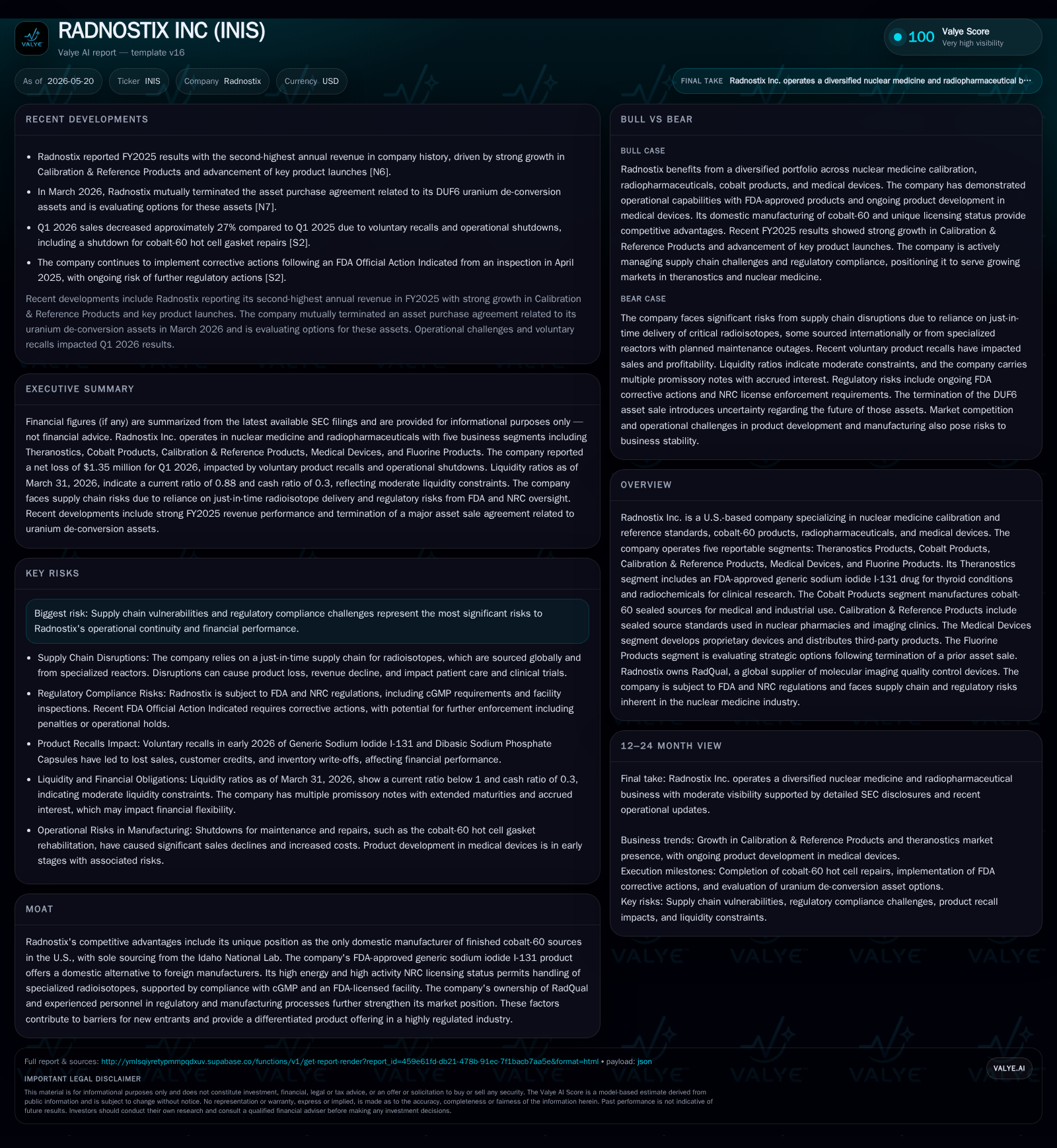
In its latest 10-Q for Q1 2026, Radnostix Inc. reported a marked 27% drop in sales driven primarily by two voluntary recalls in its Theranostics segment and a shutdown of cobalt-60 production for critical maintenance. The termination of a previously expected asset sale linked to its Fluorine Products segment has prompted the company to reconsider strategic options for those assets. Despite increased operating expenses and supply chain pressures, Radnostix retains key competitive advantages as the sole U.S. domestic manufacturer of finished cobalt-60 sources with FDA-licensed theranostic products. However, regulatory compliance risks, isotope supply challenges, and distributor uncertainties pose material constraints on near-term growth.
Recent Operating Update
Radnostix Inc.'s latest quarterly filing dated May 20, 2026 ([S2]) highlights significant operational headwinds in Q1 2026. Sales declined approximately 27% year-over-year to $2.38 million primarily due to voluntary recalls affecting its Theranostics Products segment—specifically the FDA-approved Generic Sodium Iodide I-131 drug recalled on January 26, 2026, and Dibasic Sodium Phosphate Capsules recalled on February 19, 2026. These recalls led to inventory write-offs around $75,000 and customer refunds near $50,000 with ongoing weekly sales losses estimated between $25,000 and $75,000 projected through Q2.
The Cobalt Products segment revenue plunged by approximately 87% compared to the prior year period owing to a planned shutdown for comprehensive rehabilitation of process hot cell windows and gaskets that ensure continued operational viability for an estimated additional 15–20 years while reducing radiological waste costs ([S16]). This maintenance was completed by end of March allowing resumption of normal operations.
The Calibration & Reference Products segment also experienced material revenue declines stemming from persistent global shortages of gadolinium-153 isotope since early 2024. This supply constraint hindered product availability resulting in roughly a one-third decrease in revenue versus prior comparable periods ([S13]).
Strategically impactful was the March 11, 2026 mutual termination of an Asset Purchase Agreement for its Fluorine Products business unit involving depleted uranium de-conversion assets ([S3], [S8]). The termination occurred after American Fuel Resources failed to meet payment obligations despite nearing NRC consent approvals. Radnostix now intends to explore alternative strategies including retaining the assets under existing NRC licenses or pursuing new commercialization avenues amid a revitalized nuclear energy sector.
Operating expenses increased about 17% year-over-year driven by higher salaries (+16%), general administrative costs (+16%), research & development (+40%) focused notably on the Medical Devices segment startup activities, and increased license fees within segments ([S6]).
Business Model Overview
Radnostix is an integrated manufacturer and distributor specializing in nuclear medicine calibration standards, radiopharmaceutical raw materials including sodium iodide I-131, cobalt-60 sealed source fabrication, specialized medical devices for radiopharmaceutical applications, and fluorine-based chemical products historically tied to nuclear fuel cycle processes ([S2], [S12]).
The company's five reportable segments are:
Theranostics Products: The largest revenue driver producing an FDA-approved generic sodium iodide I-131 drug used in hyperthyroidism and thyroid cancer treatment; various radiochemicals such as Tb-161; and cGMP-compliant Active Pharmaceutical Ingredients supplied to third-party theranostics developers.
Cobalt Products: Manufacture of cobalt-60 sealed sources for medical therapy, research, industrial uses plus recycling services; cobalt-59 feedstock irradiation primarily sourced from Idaho National Lab reactors.
Calibration & Reference Products: A broad portfolio of sealed radioactive sources used for equipment calibration across nuclear pharmacies, imaging centers (e.g., SPECT/PET), laboratories, veterinary clinics, and industrial instruments.
Medical Devices: Emerging segment developing proprietary devices like the EasyFill automated capsule filling system (targeting Q3 2026 launch), acquired lung ventilation device lines from AMICI Inc., alongside distribution agreements with third-party radiosynthesis equipment manufacturers.
Fluorine Products: Historically involved fluoride gas production via proprietary extraction processes designed for uranium hexafluoride de-conversion; currently inactive pending strategic re-evaluation following failed asset disposition ([S8]).
Margins vary by segment reflecting manufacturing complexity, regulatory compliance requirements, scale efficiencies, and proprietary IP integration.
Industry Structure & Competitive Position
Operating at the intersection of medical isotope production, nuclear medicine calibration supplies, and radiopharmaceutical API manufacturing within a heavily regulated environment primarily governed by FDA and NRC regulations gives Radnostix distinct barriers to entry ([S7]).
Key features include:
High regulatory hurdles requiring extensive licensing (including cGMP compliance), safety protocols for radioactive materials handling/transportation (DOT regulations), and facility approvals.
Limited domestic competition: Radnostix is reportedly the only U.S.-based manufacturer of finished cobalt-60 sources sourced exclusively via Idaho National Lab agreements providing a significant competitive moat ([S7]).
Regulatory advantages: Its FDA-approved generic sodium iodide I-131 product offers a domestic alternative amid constrained global supply chains subject to geopolitical risks.
The vertically integrated model spans raw material sourcing through processing into finished calibrated standards or pharmaceutical APIs coupled with downstream distribution enabling differentiated service levels less vulnerable to disintermediation.
However, risks include dependency on aging research reactors like INL's Advanced Test Reactor with scheduled outages potentially disrupting supply ([S18]), geopolitical exposure linked to overseas government suppliers impacting radioisotope availability ([S7]), and rising input costs contributing to recent operating expense inflation ([S6]).
Growth Drivers
Medium-term growth opportunities lie in:
Theranostics Expansion: Growing adoption of radiopharmaceutical therapies globally supports demand increases for radionuclides such as I-131 and Tb-161 variants produced by Radnostix. Expansion into active pharmaceutical ingredients sold B2B could enhance volumes alongside clinical research collaborations ([S12]).
Medical Devices Segment Development: The upcoming launch of EasyFill Automated Capsule System planned for Q3 2026 with commercialization ramp expected in mid-2027 marks a key milestone. Leveraging acquired lung ventilation devices extends product portfolio aligned with theranostics growth ([S15]).
Isotope Supply Stabilization: Efforts including joint ventures with Alpha Nuclide Inc. aim at securing alternative supply sources for critical isotopes like gadolinium-153 enabling recovery in Calibration & Reference Products revenue ([S7]).
Operational Improvements Post Hot Cell Maintenance: Completion of cobalt hot cell refurbishments ensures sustained manufacturing capacity while lowering waste management costs boosting long-term efficiency ([S16]).
Fluorine Product Asset Redeployment: Retaining DUF6 de-conversion infrastructure offers potential upside amid renewed nuclear fuel cycle investments globally subject to regulatory approvals or partnerships ([S8], [S14]).
Risks & Watchpoints
Key risks include:
Regulatory Compliance Sensitivities: An Official Action Indicated status from FDA inspections combined with ongoing product recalls introduces risk that extended corrective actions or further enforcement could impact operations or licenses ([S17], [S21]).
Supply Chain Vulnerabilities: Just-in-time inventory models constrained by isotope half-lives limit buffer stock capacity raising the risk of disrupted clinical trials or patient treatments affecting customer relationships ([S17], [S18]).
Distributor Viability Uncertainty: Ongoing discussions about territorial/regional distributors may affect market access if replacements are not secured promptly ([S7]).
Concentration on Limited Reactor Sources: Dependence on Idaho National Lab’s Advanced Test Reactor exposes operations to scheduled maintenance outages or priority shifts that could delay production continuity ([S18]). Transitioning feedstock sources would require time-intensive qualification steps impacting availability.
Working Capital Pressure: The current ratio stood at approximately 0.88 at March 31, 2026 indicating some short-term liquidity constraints although management affirms sufficiency of cash resources combined with equity financing capacity over the next twelve months ([F1], [S5]).
Financial Profile Summary
As of March 31, 2026, Radnostix held cash & equivalents near $1.35 million down from $1.69 million at December-end largely due to increased net loss driven by recall-related charges plus capital expenditures on property and equipment upgrades ([F1], [S4]). Total debt remained around $1.93 million based on latest annual data supported by accrued interest expense contributing to elevated financing costs stable compared prior year periods ([F1], [S5], [S23]).
Net loss widened sharply year-over-year from approximately $113 thousand in Q1 2025 to $1.35 million in Q1 2026 attributable mainly to recall impacts depressing revenues alongside higher operating expenses which rose roughly 17%, including salary increases (+16%), consulting fees (+16%), and R&D outlays (+40%) underpinning pipeline initiatives especially within Medical Devices ([S6], [S13], [S16]).
Gross profit erosion was evident across key segments: Theranostics margin compression (from ~72% down towards ~60%), negative gross profits in Cobalt due to fixed cost absorption during shutdowns, and a roughly 53% decline in Calibration & Reference gross profit all reflecting volume losses driven principally by external disruptions rather than fundamental demand deterioration ([S13], [S16], [S27]).
Management maintains that liquidity remains adequate given cash flows supplemented by proceeds from employee stock purchase plans but flags ongoing dependence on financing activities underscoring sensitivity if operating performance fails to recover timely ([F1], [S5]).
This analysis is based exclusively on publicly available SEC filings and documented disclosures without speculative projections or investment advice.
Disclaimer: This is research-only, informational analysis and not investment advice. It may include AI-generated interpretation and general industry context. Always verify important details using primary sources.

Comments