
International Seaways Encounters Revenue and Earnings Contraction with Fleet Expansion Underway
Despite a sizable crude and product tanker fleet, INSW faced declining revenues and profits in 2025 while preparing to add four dual-fuel ready vessels in 2026.
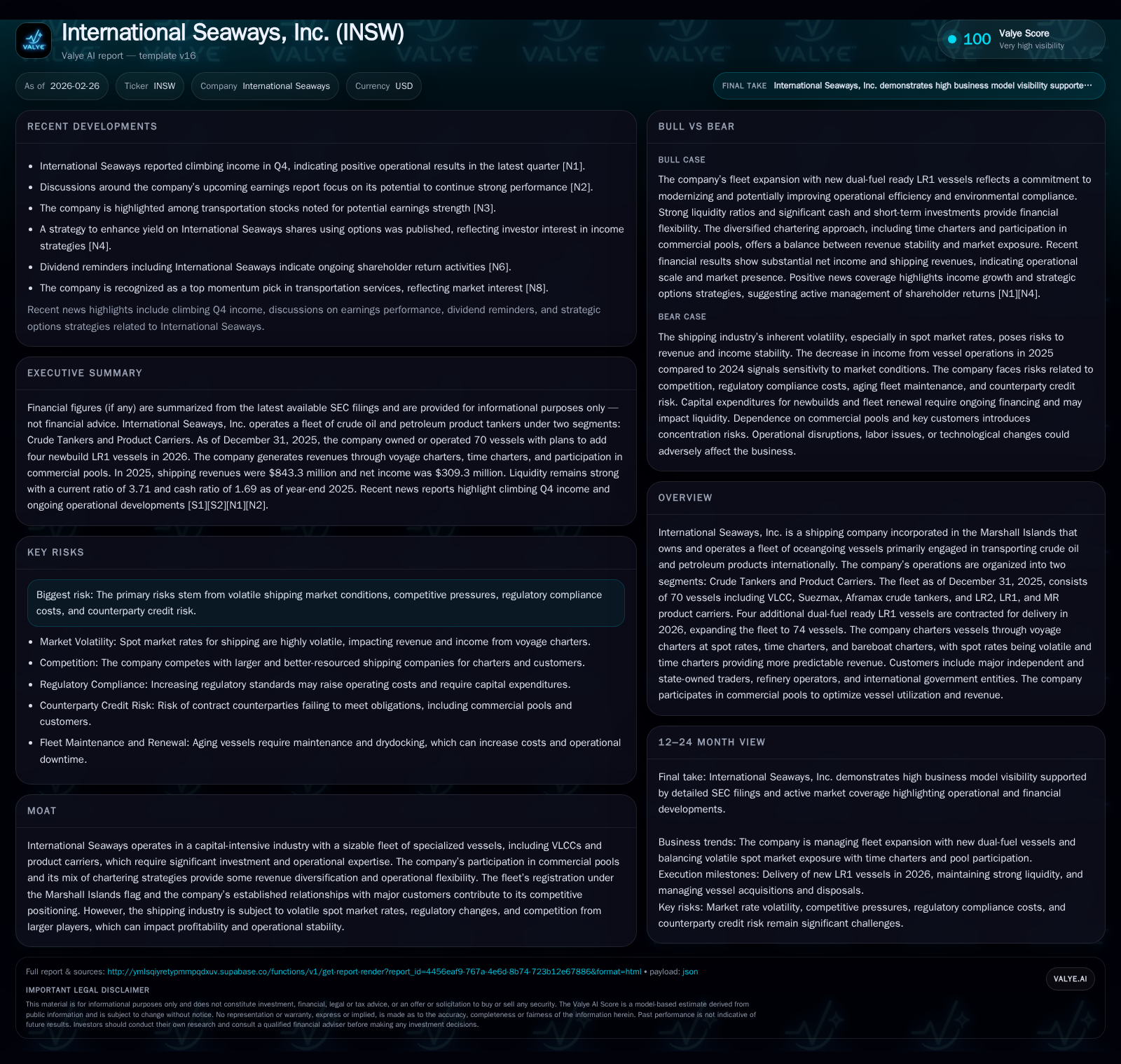
International Seaways, Inc. operates one of the larger fleets of crude tankers and product carriers under the Marshall Islands flag, with a total of 70 vessels at the end of 2025 and four more slated for delivery during 2026. The company generated $843 million in revenue in 2025, down over 11% from the prior year, alongside operating income and net income declines exceeding 24% and 25%, respectively [F1][S1]. This retreat stemmed largely from weaker spot market rates despite a solid charter mix. Capital expenditures dropped sharply as vessel deliveries were deferred or limited recently, and capital returns shifted towards dividends totaling $145 million in 2025 [F1][S4]. The company's strong cash position and moderate leverage provide financial flexibility as shipping market volatility continues to challenge earnings visibility [F1][S5][N3].
Company Overview and Fleet Composition
International Seaways, Inc., incorporated in the Marshall Islands, owns and operates a substantial fleet of oceangoing vessels focused on international crude oil and petroleum product transportation. Reporting segments encompass Crude Tankers—including VLCCs, Suezmax, Aframax—and Product Carriers such as LR2, LR1, and MR tankers. At December 31, 2025, the company operated 70 vessels aggregating approximately 8.4 million deadweight tons (dwt), with an orderbook for four additional dual-fuel ready LR1 vessels scheduled for delivery through mid-2026, expanding the fleet to 74 vessels [S1][S8].
Commercially, INSW utilizes various chartering arrangements: voyage charters typically priced at volatile spot rates; time charters offering fixed daily hire contracts; and bareboat charters where customers assume operational costs. This blend offers revenue diversification balancing market exposure with steadier cash flow streams. Customers span major independent traders, state-owned oil companies, refinery operators, and government entities with whom long-standing relationships provide business stability within an otherwise cyclical industry [S15].
Historical Performance Drivers
INSW experienced strong top-line growth during the early part of the decade before entering a phase of contraction reflective of global tanker market softening. Key historical figures: revenue peaked near $1.07 billion in FY2023 but retreated sequentially to $951 million in FY2024 and further down by more than 11% to $843 million in FY2025 [F1]. Operating income followed a similar trajectory with a peak above $615 million in FY2023 falling by approximately one-third over two years to $345 million most recently.
The decline primarily reflects lowered average daily time charter equivalent (TCE) rates driven by oversupply pressures in key tanker segments coupled with weak spot charter demand across major trade lanes [S15]. Despite this rate compression, INSW maintained solid utilization due to strategic participation in commercial pools that optimize deployment efficiency across similar vessel classes—a critical competitive advantage given operational costs for VLCCs and product carriers are steep.
Table: Selected Annual Financial Metrics (USD Thousands)
Historical performance (annual)
| FY | Rev ($mm) | Net ($mm) | CFO ($mm) | OpInc ($mm) | Rev YoY | Net YoY |
|---|---|---|---|---|---|---|
| 2025 | 843 | 309 | 380 | 345 | -11.4% | -25.8% |
| 2024 | 952 | 417 | 547 | 455 | -11.2% | -25.1% |
| 2023 | 1072 | 556 | 688 | 615 | +24.0% | +43.5% |
| 2022 | 865 | 388 | 288 | 443 |
Source: SEC companyfacts cache [F1].
Capital returns and efficiency (annual)
| FY | Div ($mm) | Buybacks ($mm) | FCF ($mm) |
|---|---|---|---|
| 2025 | 145 | 25 | 377 |
| 2024 | 284 | 25 | 428 |
| 2023 | 308 | 14 | 685 |
| 2022 | 70 | 20 | 285 |
Source: SEC companyfacts cache [F1].
Source: Company SEC filings via XBRL data [F1]
Recent Operational Developments
The company’s recent filings emphasize continued pressure on freight rates despite stable employment levels across its fleet segments. Income from vessel operations decreased approximately $110 million year over year to $345 million due primarily to lower daily TCE rates across both crude tanker and product carrier segments [S15]. To temper capital spending amidst uncertain earnings outlooks for trade-dependent assets like VLCCs and Aframaxes typically vulnerable to geopolitical shifts impacting crude flows (e.g., OPEC+ production changes), INSW sharply curtailed capital expenditures from nearly $120 million in FY2024 down to under $3 million in FY2025—which likely reflects postponement or completion of newbuild commitments balanced against ongoing maintenance capex requirements [F1].
Notably INSW is progressing on integrating cleaner technologies via its contracted four newbuild LR1 dual-fuel ready tankers allowing operation on low-sulfur fuel oils or LNG alternatives—a response both to evolving International Maritime Organization (IMO) regulations targeting emissions reductions as well as market demand for greener shipping partners—potentially bolstering long-term competitiveness beyond standard fleet upgrades [S1].
Future Growth Prospects
Growth catalysts hinge on several vectors:
- Fleet Expansion: The scheduled delivery of new dual-fuel capable LR1 vessels during H1–H3 of 2026 broadens INSW's product carrier footprint with modern eco-efficient assets aligned with IMO mandates.
- Chartering Strategy Mix: Leveraging commercial pools alongside voyage spot charters and fixed time charters can enhance revenue stability amid fluctuating oil demand patterns.
- Customer Base Diversification: Maintaining relationships with varied customers—from state-fueled buyers to private traders—mitigates risk of counterparty concentration.
- Environmental Compliance Leadership: Investments into dual-fuel technology potentially enable premium rate capture or preferred access under emerging eco-hub regulations.
Constraints remain significant:
- Spot Market Volatility: Shipping markets are inherently cyclical and influenced by macroeconomic variables such as global GDP growth trajectories impacting crude demand.
- Competition: Larger players or those with alternative fuel capabilities could exert pricing pressure.
- Regulatory Risk: Compliance costs linked to emissions trading schemes or bunker fuel standards may increase operating expenses unexpectedly.
- Counterparty Credit Risk: Trade receivables exposure within pools requires cautious credit management.
Forecasts and Milestones
INSW has not issued explicit forward guidance publicly for financial metrics or detailed timing on new vessel integration benefits beyond confirming scheduled deliveries in early-mid-2026 [N3][S1]. Monitoring quarterly TCE rate trends alongside charter backlog composition will offer insight into recovery prospects post-delivery ramp-up.
Significant milestones include:
- Receipt of four contracted LR1 dual-fuel carriers during the first three quarters of calendar year 2026 offering potential earnings uplift.
- Continued adherence to dividend policy balancing shareholder returns with liquidity preservation amid uncertain near-term tanker economics [N3][S4].
Investor communications have highlighted that while earnings might remain pressured short term due to residual oversupply concerns globally affecting spot levels across segments serviced by INSW’s diverse fleet makeup ([N3],[N2]), operational efficiencies via pool participation offer some mitigants.
Returns and Capital Allocation
During FY2025 INSW returned meaningful capital through dividends totaling approximately $145 million—a sharp reduction relative to prior years’ distributions reflecting prudent retention amid revenue contraction—while executing modest share repurchases around $25 million indicating cautious confidence without aggressive buyback leverage usage [F1][S4].
Free cash flow generation remained strong at roughly $377 million after subtracting minimal capex levels from operating cash flow ($380 million), reinforcing ample liquidity headroom alongside cash reserves exceeding $116 million as period-end emergency liquidity buffer noted by analysts [F1][S9].
Equity stands robust at roughly $2 billion providing intrinsic capitalization strength; approximate return on equity calculated near mid-teens (~15%) aligns with sector expectations given cyclical tide-turning marked by recent profitability compression [F1]. Leverage comprises multiple term loans aggregating several hundred millions alongside lease financing arrangements tied predominantly to newer vessels incorporating favorable borrowing terms denominated mostly at floating rates hedged through interest rate swaps reducing earnings volatility related to financing expenses [S5][S7][S16].
Overall capital deployment reflects conservative discipline prioritizing balance sheet solidity alongside opportunistic capacity additions focused on eco-compliant assets positioning INSW competitively within a capital-intensive industry featuring lengthy vessel lifetime asset cycles.
Industry Context (Analysis)
The global tanker shipping sector has witnessed significant swings over recent years driven by pandemic-induced supply chain dislocations transitioning into demand normalization phases compounded by geopolitical disruptions such as sanctions reshaping crude flow patterns. Vessel supply growth via newbuild deliveries frequently outpaces demand growth causing persistent downward pressure on spot freight rates especially in VLCC segments vital for bulk crude movements across Americas-Asia corridors where INSW operates heavily.
Environmental regulation tightening under IMO’s sulfur cap regime along with upcoming carbon-intensity rules incentivizes retrofit investments or newbuild ordering focusing on dual-fuel or LNG propulsion systems which typically command premium charter hire due to compliance advantages fostering differentiation among operators able to invest prudently today while others face obsolescence risk.
Commercial pool arrangements have emerged as effective platforms for mid-sized tanker owners like INSW enabling aggregated scheduling efficiencies reducing ballast miles thus improving fuel consumption metrics while pooling charter customer risk internally improving predictability relative to pure spot exposures common historically.
Risks Summary
Key risks include freight rate cyclicality exposing revenue volatility; increasing regulatory cost burdens raising breakeven thresholds; counterparty credit risk embedded within pool-based receivables; technological execution risk associated with newbuild commissioning delays; geopolitical events affecting trade volumes; and competition effects constraining pricing power particularly if larger players pursue aggressive capacity deployments or pricing strategies undermining smaller fleets’ margins [S15].
Conclusion
International Seaways enters calendar year 2026 managing through a period marked by contractionary financial results following freight rate pressures yet simultaneously advancing a fleet expansion program emphasizing cleaner fuel technologies essential for regulatory alignment and future-proofing competitive positioning.
The company’s diverse charter portfolio combined with strong balance sheet metrics supports resilience against ongoing market headwinds although caution remains warranted given inherent cyclical risks characteristic of international crude/product tanker operations.
Monitoring quarterly shipping rate developments alongside successful integration of advanced dual-fuel assets will be pivotal benchmarks influencing future earnings trajectory reshaping fundamental growth outlooks past current stabilization phase.
Disclaimer: This report is for informational purposes only and does not constitute investment advice or solicit any transaction involving securities of International Seaways or any other entity.
Disclaimer: This is research-only, informational analysis and not investment advice. It may include AI-generated interpretation and general industry context. Always verify important details using primary sources.

Comments