
Intel Corporation Navigates Semiconductor Challenges Amid Strategic Reset and AI Momentum
Intel faces a pivotal moment balancing advanced node development, foundry ambitions, and AI-driven product innovation against supply constraints and competitive pressures.
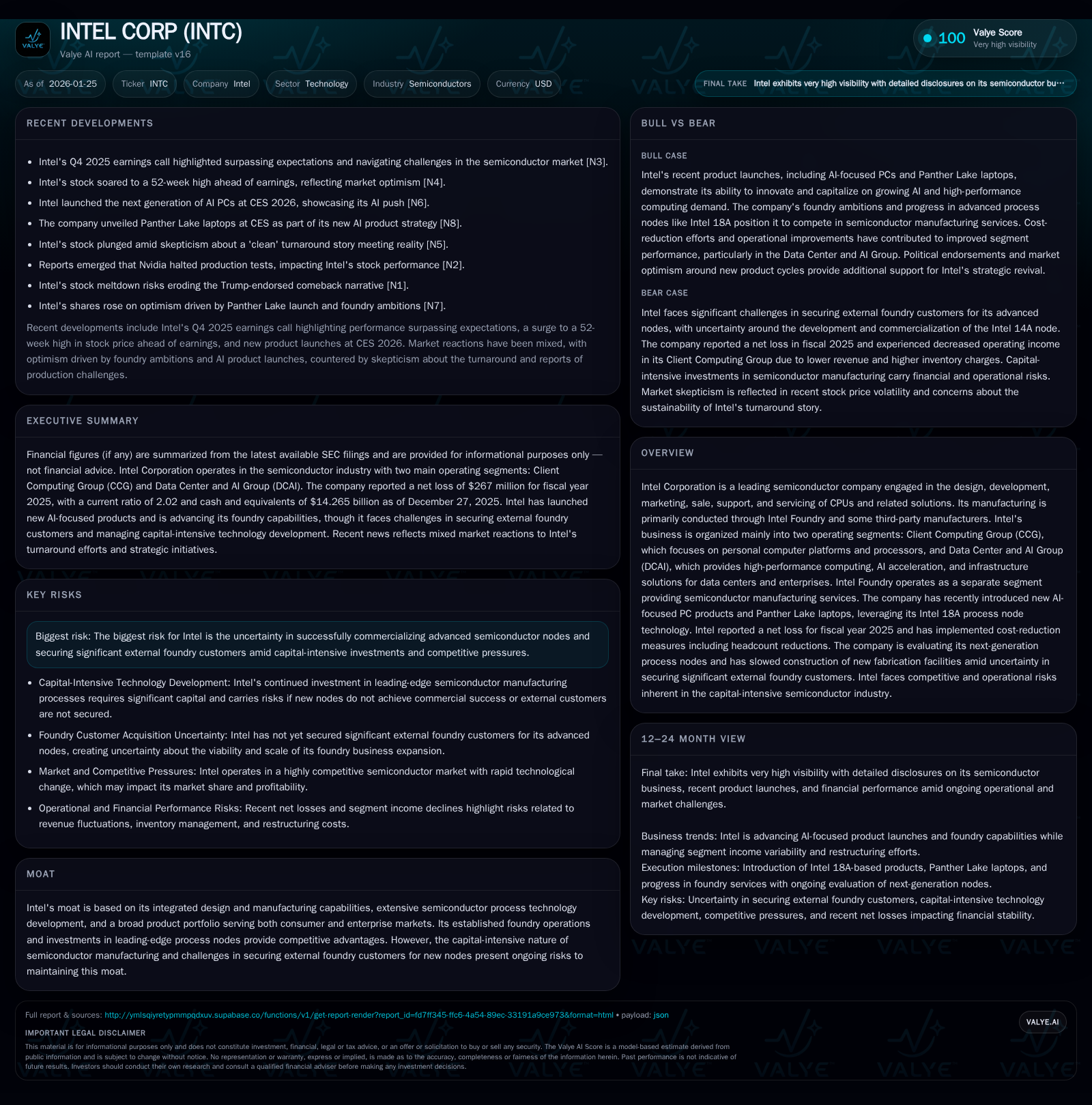
Intel reported a net loss for fiscal year 2025, driven by supply shortages and ongoing restructuring costs, yet delivered AI-focused product launches and progress in its Panther Lake platform. The company is cautiously managing capital-intensive investments in leading-edge process nodes, notably Intel 18A and 14A, while continuing to seek external foundry customers amid an uncertain competitive landscape. Intel’s integrated design and manufacturing model remains a core moat, but execution risks and market dynamics in AI and data center demand will be critical going forward.
What Changed Recently
Intel's latest fiscal year ended with a net loss of approximately $267 million, a notable setback after years of investment into next-generation semiconductor technologies and restructuring efforts [S1]. The company’s Q4 2025 earnings report revealed supply shortages that hampered sales, disappointing expectations despite a wave of AI-related product launches, including the next generation of AI PCs and Panther Lake laptops powered by Intel’s 18A process node [N3][N13][N14]. These introductions reflect Intel's strategic pivot toward AI-centric devices and platforms, attempting to regain technological leadership and drive demand.
Despite these product innovations, Intel’s revenue growth was constrained by supply chain bottlenecks, resulting in a cautious sales outlook that tempered investor enthusiasm and contributed to stock volatility around earnings announcements [N1][N8][N9]. The company’s foundry segment remains challenged; efforts to attract external customers for its advanced 14A node have yet to bear fruit, prompting Intel to moderate capital investments and delay large-scale fab expansions in Ohio [S5][N11]. This measured approach contrasts with some rivals aggressively expanding capacity amid the AI boom.
Additionally, Intel accepted a $5 billion private investment from NVIDIA, issuing over 214 million shares in a deal reflecting deepening collaboration but also signaling the need for fresh capital amid competitive pressures [S16].
Business Model as a System
Intel operates primarily as an integrated design manufacturer (IDM), combining semiconductor product design with in-house fabrication capabilities. Its business is segmented into two main operating groups: Client Computing Group (CCG) and Data Center and AI Group (DCAI), alongside Intel Foundry Services as a distinct segment [S1].
CCG focuses on CPUs and platforms for personal computers, encompassing notebooks and desktops, where performance, connectivity, and user experience are critical. This segment provides stable cash flow but faces headwinds from shifting consumer demand and increased competition from AMD and Apple’s silicon.
DCAI is centered on high-performance computing, AI accelerators, and infrastructure solutions aimed at cloud providers, enterprises, and data centers, a higher-growth area driven by AI workloads and hyperscale demand.
Intel Foundry Services (IFS) offers semiconductor manufacturing capabilities to third-party customers. This segment is crucial to Intel’s IDM 2.0 strategy but has struggled to secure meaningful external foundry volume, making future investments in leading-edge nodes like 14A and beyond contingent on customer commitments [S5].
Manufacturing is capital-intensive, involving extensive R&D and fab investments. The company relies heavily on its process technology roadmap, currently advancing Intel 18A with product launches (e.g., Panther Lake laptops), while cautiously progressing on Intel 14A and managing the risk of discontinuation if external demand does not materialize [S5]. Inventory management and supply chain are also critical, as evidenced by recent shortages impacting sales.
Industry Map & Competitive Battlefield
The semiconductor industry is characterized by rapid technological evolution, massive capital expenditure requirements, and intense competition. Key external competitive forces include:
Foundry competition: TSMC and Samsung dominate the external foundry market with advanced nodes and high customer volumes, making it challenging for Intel Foundry to attract clients.
Chip designers: NVIDIA, AMD, Apple, and others leverage foundries for manufacturing, pushing innovation in GPUs, CPUs, and AI accelerators.
End markets: PC demand has softened globally, while data center and AI workloads are accelerating rapidly, reshaping product priorities.
Technology nodes: Advancements beyond 18A (like 14A and 10A) require significant investment and risk, with Intel’s progress slower compared to TSMC’s cadence.
Intel’s moat lies in combining design and manufacturing, enabling tight integration and product differentiation. However, rivals’ outsourcing strategies and process leadership challenge this advantage. Collaborations such as the NVIDIA investment illustrate strategic alignment but also reflect competitive pressures requiring ecosystem partnerships.
Where the Economics Become Real
Unit economics hinge on several factors:
Process technology yield and performance: The cost per wafer and chip performance improvements drive competitive positioning. Intel’s 18A node is positioned as a leading process technology, but delays and uncertainties in 14A adoption affect long-term cost advantages.
Capacity utilization: Foundry fabs must run at high utilization to absorb fixed costs. Intel’s slow external customer acquisition limits economies of scale in foundry.
Product mix: Higher-margin data center and AI products in the DCAI segment have improved operating income, contrasting with CCG’s declining profitability due to lower volume and price pressures [S4].
Inventory and supply chain: Recent higher inventory reserves and supply constraints have impaired revenue recognition and cash flows [S4][N8].
Capital expenditures and R&D: Intel continues to invest billions annually in fabs and process technology development, but has slowed down Ohio fab expansions and taken cost-cutting measures to manage cash burn [S5][S14].
Customer incentives and pricing: Competitive pressures have led to increased customer incentives, affecting reported revenue and margins in the client segment [S8].
Diligence Questions / Disconfirming Signals
What is the current status of Intel’s Intel 14A node development, and how likely is the company to secure significant external foundry customers required to justify continued investment?
How sustainable are recent AI product launches (e.g., Panther Lake laptops) in driving meaningful revenue growth amid supply shortages and competitive PC market dynamics?
What are the implications of the NVIDIA equity investment for Intel’s strategic direction, governance, and competitive positioning, particularly given NVIDIA’s dual role as a competitor and partner?
How effective are Intel’s cost-reduction and restructuring initiatives in offsetting revenue declines and inventory challenges within the CCG segment?
To what extent can Intel accelerate or expand its foundry services to capture a larger share of the growing semiconductor manufacturing outsourcing market?
How resilient is Intel’s integrated IDM model against the industry trend of fabless design and outsourced manufacturing?
What operational or geopolitical risks could disrupt Intel’s supply chain, manufacturing, or customer relationships, especially in light of ongoing litigation and regulatory considerations?
How does Intel’s cash position and liquidity (current ratio ~2.0, $14.3B cash) support its capital plans and R&D commitments amid ongoing losses [S9]?
This report is based on publicly available information as of January 2026 and is not investment advice. The analysis reflects current company disclosures and market conditions but does not predict future performance.

Comments