
Innventure’s Quest to Convert Disruptive Tech into Sustainable Growth
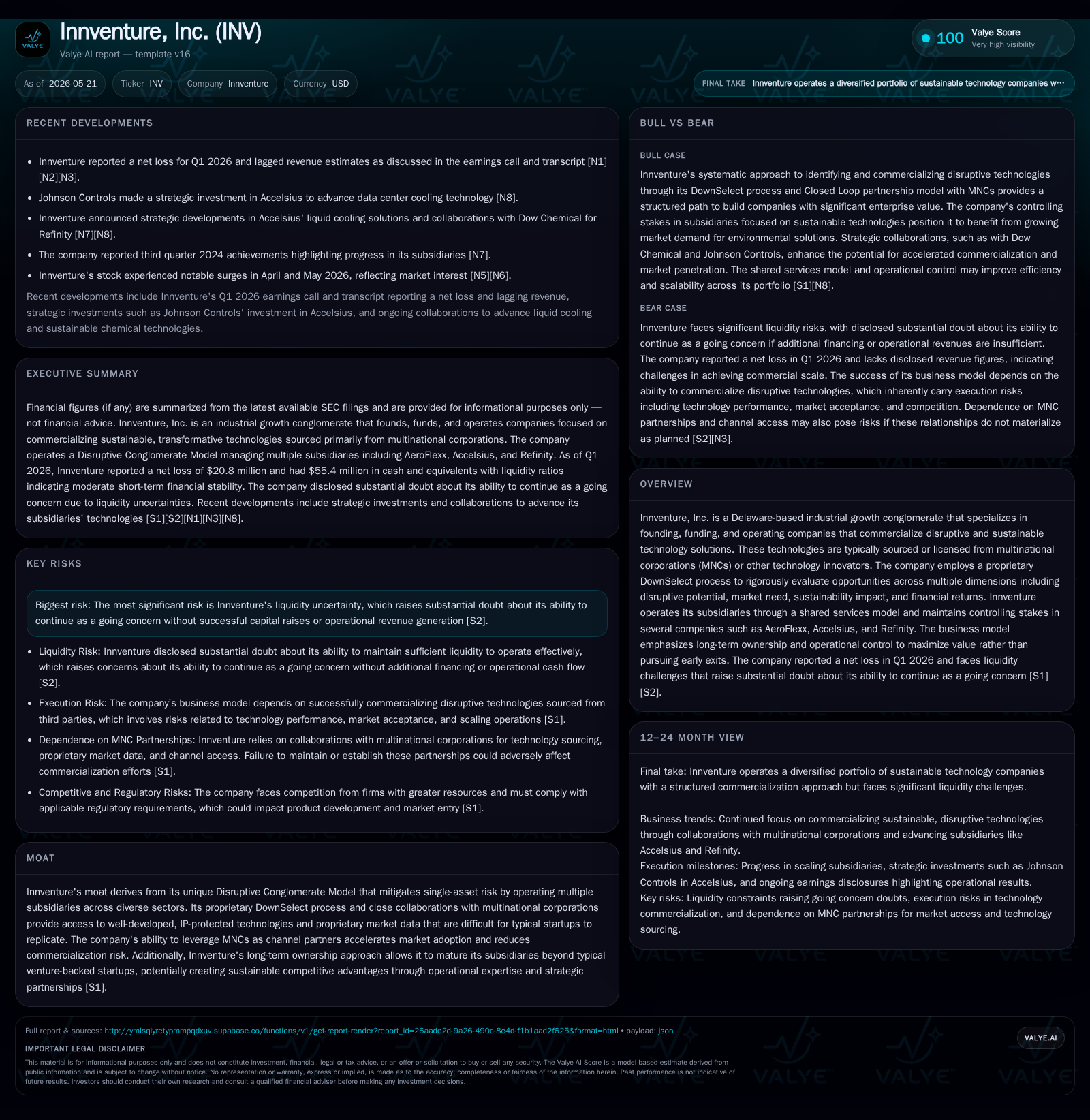
Innventure faces liquidity challenges amid ongoing net losses while advancing its multi-subsidiary commercialization model focused on sustainable, disruptive technologies sourced primarily from multinational corporations.
In Q1 2026, Innventure reported continued net losses and reiterated going concern uncertainties due to liquidity pressures. The company operates a distinctive Disruptive Conglomerate Model, incubating subsidiaries such as AeroFlexx, Accelsius, and Refinity that commercialize proprietary sustainable technologies through collaborative partnerships with major multinational corporations. While these channel partnerships provide competitive advantages and access to growth markets like flexible packaging and edge data center cooling, near-term risks include liquidity constraints and governance issues recently resolved with Nasdaq compliance restoration. Key growth drivers hinge on scaling subsidiary revenues, operational efficiencies via shared services, and expanding partner networks, with investor attention focused on capital raises, subsidiary commercialization progress, and governance stability.
Q1 2026 Operating Update: Liquidity Pressures Amid Strategic Progress
Innventure’s Q1 2026 filing [S2] confirms ongoing net losses coupled with renewed disclosures highlighting substantial doubt about its ability to continue as a going concern absent additional capital or improved operational cash flows. These liquidity concerns echo the prior annual report warnings [S1] and emphasize the critical need for successful capital raises or accelerated revenue generation within its operating subsidiaries.
Governance challenges arose in April when Daniel Hennessy resigned from the Board and Audit Committee, causing temporary noncompliance with Nasdaq Listing Rule 5605(c)(2)(A), which mandates at least three independent audit committee members [S3]. The company swiftly addressed this by appointing Bruce Brown to restore compliance by mid-May [S12], illustrating prompt remedial action amid heightened regulatory scrutiny.
The quarter thus represents an operational inflection point balancing promising technology commercialization against financial constraints requiring disciplined management focus.
Business Model: The Disruptive Conglomerate Framework
Innventure operates through a proprietary Disruptive Conglomerate Model [S1], founding, funding, and managing multiple subsidiaries that commercialize transformative sustainability-oriented technologies sourced primarily from multinational corporations or other innovators. This model mitigates risk by diversifying across sectors while leveraging centralized shared services—including legal, finance, human resources, and business development—to enhance operational efficiency.
Unlike traditional venture capital approaches emphasizing exits, Innventure aims for long-term value creation by maintaining controlling stakes in companies such as AeroFlexx, Accelsius, and Refinity. Each subsidiary is selected via a rigorous DownSelect process evaluating disruptive potential, market opportunity, sustainability impact, and financial viability.
Subsidiaries Driving Innovation: AeroFlexx, Accelsius, Refinity
AeroFlexx produces a patented flexible package designed to function like a rigid bottle (“pak”), featuring an integrated valve system that eliminates discrete closures and pumps. Its proprietary air frame maintains structural rigidity throughout product lifecycle stages including collection and sortation [S1].
Accelsius delivers two-phase direct-to-chip liquid cooling solutions tailored for edge data centers facing growing demand due to exponential increases in data generation requiring low-latency processing. This technology offers a cost-effective alternative to traditional air cooling methods unsuitable for edge deployments [S1].
Refinity focuses on chemical recycling technologies converting plastic waste into valuable intermediates. Licensed from Finland’s VTT Technical Research Centre and developed alongside Dow Chemical collaborations, Refinity targets closing sustainability loops within plastics supply chains [S1].
These subsidiaries benefit from strong intellectual property protections and strategic partnerships with global leaders—P&G for AeroFlexx; Nokia for Accelsius; Dow for Refinity—that facilitate market access while reducing early-stage commercialization risks.
Industry Context: Competitive Advantages Through MNC Partnerships
Innventure’s privileged access to mature technologies licensed from multinational corporations provides a competitive moat by focusing on innovations with established proof of concept rather than nascent ideas lacking validation [S1]. Channel partnerships integrate subsidiaries into established sales networks accelerating customer engagement critical in specialized B2B markets where trust is paramount.
Operationally, manufacturing scale is key; for example, Accelsius must meet hyperscale deployment demands requiring precision engineering in two-phase cooling systems. AeroFlexx addresses unique manufacturing challenges inherent in producing flexible yet structurally rigid packaging solutions.
Growth Drivers: Scaling Commercialization Amid Structural Market Trends
Growth prospects rest on scaling subsidiary revenues through expanded commercial adoption while leveraging shared service efficiencies to optimize costs [N2]. Key performance indicators include bookings growth within partner pipelines and progress toward operational cash flow breakeven at the subsidiary level.
Structural tailwinds support this trajectory: edge computing infrastructure is projected to see millions of new server installations annually by 2027 driving demand for innovative cooling solutions like those offered by Accelsius. Meanwhile, increasing consumer preference for sustainable packaging combined with regulatory pressures supports AeroFlexx’s differentiated offerings.
Risks and Watchpoints: Liquidity Constraints and Governance Stability
Liquidity remains the foremost risk highlighted repeatedly in filings [S2]. The company’s ability to continue operations hinges on securing financing under commercially reasonable terms or achieving meaningful revenue generation at its subsidiaries. Failure could materially impair solvency.
Governance vulnerabilities surfaced with the Audit Committee member resignation leading to temporary Nasdaq rule noncompliance [S3,S12]. Although resolved quickly through new appointments restoring compliance status by May 15 [S12], such events underscore potential investor concerns over board stability.
Execution risks persist given the complexity of simultaneously advancing multiple disruptive companies with varying product maturity timelines and regulatory requirements. Protecting intellectual property amidst competitive pressures also remains critical.
Upcoming Milestones: Monitoring Commercialization Progress and Capital Initiatives
Investors should closely track subsequent SEC filings providing updates on revenue progression at individual subsidiaries alongside corporate expense trends [N2,S3]. Commercial deployment milestones—particularly large-scale orders or validations at hyperscale customers for Accelsius—will serve as important indicators of market traction.
Continued monitoring of Nasdaq governance compliance post-board transitions will also be essential alongside announcements related to capital raises or restructuring efforts clarifying solvency outlooks.
Financial Position Snapshot as of March 31, 2026
According to the latest balance-sheet metrics [F1], Innventure holds approximately $55 million in cash & equivalents against $30 million in total debt resulting in a net cash position near $25 million.
While this liquidity buffer tempers immediate solvency concerns relative to short-term obligations, persistent net losses necessitate swift operational scaling or successful financing actions to sustain enterprise viability as emphasized by management disclosures [S2]
This analysis synthesizes recent SEC filings and verified disclosures as of May 21, 2026. It aims to provide an informed operational and industry perspective without offering investment advice or research views.
Disclaimer: This is research-only, informational analysis and not investment advice. It may include AI-generated interpretation and general industry context. Always verify important details using primary sources.

Comments