
Inflection Point Acquisition Corp. VI Advances SPAC Structure with Unit Separation on Nasdaq
The SPAC progresses post-IPO with critical trading enhancements while maintaining capital readiness for initial business combination execution.
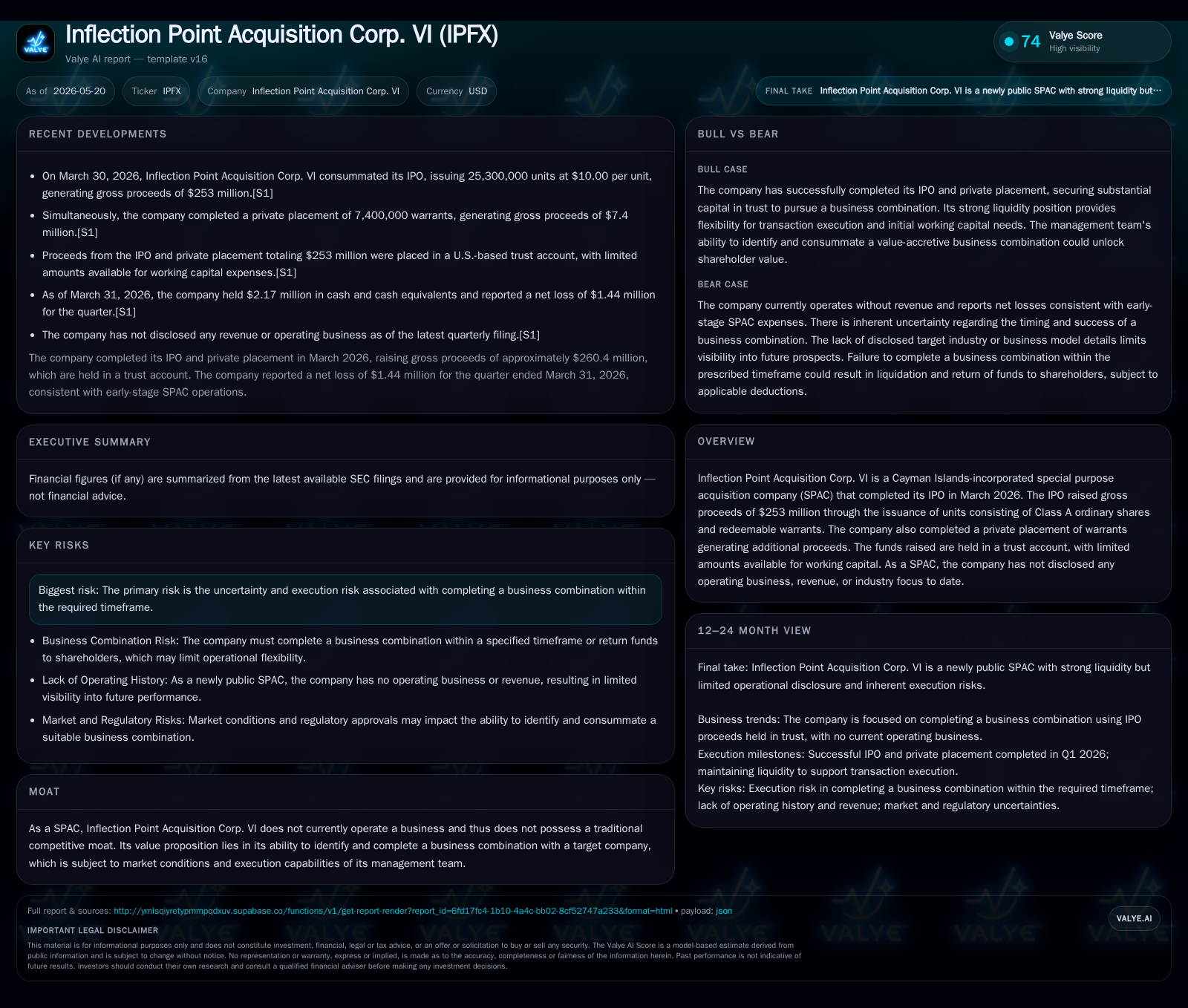
Inflection Point Acquisition Corp. VI completed its IPO in March 2026, raising $253 million in gross proceeds primarily held in trust pending a business combination. Recent SEC filings in May 2026 enable separate trading of Class A shares and warrants, enhancing investor liquidity. As a blank-check company, its value depends on executing a merger or acquisition within the designated timeframe. Financially, it remains well-capitalized with strong cash reserves and minimal debt to support future transactions.
Recent Operating Update
Inflection Point Acquisition Corp. VI (IPFX) reported its latest quarterly results on May 14, 2026 [S2], confirming no material changes to risk factors since its IPO prospectus. A pivotal update came through an 8-K filing dated May 13, 2026 [S3], announcing that holders of the company's units may elect to separately trade the Class A ordinary shares and redeemable warrants starting approximately May 18, 2026. Each unit originally bundles one Class A share with one-third of a warrant; this unbundling enhances market flexibility by allowing investors to trade shares and warrants independently.
This structural change is significant as it improves liquidity and investor choice, enabling strategies that isolate equity exposure or warrant upside without dilution concerns inherent in combined units. Previously, units traded solely as bundled securities under symbol IPFXU.
Business Model
IPFX operates as a Cayman Islands-incorporated special purpose acquisition company (SPAC) formed to raise capital through an initial public offering (IPO) and acquire or merge with an operating business [S7],[S13],[F1]. The IPO completed on March 30, 2026, raised gross proceeds of approximately $253 million from issuance of units priced at $10 each, supplemented by proceeds from private placement warrants sold concurrently.
Proceeds from the IPO and private placement are held predominantly in a U.S.-based trust account managed by Continental Stock Transfer & Trust Company, preserving principal until an initial business combination is consummated or public shares are redeemed if no deal is completed within the prescribed timeframe [S9],[S13]. Withdrawals from the trust account for working capital are subject to annual limits.
Until a qualifying business combination occurs, IPFX has no operating revenues and incurs expenses related to administrative functions and transaction diligence.
Industry Structure and Competitive Position
SPACs like IPFX serve as alternative vehicles for private companies seeking public market access without traditional IPO complexity. This space is competitive, hinging on management's ability to identify attractive acquisition targets ahead of peers amid variable market sentiment toward SPACs.
IPFX's competitive advantage lies not in operational scale but in management expertise, network access, and timing agility. Governance structures feature independent directors overseeing audit and compensation committees to bolster oversight credibility [S16].
Growth Drivers
Key growth drivers include:
- Adequate IPO proceeds providing capital runway for deal sourcing and execution.
- Enhanced trading liquidity following unit separation facilitating investor participation.
- Experienced leadership team improving access to quality acquisition opportunities.
- Favorable M&A market conditions supporting deal flow in targeted sectors.
Successful completion of an initial business combination within the allowed period is critical to unlocking shareholder value through operational equity ownership post-merger.
Risks and Watchpoints
Principal risks encompass:
- Execution risk related to sourcing and closing viable acquisitions within mandated deadlines.
- Market volatility affecting valuations and investor appetite.
- Potential regulatory developments impacting SPAC structures or transaction timelines.
- Dilution risks from warrant exercises after combination completion.
Watchpoints include announcements regarding potential business combinations, shareholder votes on proposed deals, trading volume trends post-unit separation, and quarterly updates reflecting administrative cost trends or early post-merger financial performance.
Financial Profile Summary
According to company facts as of March 31, 2026 [F1]:
- Cash & equivalents stood at approximately $2.17 million, primarily held in trust account funds ensuring robust liquidity.
- Total debt was minimal at about $36,858 USD indicating very low leverage consistent with early-stage SPAC status.
- Operating income showed a loss of around $125,751 USD reflecting pre-combination administrative expenses.
- Net loss was approximately $1.44 million due to early-stage corporate costs prior to any revenue generation.
- Current assets significantly exceeded current liabilities with a current ratio above 10x (~10.35), underscoring strong short-term solvency supported by cash resources.
Overall, IPFX's financial position typifies a well-capitalized blank check company poised for forthcoming transactional activity but not yet generating operating cash flow.
This analysis is based exclusively on publicly filed SEC documents dated through May 14, 2026 ([S2], [S3]) complemented by financial snapshot data as of March 31, 2026 ([F1]). It refrains from speculative assumptions beyond disclosed corporate developments and governance arrangements.
Disclaimer: This is research-only, informational analysis and not investment advice. It may include AI-generated interpretation and general industry context. Always verify important details using primary sources.

Comments